Skip to Content
You are currently on the new version of our website. Access the old version .

Insects

Insects is an international, peer-reviewed, open access journal on entomology, published monthly online by MDPI. 

Indexed in PubMed | Quartile Ranking JCR - Q1 (Entomology)

All Articles (7,833)

Global warming and international trade are accelerating biological invasions, making the Mediterranean basin a hotspot for alien arthropods. Two invasive species, the drosophilid Zaprionus tuberculatus and the wax scale Ceroplastes ceriferus, were recently detected in central-southern Italy. Surveys conducted between 2023 and 2024 detected Z. tuberculatus across several sites in Campania and Lazio, and C. ceriferus in Campania. Zaprionus tuberculatus was reared from ten host plants, including three new records, and reached its highest abundance on persimmon. Laboratory assays showed that Z. tuberculatus adults reproduced only on intact fig fruits and blueberry, indicating a limited risk for most crops. Ceroplastes ceriferus was found on four hosts, confirming its polyphagy and establishment in southern Italy. Molecular analyses revealed two COI haplotypes in the Italian populations of both species, while three haplotypes were detected globally in Z. tuberculatus and seven in C. ceriferus. Sequence divergences were moderate, indicating limited but appreciable mitochondrial differentiation among geographic populations. In Z. tuberculatus, the COII haplotype detected in Italy did not match available African sequences, underscoring gaps in reference data and complicating the reconstruction of invasion routes. Despite contrasting ecological traits and dispersal strategies, both species achieved successful establishment in Italy, showing that ecological plasticity and human-mediated transport can offset reduced genetic diversity. These records expand the known European range of both species and highlight the need for coordinated surveillance, genetic monitoring, and preventive measures to limit further introductions in the Mediterranean region.

12 February 2026
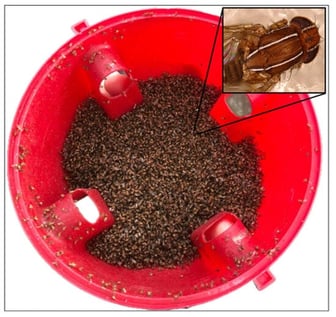
Numerous specimens of Zaprionus tuberculatus captured in an experimental “attract and kill” Decis trap (Bayer Crop Science) adapted for the control of Bactrocera dorsalis.

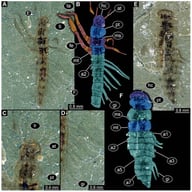
We report new fossil larval specimens that have characters of the group Megaloptera, i.e., are either megalopteran or megalopteran-like larvae from the Triassic, Cretaceous, or Eocene. Fossils from the latter two times are preserved in amber. One of the new fossils reveals that some earlier reported presumed megalopteran-like fossils, that have been already suspected to be beetles, are indeed more likely beetles of the group Myxophaga. A quantitative morphological comparison supports that most fossil megalopteran (and megalopteran-like) larvae did not differ significantly from extant megalopteran larvae, indicating no major losses of morphology over time. However, two newly reported fossil specimens from Kachin amber indeed separate from the other larvae, representing an extinct morphotype. The morphotype is characterised by a prominent terminal filament, indicating that the specimen is a representative of Sialidae. However, unlike most of the known larvae of this group, it possesses a rather elongate prothorax and strongly curved mandibles. These two characters are more commonly known in larvae of Corydalidae. It seems most likely that the presence of these characters in the new morphotype does not represent a plesisomorphy, but is more likely the product of convergent evolution.

12 February 2026

Specimens from Grèz à Voltzia. (A–D) Specimen 7531 (SMNS-P-75650-1). (A) Overview. (B) Overview, colour-marked. (C) Anterior part (head), detail. (D) Potential gills detail. (E,F) Specimen 7532 (SMNS-P-75650-2). (E) Overview. (F) Overview, colour-marked. Abbreviations: a1–7 = abdomen segments 1–7; at = antenna; fe = femur; gi = gill; hc = head capsule; ms = mesothorax; mt = metathorax; pt = prothorax; ta = tarsus; ti = tibia.
  • Brief Report
  • Open Access

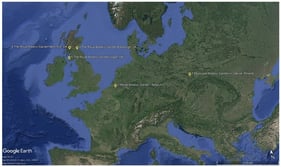
Botanic gardens host diverse living plant collections and are increasingly recognized as sentinel sites for documenting insect biodiversity and detecting biological invasions. Aphids (Hemiptera: Aphididae) are well suited to such monitoring due to their close host associations, rapid population growth, and importance as horticultural pests and virus vectors. Here, we document the aphid fauna recorded in five European botanic gardens—Zabrze (Poland), Meise (Belgium), and the Royal Botanic Gardens in Edinburgh, Benmore, and Logan (UK)—based on surveys conducted in 2022 and 2023. Sampling approaches included short-duration expert bioblitz-style surveys and extended seasonal monitoring. In total, more than one hundred aphid species were recorded across all sites. Observed species lists differed among gardens and survey periods, reflecting variation in sampling timing, intensity, and host plant composition. Several alien aphid species to Europe of Oriental and Nearctic origin were detected, including multiple new national records. Alien taxa were found both in outdoor living collections and in controlled environments such as glasshouses, nurseries, restricted areas, and plant shops, which may function as entry points as well as locations for early intervention. These findings illustrate the value of botanic gardens for documenting aphid diversity and supporting early detection of non-native species relevant to plant health and biosecurity.

12 February 2026

Locations of the five botanic gardens surveyed in this study: (1) Municipal Botanic Garden in Zabrze (Poland), (2) Meise Botanic Garden (Belgium), (3) The Royal Botanic Garden Edinburgh (UK), (4) The Royal Botanic Garden Benmore (UK), (5) The Royal Botanic Garden Logan (UK).

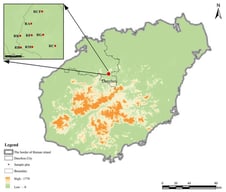
Rubber (Hevea brasiliensis) plantations constitute the largest artificial ecological forest systems in tropical regions of China, while long-term monoculture has significantly reduced biodiversity, particularly among insect communities. Rubber-based agroforestry systems are widely recognized as a promising approach to improving ecosystem functionality. However, the mechanisms by which different intercropping patterns affect insect community dynamics remain poorly understood. This study systematically evaluated the effects of eight rubber-based agroforestry systems on insect community diversity, functional group composition, and associated environmental drivers. Using rubber monoculture as a control, seven rubber-based agroforestry systems were investigated from April 2024 to March 2025. A total of 94,483 insect individuals belonging to 16 orders, 222 families, and 1560 species were recorded. The results indicate that the rubber–fig (Ficus hirta) and rubber–banana (Musa nana) agroforestry systems supported higher insect richness, diversity, and community stability than other systems, while the more complex rubber–coconut (Cocos nucifera)–fig (Ficus hirta) system exhibited a relatively lower value. Functionally, herbivores dominated the rubber monoculture system. The moderately grazed rubber–forage grass (Brachiaria eruciformis)–black goat agroforestry system promoted predators and detritivores, whereas the rubber–konjak (Amorphophallus bulbifer) agroforestry system attracted more omnivores. The permutational multivariate analysis of variance revealed that insect species composition was primarily negatively driven by canopy cover (R2 = 14.65%) and management intensity (R2 = 11.54%). The ecological benefits of rubber-based agroforestry systems depend not only on crop species diversity but also on vegetation structural complexity and management practices. It is recommended to promote the rubber–banana and rubber–fig agroforestry systems as optimized models and to enhance insect-mediated ecosystem services by maintaining understory vegetation structure, regulating canopy cover, and implementing low-intervention management practices.

12 February 2026

Distribution of surveyed plots within the study area and location on Hainan Island. RCF: Rubber–coconut–fig agroforestry system; RA: Rubber–Alpinia agroforestry system; RK: Rubber–konjak agroforestry system; RF: Rubber–fig agroforestry system; RG: Rubber–forage grass–black goat agroforestry system; RB: Rubber–banana agroforestry system; RC: Rubber–coconut agroforestry system; RM: Rubber monoculture system.

News & Conferences

Issues

Open for Submission

Editor's Choice

Reprints of Collections

Corn Insect Pests
Reprint

Corn Insect Pests

From Biology to Control Technology
Editors: Tiantao Zhang
Environmentally-Friendly Pest Control Approaches for Invasive Insects
Reprint

Environmentally-Friendly Pest Control Approaches for Invasive Insects

Editors: Yibo Zhang, Hongbo Jiang, Ying Yan

Get Alerted

Add your email address to receive forthcoming issues of this journal.

XFacebookLinkedIn
Insects - ISSN 2075-4450