- Article

Validation of a Sustainable Pest Management Program to Control Coffee Berry Borer
- Pablo Benavides,
- Luis Eduardo Escobar and
- Hilda Diaz-Soltero
- + 5 authors
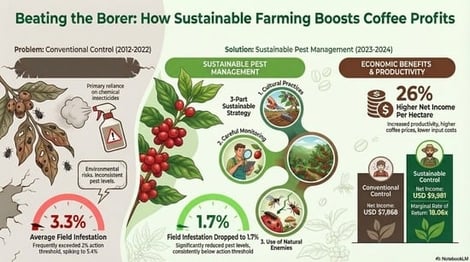
This study aimed to evaluate the effectiveness of a sustainable pest management program for controlling the coffee berry borer (CBB), Hypothenemus hampei, at La Catalina coffee farm (Pereira, Risaralda, Colombia) and compare it with the historical conventional control approach (2012–2022), a period during which the management of CBB was based primarily on the application of synthetic chemical insecticides. The working hypothesis was that integrating biological control agents (Phymastichus coffea, Prorops nasuta, and Beauveria bassiana) with cultural and monitoring practices would significantly reduce infestation levels and insecticide dependence while maintaining or improving economic profitability. From 2023 to 2024, GIS-based hotspot mapping, targeted parasitoid release, and fungal application triggered when infestation thresholds were reached were incorporated into sustainable pest management. Infestation, flight activity, and parasitism rates were monitored, and climatic variables were analyzed to determine their relationships with pest dynamics. The results showed that a sustainable pest management program reduced field infestation from a historical average of 3.3 ± 0.15% to 1.7 ± 0.2%, remaining below the 2% action threshold (F-test, p < 0.05). Prorops nasuta reduced the number of CBB life stages by 32.1%, falling from 10.9 ± 0.3 individuals per berry in non-parasitized fruits to 7.0 ± 0.7 in parasitized berries, while parasitism by P. coffea peaked at 70%. CBB flight activity decreased markedly compared to historical averages. The shift from a chemical approach to sustainable pest management resulted in a 26% increase in net income per hectare and a Marginal Rate of Return (MRR) of 18.06. Overall, the results confirm that a sustainable pest management program effectively suppresses CBB populations, minimizes pesticide use, and enhances the economic and environmental sustainability of coffee production systems.
7 February 2026