Skip Content
You are currently on the new version of our website. Access the old version .

Immuno

Immuno is an international, peer-reviewed, open access journal on immunological research and clinical applications published quarterly online by MDPI.

All Articles (220)

Extracellular vesicles (EVs) constitute a heterogeneous group of membrane-derived particles generated through distinct biogenesis pathways, each regulated by precise molecular mechanisms. They carry a diverse array of cargo that reflects the physiological or pathological state of their parent cells. Their classification continues to evolve, as advances in isolation and characterization techniques have revealed novel vesicle subpopulations beyond the traditional categories of microvesicles, and apoptotic bodies, further highlighting the complexity of the EV landscape. Within the central nervous system (CNS), neurons, microglia, astrocytes, oligodendrocytes, and endothelial cells actively release EVs that contribute to intercellular communication. Growing evidence demonstrates that these vesicles play critical roles in neuroinflammation and neurodegeneration by transporting bioactive molecules that influence disease pathways. Their ability to cross the blood–brain barrier allows CNS-derived EVs to be detected in peripheral fluids, making them promising candidates for noninvasive biomarkers. Moreover, EVs are increasingly being explored as therapeutic tools due to their stability, biocompatibility, and capacity to deliver targeted molecular cargo. In this review, we provide a comprehensive overview of EV biogenesis and release mechanisms in CNS cell types, discuss their emerging functions in neuroinflammatory and neurodegenerative disorders, and summarize current advances in EV-based diagnostics and therapeutic approaches, including ongoing clinical trials.

3 February 2026
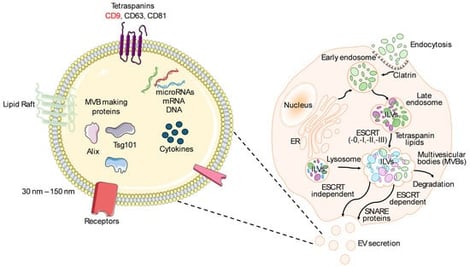
Exosomes/sEVs (left) are nano-vesicles enriched in tetraspanins (e.g., CD9, CD63, CD81) and canonical markers such as ALIX and TSG101, and they carry proteins, cytokines, and nucleic acids (miRNAs, mRNAs, DNA). In cells (right), inward budding of the endosomal membrane generates intraluminal vesicles (ILVs) within early and late endosomes, forming multivesicular bodies (MVBs). ILVs arise through ESCRT-dependent mechanisms (ESCRT-0/-I/-II/-III with ALIX, TSG101, VPS4) or ESCRT-independent pathways organized by tetraspanin-enriched microdomains and lipid rafts. MVBs are either delivered to lysosomes for degradation or, aided by ER–endosome contact sites and small Rab GTPases (RAB27a/b, RAB11, RAB7, RAB35), trafficked to the plasma membrane. Fusion of MVBs with the plasma membrane and subsequent exosome release requires SNARE proteins (VAMP7, YKT6) and additional regulators, including syntenin, syndecan, PLD2, and ARF6.

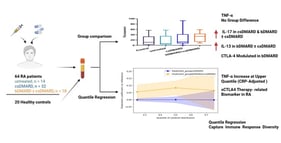
Rheumatoid arthritis (RA) is triggered by dysregulated cytokine networks, but the distributional association of conventional synthetic (csDMARDs) and biologic DMARDs (bDMARDs) with circulating mediators has not been fully described. In this study, we aimed to investigate the treatment-associated modulation of TNF-α, IL-17, IL-13, and soluble CTLA-4 (sCTLA-4) in 64 RA patients (untreated, n = 14; csDMARD, n = 32; bDMARD ± csDMARD, n = 18) and 20 controls. ELISA was used to determine the serum levels, and Kruskal–Wallis tests and false discovery rate correction were used to determine the differences between groups, accompanied by DAS28- and CRP-adjusted quantile regression. Group-level analysis demonstrated that the levels of IL-17 were higher in patients treated with csDMARDs and bDMARDs than in the controls (FDR-adjusted p = 0.0009 and <0.0001, respectively), and the levels of IL-13 were higher in patients treated with bDMARDs than in the controls (p = 0.026). However, quantile regression did not reveal consistent treatment-related associations, suggesting that long-term pathway-specific immune responses and context-dependent regulation may be involved. Smoking independently predicted higher IL-13 at lower quantiles (β = 35.5; p < 0.0001), while TNF-α showed treatment-related increases only at the upper quantile in CRP-adjusted models (β = 323.7; p = 0.049). On the other hand, sCTLA-4 had the largest and most significant treatment-based increase (p < 0.0001), regardless of disease activity, and constant effects across mid-quantiles. Taken together, these findings suggest that sCTLA-4 shows therapy-responsive distributional changes, supporting its potential utility as a biomarker of biological efficacy. In contrast, the observed increases in IL-17 and IL-13 reflect ongoing immune activity and possible environmental influences. Distribution-sensitive biomarker profiling provides a nuanced approach to capturing immune response diversity in RA and may enhance precision in monitoring procedures.

28 January 2026

Serum concentrations of (a) TNF-α, (b) IL-17, (c) IL-13, and (d) sCTLA-4 in healthy controls and patients with RA; the latter were stratified into untreated, csDMARD-treated, and biologic bDMARD + csDMARD-treated groups. Statistical significance was defined as FDR-adjusted p &lt; 0.05 (*); p &lt; 0.001 (***); and p &lt; 0.0001 (****); NS = not significant.

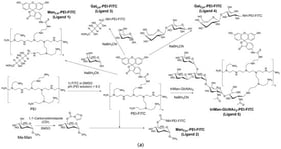
The balance of alveolar macrophage (AM) polarization is severely disrupted in chronic inflammatory diseases like bronchiectasis, where a persistent pro-inflammatory (M1) phenotype perpetuates inflammation. To address this, we developed a high-throughput platform using a series of synthetic glycoligands (L1-L5) on a polyethyleneimine (PEI) scaffold. These ligands, which have varying affinities for macrophage lectin-like receptors, were used for phenotypic “fingerprinting” of AM subpopulations from pediatric bronchiectasis patients and a healthy control. Analysis of bronchoalveolar lavage fluid (BALF) revealed a pathogenic, M1-dominant profile (55% M1) in patients, confirming a state of chronic inflammation, which starkly contrasted with the quiescent, M0-dominant profile in the healthy control. We then leveraged this platform for targeted immunomodulation, using a drug-ligand conjugate to steer the dysregulated macrophage population toward a healthy state. The most potent conjugate, Dox-L5, dramatically suppressed the pathogenic M1 population (from 55% to 16%). This M1 suppression was accompanied by a significant shift toward the M2a (tissue-repair) phenotype and the emergence of a quiescent M0-like population, effectively remodeling the AM profile. This work validates a glycan-based platform for both diagnosing and correcting pathological macrophage imbalances. Our targeted approach offers a precise strategy to resolve chronic inflammation in bronchiectasis by suppressing M1 macrophages and promoting a pro-resolving M0/M2 phenotype, thereby restoring lung homeostasis.

20 January 2026

The scheme of synthesis of (a) a series of macrophage phenotype profiling (FITC) ligands and (b) a series of macrophage remodeling (Dox) ligands.

Molecular Mimicry Between Trypanosoma cruzi and Human TUBB as a Potential Autoimmune Mechanism in Chagas

  • Ana Valentina Centeno-Iglesias,
  • Celeste Abigail Quille-Juarez and
  • Luis Alberto Ponce-Soto
  • + 3 authors

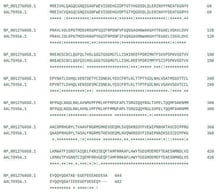
Chagas disease, caused by Trypanosoma cruzi, affects a significant proportion of patients who develop digestive and cardiac complications, including megaviscera. This pathogenesis has been associated with autoimmune mechanisms mediated by molecular mimicry. In this study, an in silico evaluation of the potential structural basis of cross-reactivity of β-tubulin 1.9 of T. cruzi and the human β-4A tubulin isoform 3 was conducted. Using bioinformatics tools, homologous regions were identified and potentially immunogenic epitopes were predicted, considering their structural modeling and molecular docking. The proteins shared 87% sequence identity and 95% similarity, with an almost identical structural overlap, RMSD 0.291 Å. Three epitopes, VPFPRLHFF, NDLVSEYQQYQDATI, and GQSGAGNNWAKGHYTEGAELIDS, exhibited high predicted antigenicity, with the 9-mer and 16-mer peptides displaying structurally compatible docking poses within the binding grooves of MHC class I and class II molecules, respectively, while B-cell epitope potential was inferred from sequence-based property predictions. Normal mode analysis, used as an exploratory approach, suggested comparable flexibility profiles for the parasitic- and human-derived peptide–MHC complexes. These findings provide an exploratory structural framework supporting a potential role of β-tubulin epitopes in molecular mimicry processes implicated in the development of chagasic megaviscera.

14 January 2026

Sequence alignment, where (*) denotes identity, indicating an exact match between both sequences, while (:) and (.) represent similarity, corresponding to conservative substitutions indicating high and low similarity, respectively.

News & Conferences

Issues

Open for Submission

Editor's Choice

Get Alerted

Add your email address to receive forthcoming issues of this journal.

XFacebookLinkedIn
Immuno - ISSN 2673-5601