Skip Content
You are currently on the new version of our website. Access the old version .
  • Tracked for
    Impact Factor
  • Indexed in
    Scopus
  • 22 days
    Time to First Decision

International Medical Education

International Medical Education (IME) is an international, peer-reviewed, open access journal on international medical education, published quarterly online. 
It is the official journal of the Academic Society for International Medical Education.

All Articles (156)

Health Profession Education research is playing an increasing role in ensuring evidence-based practice in Health Profession Education (HPE). To this end, HPE research uses, among other approaches, comparisons as a method in the sense of Comparative Education Research (CER), which allows to compare programs at different levels of education. To obtain evidence-based results, it needs a methodologically sound approach with transparent and justifiable sampling strategies as well as defined sampling criteria. The aim of this research is to identify sampling criteria used in CER for program comparisons and to draw conclusions about what HPE research can probably learn from that. We conducted a scoping review following the Arksey and O’Malley framework, searching three databases and grey literature for international comparative education studies. Four reviewers selected and analyzed the studies using content analysis. A total of 68 studies were included, and six sampling criteria for international CER were identified: (1) culture, (2) education system, (3) curriculum of an education program, (4) ranking, achievement or performance, (5) state and relevance of research, and (6) opportunities and pragmatic reasons. All these criteria appear to be applicable to education research on HPE programs. The sampling criteria derived can serve as a guide for sample selection in international CER and HPE research, providing impetus to improve the quality of research methodology. This necessitates unrestricted access to data on educational programs and a more profound comprehension of the cultural, political and educational characteristics of the respective country.

9 February 2026
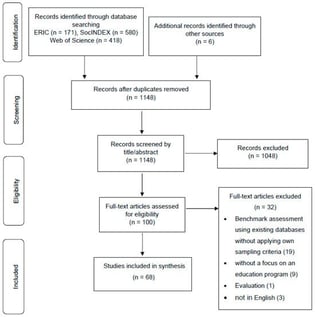
Flow diagram of search and study selection process.

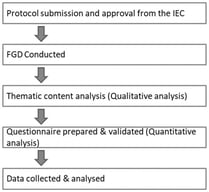
The competency-based medical education (CBME) curriculum was introduced recently for undergraduate courses in medical institutions in India. The program needs a paradigm shift in the teaching and assessment methods. Therefore, challenges at the individual as well as organizational level are expected in the initial years of implementation. We used a mixed-method approach through focus group discussions (FGD) and an online survey to assess the perception and attitude of MBBS phase 1 and 2 teachers towards CBME. Themes were generated from FGD, and quantitative data were collected using a structured questionnaire through an online survey. Nearly 80% of the participating faculty perceived that the CBME curriculum was better than traditional teaching methods. Major challenges were either related to a deficiency of curriculum-optimized learning material (85%), material infrastructure (38%), and manpower (46%), or increased documentation (74%), and time constraints (52%). The faculty felt attitudinal change (63%), better acquaintance with the professional environment (60%), improved participation (58%), and the performance of students (38%) were major commendations of CBME. The CBME curriculum is a welcome change in Indian medical teaching institutes, and faculty intend to improve it through feedback mechanisms. The perceived complexities need to be addressed at different levels through collaborative approaches.

6 February 2026

Flow-chart depicting the study methodology (ICE = Institutional ethical committee, FGD = Focus group discussions).
  • Perspective
  • Open Access

Critical Alliance of AI in Education: A Pedagogical Framework for Safeguarding Cognitive Skills

  • Marcos J. Ramos-Benitez,
  • Martha E. García-Osorio and
  • Yamixa Delgado

The integration of artificial intelligence (AI), particularly large language models (LLMs), into education, marks a profound shift in how knowledge is accessed, processed, and applied. These tools offer clear advantages—including improved efficiency, immediate support, and high productivity—but it may simultaneously weaken foundational skills. This Perspective examines the dual impact of AI on education, arguing that over-reliance on AI may displace essential cognitive processes that reinforce professional competence. Emerging evidence points to troubling associations between frequent AI use and diminished critical reasoning. We propose a model of critical alliance, in which AI augments but does not replace core intellectual processes. Unlike existing AI competency or digital literacy, this model centers on preserving human cognitive agency, judgment, reflection, and intellectual ownership, as primary educational outcomes. This framework not only emphasizes cognitive independence, but also equitable access, ethical vigilance, and faculty development as cornerstones of AI literacy. Addressing these questions is essential to safeguard both intellectual growth and educational equity in an AI-augmented era. Unlike existing digital literacy or AI competency frameworks, the critical alliance explicitly centers on preserving human cognitive agency and intellectual ownership as educational priorities, particularly in environments increasingly shaped by high-performing generative systems.

4 February 2026

The AI Utility–Cognitive Risk Framework: Mapping Learner Engagement and Cognitive Independence. Critical Alliance Zone (QI) promotes critical thinking and deep learning. Over-Reliance Zone (QII) reduces critical thinking. Underuse/Limited Access Zone (QIII) shows minimal use. Misuse Zone (QIV) promotes reliance on incorrect information. The central diagonal double-headed arrow labeled “The Continuum of Cognitive Independence” represents the conceptual spectrum from cognitive offloading to balanced cognitive engagement to cognitive independence. The arrow is not prescriptive; it does not indicate a recommended direction. The pedagogical goal is to maintain learners in the Critical Alliance Zone, avoiding shifts toward extremes.

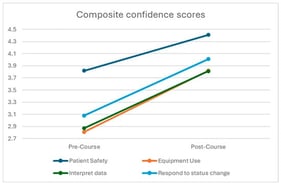
Simulation-based learning experiences (SBLE) are widely used in health professions education to enhance clinical skills, confidence, and decision-making in a safe environment. In Doctor of Physical Therapy (DPT) programs, peer simulation offers a cost-effective alternative to high-fidelity simulation and standardized patients, though its effectiveness across different instructional formats remains underexplored. This study examined the differences in student confidence in outpatient physical therapy between cohorts of students from three educational delivery methods, which included face-to-face (F2F), virtual instruction (VI), and F2F combined with integrated clinical experiences (F2F + ICE), prior to their first clinical experience. Using a three-group comparative design, 107 students across three academic years (2019, 2020, and 2022) completed pre- and post-course surveys assessing confidence in four domains and interest in outpatient care. A two-way ANCOVA, controlling baseline interest, revealed significant differences in confidence across all cohorts between pre- and post-course assessment time periods (p < 0.001), with no significant differences between cohorts under the various delivery formats at post-course assessment. While the F2F + ICE group demonstrated higher baseline confidence, this difference was not found post-course. Findings suggest that peer simulation effectively improves perceived confidence in outpatient physical therapy regardless of delivery mode. These results support the integration of SBLE in DPT curricula to prepare students for clinical practice and highlight the need for further research across multiple programs.

3 February 2026

Confidence scores of all students (n = 107) in domains.

News & Conferences

Issues

Open for Submission

Editor's Choice

Get Alerted

Add your email address to receive forthcoming issues of this journal.

XFacebookLinkedIn
Int. Med. Educ. - ISSN 2813-141X