Skip Content
You are currently on the new version of our website. Access the old version .

International Journal of Topology

International Journal of Topology is an international, peer-reviewed, open access journal on differential topology, algebraic topology, manifolds, geometry, and related applications.
Its purpose is to provide a platform for research and development in various fields of topology, expand topology to a wider range of applications, and promote the development of mathematics. This journal is published quarterly online by MDPI.

All Articles (29)

This paper investigates quantum contextuality, a central nonclassical aspect of quantum mechanics, by employing the algebraic and topological structures of modular tensor categories. The analysis establishes that braid group representations constructed from modular categories, including the SU(2)k and Fibonacci anyon models, inherently produce state-dependent contextuality, as revealed by measurable violations of noncontextuality inequalities. The explicit construction of unitary representations on fusion spaces allows this paper to identify a direct structural correspondence between braiding operations and logical contextuality frameworks. The results offer a comprehensive topological framework to classify and quantify contextuality in low-dimensional quantum systems, thereby elucidating its role as a resource in topological quantum computation and advancing the interface between quantum algebra, topology, and quantum foundations.

2 February 2026

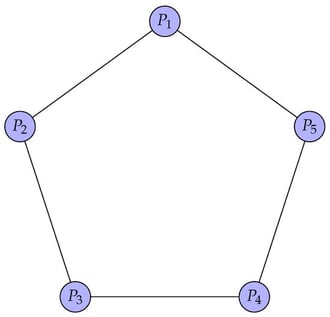
Orthogonality graph of the KCBS measurement scenario realized by projectors in the Fibonacci fusion space. The vertices represent projectors 
  
    P
    1
  
–
  
    P
    5
  
, and the edges connect commuting projectors forming measurement contexts.
  • Feature Paper
  • Article
  • Open Access

We present a comprehensive investigation into the emergence of interface-bound states, particularly Majorana zero modes (MZMs), in a lateral heterostructure composed of two three-dimensional topological insulators (TIs), Bi2Se3 and Sb2Te3, under the influence of proximity-induced superconductivity from niobium (Nb) contacts. We develop an advanced two-dimensional Dirac model for the topological surface states (TSS), incorporating spatially varying chemical potentials and s-wave superconducting pairing. Using the Bogoliubov–de Gennes (BdG) formalism, we derive analytical solutions for the bound states and compute the local density of states (LDOS) at the interface, revealing zero-energy modes characteristic of MZMs. The topological nature of these states is rigorously analyzed through winding numbers and Pfaffian invariants, and their robustness is explored under various physical perturbations, including gating effects. Our findings highlight the potential of this heterostructure as a platform for topological quantum computing, with detailed predictions for experimental signatures via tunneling spectroscopy.

23 January 2026

  • Feature Paper
  • Article
  • Open Access

Microtubules are cylindrical protein polymers that organize the cytoskeleton and play essential roles in intracellular transport, cell division, and possibly cognition. Their highly ordered, quasi-crystalline lattice of tubulin dimers, notably tryptophan residues, endows them with a rich topological and arithmetic structure, making them natural candidates for supporting coherent excitations at optical and terahertz frequencies. The Penrose–Hameroff Orch OR theory proposes that such coherences could couple to gravitationally induced state reduction, forming the quantum substrate of conscious events. Although controversial, recent analyses of dipolar coupling, stochastic resonance, and structured noise in biological media suggest that microtubular assemblies may indeed host transient quantum correlations that persist over biologically relevant timescales. In this work, we build upon two complementary approaches: the parametric resonance model of Nishiyama et al. and our arithmetic–geometric framework, both recently developed in Quantum Reports. We unify these perspectives by describing microtubules as rectangular lattices governed by the imaginary quadratic field Q(i), within which nonlinear dipolar oscillations undergo stochastic parametric amplification. Quantization of the resonant modes follows Gaussian norms , linking the optical and geometric properties of microtubules to the arithmetic structure of Q(i). We further connect these discrete resonances to the derivative of the elliptic L-function, L(E,1), which acts as an arithmetic free energy and defines the scaling between modular invariants and measurable biological ratios. In the appended adelic extension, this framework is shown to merge naturally with the Bost–Connes and Connes–Marcolli systems, where the norm character on the ideles couples to the Hecke character of an elliptic curve to form a unified adelic partition function. The resulting arithmetic–elliptic resonance model provides a coherent bridge between number theory, topological quantum phases, and biological structure, suggesting that consciousness, as envisioned in the Orch OR theory, may emerge from resonant processes organized by deep arithmetic symmetries of space, time, and matter.

7 January 2026

  • Feature Paper
  • Article
  • Open Access

The field of probabilistic metric spaces has an intrinsic interest based on a blend of ideas drawn from metric space theory and probability theory. The goal of the present paper is to introduce and study new ideas in this field. In general terms, we investigate the following concepts: linearly ordered families of distances and associated continuity properties, geometric properties of distances, finite range weak probabilistic metric spaces, generalized Menger spaces, and a categorical framework for weak probabilistic metric spaces. Hopefully, the results will contribute to the foundations of the subject.

11 December 2025

News & Conferences

Issues

Open for Submission

Editor's Choice

Get Alerted

Add your email address to receive forthcoming issues of this journal.

XFacebookLinkedIn
Int. J. Topol. - ISSN 2813-9542