



- Article

Operationalizing Co-Design in Exercise Interventions with Indigenous Peoples in Australia: Development and Cultural Adaptation of the PrIDE Tools
- Morwenna Kirwan,
- Connie Henson and
- Kylie Gwynne
- + 5 authors
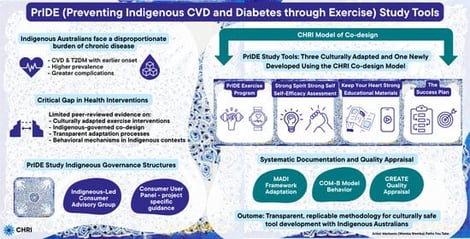
Indigenous Australians experience a disproportionate burden of type 2 diabetes mellitus and cardiovascular disease. While clinician-led, community-based exercise programs are effective in general populations, limited peer-reviewed evidence is available describing culturally adapted exercise interventions with Indigenous Australians that transparently reports governance, cultural adaptation, and theoretical design. This paper reports the co-design and development of tools for the Preventing Indigenous Cardiovascular Disease and Diabetes through Exercise (PrIDE) study, an adaptation of the Beat It program that incorporates wearable technology. Using the Co-design Health Research and Innovation Model, four tools were developed with Indigenous governance through a Consumer Advisory Group and a project-specific Consumer User Panel. Three tools were culturally adapted—the PrIDE Exercise Program, the Strong Spirit Strong Self self-efficacy assessment, and Keep Your Heart Strong educational materials—and a newly developed tool, the Success Plan. Cultural adaptations were prospectively documented using the Model for Adaptation Design and Impact, and all tools were assessed using the Aboriginal and Torres Strait Islander Quality Appraisal Tool. Behavior change mechanisms were mapped using the COM-B model. This paper provides transparent documentation of culturally adapted theory-informed tool development to support reproducibility and knowledge translation. The evaluation of effectiveness, acceptability, and psychometric properties will be reported following PrIDE implementation.
17 February 2026