
Skip to Content
You are currently on the new version of our website. Access the old version .
  • 22 days
    Time to First Decision

Hospitals

Hospitals is an international, peer-reviewed, open access journal on hospital management, services and policy published quarterly online by MDPI.

All Articles (49)

Analytical Assessment of Environmental Noise in High- or Low-Risk Neonatal Wards and Neonatal Intensive Care Units

  • Leonardo Nava-Velazquez,
  • Angélica Saraí Jiménez-Osorio and
  • Erika Elizabeth Rodriguez-Torres
  • + 4 authors

This study analyzed environmental noise levels in neonatal hospital units, including both low- and high-risk nurseries, as well as neonatal intensive care units (NICUs). Continuous 24 h measurements over ten days revealed that average sound levels significantly exceeded international recommendations. Hourly LAeq values frequently reached or surpassed 65 dB, with over 20% of daily recordings exceeding this limit, and in some instances, more than 50%. Heatmaps indicated consistent noise patterns: high-risk nurseries experienced peaks during late morning and afternoon, low-risk nurseries at night, while NICU maintained elevated levels throughout the day. The main sources of noise included alarms, medical equipment, and activity from staff or visitors. This highlights the need for hospital policies aimed at protecting the neurosensory health of neonates. These findings provide evidence-based recommendations for creating quieter environments in neonatal care.

10 February 2026
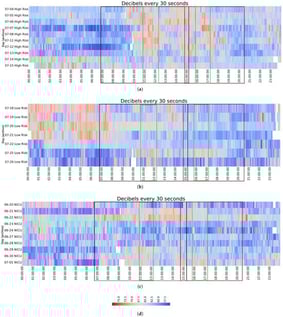
Heatmaps of A-weighted sound level pressures temporally averaged into 30 s windows for visualization. Black and red squares correspond to shifts from 7:00 to 15:00 and from 15:00 to 20:30, respectively. Green squares correspond to visiting hours: (a) High-risk nursery. (b) Low-risk nursery. (c) NICU. (d) Graduation Bar.

Nurse Staffing and Hospital-Acquired Infections in Rural Versus Non-Rural Hospitals

  • Kimberly Jones-Rudolph,
  • Lorraine Brown and
  • Soumya Upadhyay
  • + 1 author

This study explores how hospital location (rural/non-rural) may moderate the nurse staffing ratio’s impact on three hospital-acquired infections. This study used data from 2022 to 2024 on nurse staffing and hospital characteristics from the American Hospital Association Annual Survey and data on hospital-acquired infection rates from the Medicare Care Compare dataset provided by the Centers for Medicare and Medicaid Services. After removing missing values, the final dataset included 7997 hospital-year observations across the US. Independent variables include rural hospital designation, nursing hours per patient day, and RN FTE per adjusted day. The dependent variables included infection rates of Central Line-Associated Bloodstream Infection, Catheter-Associated Urinary Tract Infection, and Methicillin-Resistant Staphylococcus aureus. Multiple regression was performed in Stata 18. Our research found that across all three infection types, an increase in nursing hours per patient day is significantly associated with a decrease in the infection rate, and that impact was not moderated by hospital rurality. Extra time spent with patients in either a rural or non-rural hospital decreased hospital-acquired infection rates. While RN FTEs were included in the model, total nursing hours per patient day emerged as the more consistent predictor of lower hospital-acquired infection rates.

5 February 2026

  • Commentary
  • Open Access

Agilience: Bridging Agility and Resilience for Safer Healthcare—A Conceptual Commentary

  • Elissa Dabkowski,
  • Simon J. Cooper and
  • Karen Missen
  • + 1 author

Healthcare systems operate in safety-critical environments where rapid adaptation and sustained functioning must occur simultaneously, yet existing safety frameworks tend to conceptualise agility and resilience as separate, sequential, or retrospective capabilities. This conceptual separation limits understanding of how safety is enacted during disruption, when healthcare workers and organisations must respond in real time without temporal or structural buffers. This paper introduces agilience as an emerging conceptual construct that captures the concurrent enactment of agility (rapid adaptation) and resilience (sustained functioning, recovery, and learning) under conditions of uncertainty. Drawing on safety science, resilience engineering, organisational theory, and comparative industry literature, this conceptual commentary clarifies how agilience extends existing Safety-I and Safety-II paradigms by addressing the temporal gap between prevention-focused and learning-focused approaches. Agilience is positioned as both an explanatory lens and an aspirational organisational state, highlighting the alignment required between individual adaptive capability and organisational structures to support safe, sustainable care delivery. The paper outlines the defining features, boundaries, and system conditions under which agilience becomes visible, and illustrates its relevance through healthcare examples. By articulating agilience as a distinct conceptual contribution, this work provides a foundation for future empirical investigation, measurement development, and application in healthcare safety management.

3 February 2026

From Prototype to Practice: A Mixed-Methods Study of a 3D Printing Pilot in Healthcare

  • Samuel Petrie,
  • Mohammad Hassani and
  • Prosper Koto
  • + 3 authors

Health systems face pressure to strengthen resilience against supply chain disruptions while maintaining cost-effective service delivery. This mixed-methods study describes a pilot project that integrated 3D printing services into a Canadian provincial health authority. Quantitative data were derived from internal clinical engineering work orders, where a scenario-based economic analysis compared original equipment manufacturer (OEM) procurement with modelled 3D-printed parts. Using conservative assumptions, selected non-electronic structural parts were assigned a fixed unit cost. Qualitative data were collected from two focus groups with clinical engineers and other end-users. Results from an exploratory scenario-based economic analysis suggest that substituting selected structurally simple clinical engineering parts with 3D-printed alternatives would be associated with modelled cost impacts ranging from a 67.4% net increase (OEM prices halved and 3D-printing costs doubled) to a 69.6% cost reduction (OEM prices increased by 10% and 3D-printing costs decreased by 20%). Demand changes affected absolute savings but not the percent difference (58.1% under ±50% quantity changes), and a pessimistic procurement scenario (OEM prices decreased by 30% and 3D-printing costs increased by 50%) reduced savings to 10.3%. Focus groups highlighted perceived benefits and implementation challenges associated with integrating additive manufacturing. Implementation was facilitated through an outsourcing model, which was perceived to shift certain responsibilities and risk-management functions to the vendor. Long-term adoption will require clearer communication and targeted education. This pilot study suggests that, under constrained regulatory scope and scenario-based assumptions, additive manufacturing may contribute to supply chain resilience and may be associated with modelled cost advantages for selected low-risk components.

27 January 2026

News & Conferences

Issues

Open for Submission

Editor's Choice

Get Alerted

Add your email address to receive forthcoming issues of this journal.

XFacebookLinkedIn
Hospitals - ISSN 2813-4524