Skip Content
You are currently on the new version of our website. Access the old version .

Hematology Reports

Hematology Reports - formerly Hematology Reviews - is an international, peer-reviewed, open access journal on all aspects of prevention, diagnosis and management of disorders of the blood, and is published bimonthly online by MDPI (from Volume 14, Issue 1 - 2022).
The Society of Hematologic Oncology Italy (SOHO Italy) is affiliated with Hematology Reports, serving as its official journal. Society members receive discounts on the article processing charges.

All Articles (598)

Introduction: This review specifically focuses on interventional clinical trials in leukemias and myelodysplastic syndromes (MDS), summarizing how patient-reported outcome measures (PROMs) have been implemented to evaluate treatment effects rather than to directly influence clinical outcomes. Objective: Clinical outcomes of interest typically include response rates, disease-free survival (DFS), and overall survival (OS). Patient-reported outcome measures (PROMs) are standardized questionnaires that collect information regarding health outcomes directly from the patient and are used to evaluate new treatments and healthcare quality. In addition, the use of PROMs in cancer care has been shown to improve patient-provider communication and patient satisfaction. Material and Methods: This is a qualitative, narrative synthesis and review structured around PROMs focused on six critical themes: symptoms/symptom burden, physical, emotional, social/role, and functional status, and global health status measurement. Results: PROMs that are assessed in oncologic research include the EORTC QLQ-C30, FACT-Leu, QLQ-CLL16, and EQ-5D. PROs are associated with clinical outcomes such as DFS and OS, and the FACT-Leu scales, HRQOL and physical functioning scores were independent prognosticators of OS in patients with AML. Conclusions: Through our review, notable trends were identified that further highlight the importance of greater incorporation of PRO measures in future clinical trials, particularly in the understudied realm of hematologic malignancies, in order to better delineate the link between survival and HRQOL.

6 February 2026
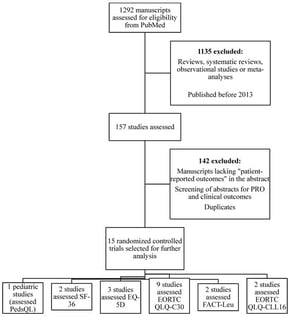
Selection process of literature review in myeloid diseases and leukemias with patient-reported outcome instruments.

Factors Influencing the Use of G-CSF in Drug-Induced Agranulocytosis

  • Emmanuel Andrès,
  • Jean-Edouard Terrade and
  • Noel Lorenzo-Villalba
  • + 1 author

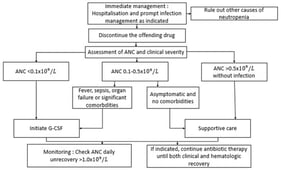
Drug-induced agranulocytosis is a rare but life-threatening adverse reaction associated with numerous non-chemotherapy drugs. Management relies on immediate drug withdrawal, infection control, and, in selected patients, administration of granulocyte-colony stimulating factor (G-CSF). This review summarizes current knowledge on the determinants of epidemiology, clinical presentation, hematologic and biologic features, comorbidities, and outcomes influencing the decision to introduce G-CSF in drug-induced agranulocytosis. Evidence from observational studies and meta-analyses suggests that G-CSF shortens neutropenia duration and hospitalization, although its impact on mortality remains uncertain. The decision to use G-CSF should consider initial neutrophil count, presence of severe infection or sepsis, age, and comorbidities. Despite the accumulated experience, randomized controlled trials are still lacking, and treatment algorithms remain empirical.

3 February 2026

Practical algorithm for management of drug-induced neutropenia and granulocyte colony-stimulating factor (G-CSF) therapy. ANC: Absolute Neutrophil count.
  • Case Report
  • Open Access

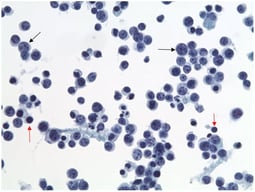
Primary effusion-based lymphomas are uncommon and may pose significant diagnostic challenges. Fluid overload-associated large B-cell lymphoma is a recently recognized entity in the 5th edition of the World Health Organization Classification of Hematolymphoid Tumors and should be included in the differential diagnosis of effusion-based lymphomas, particularly in elderly immunocompetent patients with conditions that predispose to fluid overload. Background and Clinical Significance: We report a case of fluid overload-associated large B-cell lymphoma to add to the limited literature and highlight distinguishing features from other primary effusion lymphomas. Case Presentation: A 77-year-old male with end-stage renal disease on hemodialysis and heart failure with reduced ejection fraction was admitted for respiratory failure and found to have a right-sided pleural effusion. Two pleural fluid specimens examined several weeks apart revealed sheets of large atypical lymphoid cells positive for CD20, Pax-5, CD79a, CD45, MUM1, BCL2, BCL6 (weak) and negative for TTF1, CD68, MOC31, BER EP4, WT1, Calretinin, CD3, CD138, CD30, and cMYC. Human Herpesvirus-8 and Epstein–Barr virus were negative. Staging showed a few mildly fluorodeoxyglucose-avid mediastinal lymph nodes which were benign. Ultimately, the patient was diagnosed with fluid overload-associated large B-cell lymphoma and treated with rituximab, cyclophosphamide, vincristine sulfate, and prednisone, but passed away three months after diagnosis. Conclusions: Fluid overload-associated large B-cell lymphoma is a new and important diagnostic consideration in effusion-based lymphomas. It may be mistaken for other conditions such as primary effusion lymphoma or other diffuse large B-cell lymphomas. The presence of a Human Herpesvirus-8-negative effusion-based lymphoma in an elderly immunocompetent patient without nodal or tissue involvement should prompt consideration of fluid overload-associated large B-cell lymphoma.

2 February 2026

Pap, 400×. ThinPrep cytology reveals many large atypical lymphoid cells in a background of scattered small mature lymphocytes. The atypical cells show round to slightly irregular nuclear contours, open chromatin, and prominent nucleoli. Red arrows highlight background small, mature lymphocytes. Black arrows highlight large, atypical lymphoid cells.
  • Case Report
  • Open Access

Primary Indolent Acute Promyelocytic Leukemia

  • Breanne Wolfenbarger,
  • Daley Morera and
  • Mei Zheng
  • + 2 authors

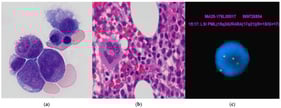
Background and Clinical Significance: Acute promyelocytic leukemia (APL) is a rapidly progressive subtype of acute myeloid leukemia defined by PML::RARA fusion and characterized by life-threatening coagulopathy. Because the disease typically follows an aggressive course, immediate treatment is essential once APL is suspected. This case report describes an atypical de novo presentation marked by indolent progression rather than the expected aggressive trajectory. Case Presentation: A 37-year-old female exhibited gradually declining white blood cell and neutrophil counts over the course of a year, followed by unexplained pancytopenia with severe neutropenia (0.1 × 10⁹/L). Evaluation for nutritional deficiencies and autoimmune disease was unrevealing aside from a positive ANA without clinical features of autoimmunity. Bone-marrow biopsy demonstrated morphologic and flow cytometric findings suggestive of APL, low-level t(15;17), PML::RARA fusion, and concomitant TP53 loss and ETV6 mutation. Despite the indolent clinical presentation and low disease burden, the molecular and cytogenetic findings confirmed the diagnosis of classical APL with TP53 loss and ETV6 mutation. Induction therapy with all-trans-retinoic acid and arsenic trioxide resulted in hematologic remission. Conclusions: This case highlights an unusually indolent form of de novo APL not previously documented in the literature, expanding the recognized clinical spectrum of the disease. The findings emphasize the importance of still considering severe diagnoses, such as APL, when presentations deviate from classical patterns. Atypical clinical trajectories should prompt careful assessment of marrow morphology and immunophenotypic features. Continued characterization of such cases may refine diagnostic criteria and direct individualized approaches to therapy.

27 January 2026

Morphologic and cytogenetic study of APL case with indolent behavior in a treatment naïve individual: (a) bone-marrow aspirate showing APL cells with “figure of 8” nuclear morphology, smooth chromatin, and cytoplasmic hot pink granules (×1000); (b) bone-marrow core biopsy demonstrates increased promyelocytes/blasts in a background of decreased trilineage maturing hematopoiesis (×1000); (c) PML::RARA FISH study shows PML::RARA fusion signal in yellow (PML-red/RARA-green).

News & Conferences

Issues

Open for Submission

Editor's Choice

Get Alerted

Add your email address to receive forthcoming issues of this journal.

XFacebookLinkedIn
Hematol. Rep. - ISSN 2038-8330