Skip to Content
You are currently on the new version of our website. Access the old version .

Genes

Genes is a peer-reviewed, open access journal of genetics and genomics published monthly online by MDPI.
The Spanish Society for Nitrogen Fixation (SEFIN) is affiliated with Genes and its members receive discounts on the article processing charges.
Indexed in PubMed | Quartile Ranking JCR - Q2 (Genetics and Heredity)

All Articles (14,158)

Backgrounds: Roegneria ciliaris is a perennial tetraploid wild relative of wheat that is widely distributed in China. It can be used both as a forage crop and ecological grass (the grasses specifically bred for ecological restoration) due to its strong stress tolerance, early green-up, vigorous seedling growth in spring, and great palatability. Methods: It is necessary to select and validate appropriate reference genes (RGs) for gene expression normalization by qRT-PCR in order to decipher the stress tolerance mechanism of this grass species. Therefore, eight candidate RGs were identified from transcriptome data of R. ciliaris ‘Liao sheng’ in response to drought stress. The expression stability of these RGs was evaluated by five algorithms (∆Ct, geNorm, NormFinder, Bestkeeper and ReFinder) using samples from different tissues and drought stress. Results: The results showed that MDH and RPL19 were the most stable RGs among all samples, while GAPDH and TUBA presented the lowest expression stability. These representative RGs were further used to normalize the expression level of the pyrroline-5-carboxylate synthase (P5CS) and protein phosphatase 2C (PP2C) genes in different tissues and under drought stress. The results of P5CS and PP2C expression were consistent with transcriptome data. Conclusion: Our study provided the first systematic evaluation of the most stable RG selection for qRT-PCR normalization in R. ciliaris, which will promote further research on its tissue-specific gene expression and mechanism of drought tolerance.

14 February 2026
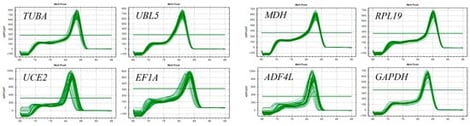
Specificity of primer pairs for qRT-PCR amplification in R. ciliaris.

Parkinson’s disease (PD) is a complex neurodegenerative disorder influenced by age, genetic predispositions, and environmental exposures, with a growing global incidence. This review aims to summarize findings from ATSDR Toxicological Profiles, EPA Risk Assessments, and other sources of peer-reviewed literature to examine the potential associations between PD and select metals, pesticides, and chlorinated organic compounds. Additionally, it explores using computational toxicology methods to elucidate the interactions between specific chemicals, associated genes, and their possible roles in PD. A total of 29 substances were identified to be neurotoxic with direct or probable association with PD. Risk of disease onset or symptom exacerbation of PD has been linked to exposures to neurodegenerative metals, pesticides, chlorinated organic compounds, and other environmental toxicants, alongside intrinsic factors such as genetic predisposition and aging. Supporting evidence from neurotoxicological studies directly or possibly associated with PD are summarized in referenced toxicological profiles and EPA risk assessments. Genotoxic endpoints evaluated in exposure-induced neurodegeneration including oxidative stress, DNA strand breaks, mitochondrial dysfunction, impaired DNA repair, and telomere alterations may play a critical role in linking environmental exposures to PD pathogenesis. Although these endpoints represent imperative data gaps between environmental and genetic risk factors for PD, isolating individual substances may not be necessary for prevention, as many co-occur at contaminated sites or within certain occupations. Further research is needed to clarify causal relationships between environmental exposure and genotoxic endpoints seen in neurodegenerative processes that can also be seen in PD for consideration in the development of preventive and therapeutic strategies.

13 February 2026

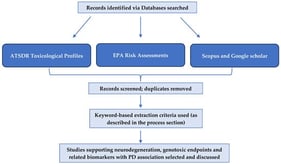
Data Collection and Screening Workflow. Note. Figure 1 outlines the methodological steps used to collect, screen, and organize data for analysis. The process includes topic selection, a literature review using ATSDR toxicological profiles and Scopus, keyword-based data extraction with inclusion/exclusion criteria, and final organization into structured tables for visualization and interpretation.

Antibiotic-Driven Evolutionary Engineering in Salmonella Heidelberg Reveals Genomic Signatures of Attenuation

  • Ruy D. Chacón,
  • Manuel Ramírez and
  • Antonio J. Piantino Ferreira
  • + 1 author

Background/Objectives: Salmonella Heidelberg (SH) is a globally distributed pathogen associated with gastrointestinal disease in humans and animals and frequently affects poultry. Among the classic strategies used in vaccine development, evolutionary engineering enables the generation of attenuated bacterial strains through exposure to selective pressures such as antibiotics. In this study, spontaneous antibiotic-resistant mutant strains of SH were generated by exposure to high concentrations of streptomycin and rifampicin, after which their phenotypic and genotypic characteristics were evaluated. Methods: The wild-type strain SA628 wt was subjected to continuous and discontinuous selection under antibiotic pressure. Phenotypic characterization included biochemical profiling and antibiotic susceptibility testing. Whole-genome sequencing was performed to identify genetic changes affecting virulence- and resistance-associated genes, plasmid content, and point mutations using variant calling approaches. The potential functional relationships of the mutated genes were further analyzed through genetic network analysis. Results: The mutant strains SA628 mut1 and SA628 mut3 were obtained through discontinuous selection, whereas strain SA628 mut2 was generated under continuous selection. Phenotypically, all the mutant strains exhibited resistance to streptomycin, whereas SA628 mut2 and SA628 mut3 also exhibited resistance to rifampicin. Genomic analyses revealed mutations in rpoS, ascD, ynfE, rpoB, and cyaA associated with discontinuous selection and in iscU, ybiO, rpoB, and rsmG associated with continuous selection. Network analysis indicated that these genes are functionally connected within regulatory and metabolic interaction networks, including global transcriptional regulation, anaerobic metabolism, cAMP-mediated signaling, translation, and iron–sulfur cluster biogenesis. Conclusions: Collectively, these findings suggest that antibiotic-driven selection promotes coordinated genetic changes affecting stress responses and metabolism, which may contribute to reduced virulence. This work provides insights into bacterial adaptation under antibiotic stress and supports the potential use of evolutionary engineering for the development of attenuated strains.

12 February 2026

Schematic representation of the discontinuous (top) and continuous (bottom) selection strategies used to generate sequential SA628 mutant strains. The strains were exposed to streptomycin (800 mg/L) or rifampicin (1000 mg/L). Discontinuous selection resulted in a stepwise evolutionary trajectory (SA628 mut1 → SA628 mut3), whereas continuous selection led to the independent emergence of SA628 mut2. The figure was created with BioGDP [28].

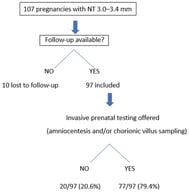
Background: Increased nuchal translucency (NT) is associated with an elevated risk of genetic abnormalities and structural malformations. The clinical utility of invasive testing and the optimal diagnostic approach in mildly increased NT (3.0–3.4 mm) is debated. This study aimed to evaluate genetic and ultrasound findings in this subgroup and to assess the diagnostic yield of advanced genetic testing. Methods: We retrospectively included a total of 107 fetuses with NT between 3.0 and 3.4 mm from a single fetal medicine unit. Complete outcome data were available for 97 pregnancies. Invasive prenatal testing with standard karyotype, chromosomal microarray analysis (CMA) and RASopathy panel testing were offered. All patients underwent detailed ultrasound examination to detect structural abnormalities at 16 and 20 weeks, regardless of whether invasive testing was performed. Results: Invasive prenatal testing, amniocentesis or chorionic villus sampling, (CVS), was performed in 77/97 cases (79.4%). Genetic abnormalities were detected in 28/97 (28.9%). Overall, five rare genetic anomalies were identified; none would have been detected by quantitative fluorescent polymerase chain reaction (QF-PCR) or non-invasive prenatal testing (NIPT). Two anomalies were detectable by standard karyotype, two exclusively by CMA and one exclusively by RASopathy panel. When considering all cases undergoing advanced genetic testing (CMA or RASopathy panel, n = 35) the overall diagnostic yield was 8.5% (3/35). When calculated across the entire cohort with complete follow-up, the additional diagnostic yield was 3.1% (3/97). Major structural malformations were identified in 17/97 cases (17.5%), of which 10 (58.8%) were associated with genetic abnormalities. Conclusions: Fetuses with NT measurements between 3.0 and 3.4 mm show a substantially increased risk of genetic abnormalities and structural malformations. These findings support a comprehensive prenatal evaluation, including invasive testing with advanced genetic analysis and detailed ultrasound assessment, to optimize diagnosis and counseling.

12 February 2026

Flowchart of the study population and prenatal diagnostic work-up in pregnancies with NT between 3.0 and 3.4 mm.

News & Conferences

Issues

Open for Submission

Editor's Choice

Reprints of Collections

RNA Interference Pathways
Reprint

RNA Interference Pathways

Editors: Tamas I. Orban
Trends and Prospects in Pig Genomics and Genetics
Reprint

Trends and Prospects in Pig Genomics and Genetics

Editors: Katarzyna Piórkowska, Katarzyna Ropka-Molik

Get Alerted

Add your email address to receive forthcoming issues of this journal.

XFacebookLinkedIn
Genes - ISSN 2073-4425