

- Article

Mechanistic Investigation of Microdroplet Formation in High-Viscosity Shear-Thinning Hydrogel Bioinks
- Qiang Gao,
- Yanling Mi and
- Peng Zhang
- + 4 authors
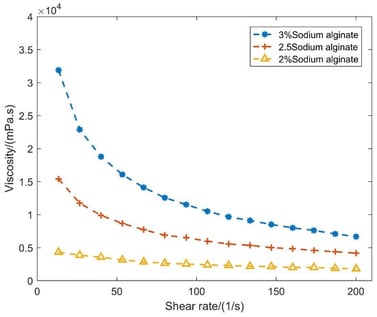
High-resolution biofabrication requires precise microscale deposition, yet drop-on-demand (DOD) inkjet bioprinting is constrained by a narrow printable viscosity window. Many biocompatible hydrogel precursors display high zero-shear viscosity and strong shear-thinning, so stable droplet ejection typically requires dilution or reformulation that can compromise the biochemical microenvironment. We present a transient shear-enabled jetting method that exploits intrinsic shear-thinning by using a high-frequency electromagnetic microvalve to deliver short, high-pressure pulses. The resulting localized shear dynamically lowers apparent viscosity in the nozzle region and promotes controlled nucleation, ligament formation, necking, and pinch-off. A coupled, rheology-informed modeling framework (axisymmetric transient CFD, valve dynamics, and electromagnetic FEM) links actuation parameters to droplet volume and stability and guides hardware optimization. Experiments with 2.5% (w/v) sodium alginate validate stable droplet generation and tunable droplet size via stroke length and driving conditions. These results define a practical process window for high-resolution droplet printing of high-viscosity shear-thinning hydrogel inks.
6 February 2026
![(a) Preparation mechanism of BT-SAP, (b) FT-IR spectra, (c) XRD patterns of SAP and BT-SAP, (d) SEM images of BT-SAP [magnifications: 50×, 50×, 2000×, 50,000×], (e) nitrogen adsorption–desorption isotherm, and (f) pore width distribution of BT-SAP.](https://mdpi-res.com/cdn-cgi/image/w=281,h=192/https://mdpi-res.com/gels/gels-12-00145/article_deploy/html/images/gels-12-00145-g001a-550.jpg)