Skip Content
You are currently on the new version of our website. Access the old version .

Gels

Gels is an international, peer-reviewed, open access journal on physical and chemical gels, published monthly online by MDPI.

Indexed in PubMed | Quartile Ranking JCR - Q1 (Polymer Science)

All Articles (4,402)

In the fabrication of ultrathin multilayer ceramic capacitors (MLCCs), the long-term stability of ceramic slurries is a critical yet often overlooked factor that can significantly influence coating uniformity, interfacial adhesion, and process reproducibility. Despite its industrial importance, the time-dependent evolution of slurry dispersion structures during storage and its direct impact on green sheet properties remain insufficiently understood. This study examined the time-dependent physicochemical evolution of barium titanate (BaTiO3)-based green sheet slurries, which behave as colloidal gel-like dispersion systems, and their influence on the structural, optical, and interfacial properties of the resulting sheets. Dynamic light scattering revealed progressive yet uniform particle aggregation, while viscosity measurements indicated a gradual ~10% decrease over 960 h, reflecting reduced dispersion stability and progressive weakening of the slurry gel network during extended storage. The slurry, consisting of BaTiO3 particles, polymeric binders, and plasticizers, forms a three-dimensional transient gel network, in which particle–particle and particle–binder interactions govern rheological behavior. The observed viscosity decrease and turbidity reduction indicate gel network relaxation and partial gel–sol–like transition behavior driven by aggregation. Cross-sectional scanning electron microscopy demonstrated that these changes produced a measurable reduction in final green sheet thickness, despite identical processing conditions. Furthermore, peel tests revealed that interfacial adhesion strength increased with storage time, attributable to localized solid enrichment within the slurry gel matrix and enhanced bonding at the release film interface. The reduced coating thickness also contributed to lower optical haze, reflecting a shortened light-transmission path. Collectively, these findings demonstrate that even moderate aggregation in a ceramic network-forming dispersion system substantially alters coating behavior, adhesion, and optical performance. The results underscore the importance of managing gel-network stability and rheology to ensure reliable green sheet fabrication and storage in MLCC manufacturing.

7 February 2026
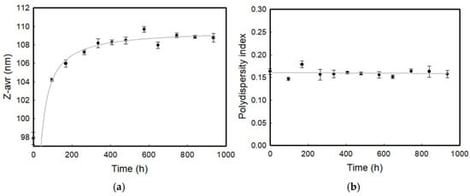
Time-dependent analysis of BaTiO3 slurry particles: (a) particle size and (b) dispersion uniformity.

The continuous advancement and improved understanding of technologies for gel synthesis and formulation have enabled the development of novel gel systems with diverse pharmaceutical applications [...]

7 February 2026

High-resolution biofabrication requires precise microscale deposition, yet drop-on-demand (DOD) inkjet bioprinting is constrained by a narrow printable viscosity window. Many biocompatible hydrogel precursors display high zero-shear viscosity and strong shear-thinning, so stable droplet ejection typically requires dilution or reformulation that can compromise the biochemical microenvironment. We present a transient shear-enabled jetting method that exploits intrinsic shear-thinning by using a high-frequency electromagnetic microvalve to deliver short, high-pressure pulses. The resulting localized shear dynamically lowers apparent viscosity in the nozzle region and promotes controlled nucleation, ligament formation, necking, and pinch-off. A coupled, rheology-informed modeling framework (axisymmetric transient CFD, valve dynamics, and electromagnetic FEM) links actuation parameters to droplet volume and stability and guides hardware optimization. Experiments with 2.5% (w/v) sodium alginate validate stable droplet generation and tunable droplet size via stroke length and driving conditions. These results define a practical process window for high-resolution droplet printing of high-viscosity shear-thinning hydrogel inks.

6 February 2026

The growing need for ecologically sound and ethical protein sources has contributed to the development of meat analogs (MAs) and restructured meat products (RMPs). Next generation MA and RMP production requires sustainable structuring techniques to imitate the physical, chemical, and sensory characteristics of conventional meat. Innovative gelling techniques are essential for attaining optimal texture, chewiness, and structural firmness in MAs and RMPs. Food gels can modulate water and fat retention, as well as the physical and mechanical characteristics of MA and RMP. Different gelling systems such as hydrogels, emulsion gels, oleogels, and hybrid gels contribute to texture formation, water and fat retention, juiciness, and structural integrity, which are essential for mimicking conventional meat. The role of gels as key structuring elements is integrated with advanced processing technologies such as high-moisture extrusion and 3D printing. This review discusses how protein, polysaccharide, lipid, and hybrid gelling techniques facilitate the development of MAs and RMPs with enhanced texture, sensory quality, nutritional value, and sustainability. Advanced structuring techniques, such as high-moisture extrusion, shear cell processing, and 3D printing, are explained regarding their integration of tailored gels (hydrogels, emulsion gels, oleogels, and hybrid gels) to fabricate imitated meat structures. Moreover, this article investigates the sensory and nutritional ramifications of various gelling techniques, spanning their role in juiciness and flavor composition. This review emphasizes significant research deficiencies and suggests more extensive future studies to facilitate the further development of economically viable and sustainable MAs and RMPs.

5 February 2026

News & Conferences

Issues

Open for Submission

Editor's Choice

Reprints of Collections

Oleogels, Bigels, and Emulgels
Reprint

Oleogels, Bigels, and Emulgels

Fabrication, Application and Research Trends
Editors: Cristina Ghinea, Ana Leahu
Current Directions and Prospects of Hydrogels for Biomedical Applications
Reprint

Current Directions and Prospects of Hydrogels for Biomedical Applications

Editors: Zhiyuan Jia, Holger Schönherr, Nowsheen Goonoo

Get Alerted

Add your email address to receive forthcoming issues of this journal.

XFacebookLinkedIn
Gels - ISSN 2310-2861