Skip Content
You are currently on the new version of our website. Access the old version .

Forests

Forests is an international, peer-reviewed, open access journal on forestry and forest ecology published monthly online by MDPI.

Quartile Ranking JCR - Q2 (Forestry)

All Articles (15,597)

Cortical microtubules comprise heterodimeric units of α- and β-tubulin which have been shown to guide the deposition of cellulose microfibrils in plant cell walls where their arrangement is important in determining cell morphology and cell wall properties. Tubulin genes are highly expressed in woody tissues and a functional study has demonstrated a role for a β-tubulin gene family member in affecting the orientation of cellulose microfibrils in wood fibre cells, an important trait in determining the mechanical properties of wood fibres. To further understand the role of tubulins in plant cell trait determination, this study identified and investigated the expression of the α- and β-tubulin gene families in Eucalyptus and then, using transgenesis techniques, investigated the role of specific eucalypt tubulin isoforms in determining secondary cell wall traits of wood fibres in plant stems. This study found that the α- and β-tubulin gene families in Eucalyptus are relatively small compared to other species and show higher expression in woody stem tissue when compared to leaf. Functional studies revealed that cambial cells transformed with α- and β-tubulin overexpression and knockdown vectors, either on their own or in combination, lead to changes in the angle of microfibrils in the secondary cell wall of wood fibre cells with Class I- and Class I-like gene family members explicitly involved. This study demonstrates the importance of tubulins in determining the mechanical properties of wood fibres through a mechanism involving specific tubulin isoform expression during wood fibre formation.

9 February 2026
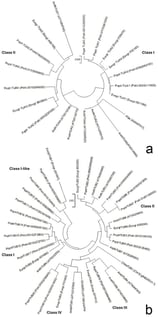
Phylogenetic analysis of eucalypt, poplar and Arabidopsis α-tubulin (a) and β-tubulin; (b)gene family members. AlgaAAN87017 and Cre12.g542250.t1.1 were used as outgroups.

Forestry operations expose workers to a high risk of health constraints, accidents, and injuries. We are trying to protect them and implement many effective countermeasures; nevertheless, the development of new forestry machines remains a long process, with limited safety and ergonomic feedback, usually provided only at a late stage in the design process. In this study, we propose a practical digital ergonomics workflow that combines inertial motion capture, standardized risk scoring, and digital human modelling to improve and shorten human-centered and safer design of forestry machinery. We validated the approach in a field pilot on a prototype milling–spraying device for standing trees. Two experienced operators performed a full work-cycle (carry → install → operate → dismantle → return), during which their whole-body kinematics were captured in real forest conditions. These were then evaluated using kinematic metrics, RULA, OWAS, and a heart-rate-based load index. Based on these ergonomical and risk findings, we translate motion-derived risk ‘hotspots’ into real redesign targets (grip/handle geometry, weight distribution, support elements, and control layout), outlining an updated forestry-specific DHM/HDT (digital human modeling; human digital twin) framework that explicitly incorporates terrain and environmental constraints to accelerate the iteration of safer prototypes. The updated digital modeling framework will be used in the design of the new, more complex machine—“Semi-autonomous system for optimizing degraded soils by deep injection”. This machine contains a much more complex and advanced structure, including a tractor with an attachment tool for specialized deep soil injection. We suppose that using motion capture data, human digital twins, and digital human models can effectively support designing and the development process to avoid human-related construction nonconformities of this complex machine even before the final machine prototype is produced for functional field testing.

9 February 2026

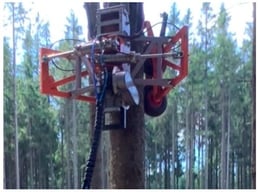
Prototype of the Milling machine with adapters and a sprayer on a climbing carrier.

Clarifying how different green finance instruments affect the investment and financing performance of forestry enterprises is critical for enhancing their sustainability. This study adopts an agent-based modeling (ABM) approach to analyze the interactions among core stakeholders (governments, forestry enterprises, financial institutions) in forestry enterprises’ investment and financing activities and elucidates how green finance instruments—namely preferential interest rates, industrial subsidies, and financing guarantees—differentially affect the investment and financing performance of heterogeneous forestry enterprises. Further, it simulates the impacts of different instrument combinations and intensities on green and general investment and financing performance. Results indicate that: (1) Forestry enterprises face constrained financing channels, with unmet green financing demand. (2) Existing green finance instruments exert a significant positive effect on financing performance; specifically, increasing industrial subsidies outperforms enhancing interest rate preferences or expanding financing guarantees in boosting financing performance (especially green financing), though their impact on investment performance is limited. (3) Policy combinations that integrate all three instruments and increase their intensity significantly improve general investment and financing performance, yet they still fall short of effectively driving the green transformation of forestry enterprises. These findings suggest that green finance instruments should avoid market distortions, encourage multi-stakeholder engagement, and shift from direct subsidies towards fostering innovation in the green finance support system.

9 February 2026

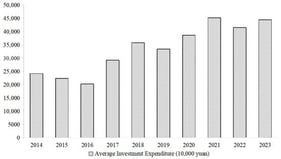
Investment expenditures of sample enterprises from 2014 to 2023.

To investigate the effects of long-term continuous rotary tillage incorporation (RT) on Fraxinus chinensis Roxb. plantations, this study compared 7- and 15-year-old stands subjected to RT since afforestation with their non-tilled counterparts (CK). Results demonstrated that RT significantly enhanced tree growth by synergistically improving soil nutrient availability, physical properties, and microbial community structure and function: (1) Compared with CK, RT increased diameter at breast height (DBH) by 28.89% in 7-year-old stands and 22.58% in 15-year-old stands, and tree height by 19.51% in 7-year-old stands and 25.00% in 15-year-old stands; (2) RT increased contents of soil organic carbon (SOC), total nitrogen (TN), and total phosphorus (TP), rearranged the distribution patterns of soil particulate organic carbon (POC) and mineral-associated organic carbon (MAOC), and reduced soil bulk density (BD) and soil water content (SWC); (3) RT regulated microbial diversity, co-occurrence networks, and carbohydrate-degrading gene abundances, with more prominent effects in 15-year-old stands. This tillage practice is feasible and effective, and thus is recommended for application in F. chinensis plantation management, providing a scientific basis for refined and sustainable plantation management.

8 February 2026

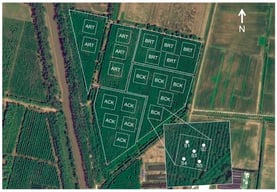
Distribution of plots and sample points in the study area. The arrow indicates the north direction; rectangles labeled ART, ACK, BRT, and BCK represent the quadrat distributions of corresponding plots, with five replicate quadrats per plot; the inset in the lower right corner shows the distribution of five sampling points (S1–S5) within each quadrat.

News & Conferences

Issues

Open for Submission

Editor's Choice

Reprints of Collections

Plant Invasion
Reprint

Plant Invasion

Editors: Bruce Osborne, Panayiotis G. Dimitrakopoulos
Modeling Aboveground Forest Biomass
Reprint

Modeling Aboveground Forest Biomass

New Developments
Editors: Ana Cristina Gonçalves, Teresa Fidalgo Fonseca

Get Alerted

Add your email address to receive forthcoming issues of this journal.

XFacebookLinkedIn
Forests - ISSN 1999-4907