Skip to Content
You are currently on the new version of our website. Access the old version .
  • Tracked for
    Impact Factor
  • 2.9
    CiteScore
  • 23 days
    Time to First Decision

Forensic Sciences

Forensic Sciences is an international, peer-reviewed, open access journal on all aspects of forensic science published quarterly online by MDPI.
The Portuguese Association of Forensic Sciences (APCF) is affiliated with Forensic Sciences and their members receive a discount on the article processing charges.

All Articles (268)

Autopsy Findings in Hanging: A 10-Year Prospective Study of 660 Cases

  • Roman Kuruc,
  • Andrea Szórádová and
  • Ľuboš Nižnanský
  • + 2 authors

Background/Objectives: Hanging is the most common method of suicide in most countries worldwide. It is characterized by high lethality, technical simplicity, and typical autopsy findings. Autopsy plays a crucial role in determining the cause and mechanism of death. While external injuries are relatively consistent, internal findings show considerable variability in the literature. The aim of this prospective study was to analyze 660 cases of suicidal hanging over a ten-year period, focusing on the occurrence of forensically relevant internal autopsy findings. Methods: The study was conducted at the Department of Forensic Medicine in Bratislava between 2015 and 2024. All cases underwent standardized complete autopsy, including histology, toxicology, and analysis of death circumstances. Recently reported thoracic aortic adventitial hemorrhages described in 2024 were evaluated only in a targeted subset of cases examined between July and December 2024. Statistical evaluation was performed using the chi-square test to identify associations between internal findings and suspension type, knot location, age, sex, and body weight. Results: The argent line was present in 61.1% of cases, most frequently with posterior knot placement and complete suspension. Neck muscle hemorrhages occurred in 53.8%, predominantly at the periosteal-clavicular attachment of the sternocleidomastoid muscle, with higher incidence in complete and anterior suspension. Amussat’s sign was observed in 10.2% of cases, and Etienne-Martin’s sign in 1.1%. Fractures of the laryngo-hyoid complex were present in 49.7%, mainly in cases with complete suspension and posterior knot location. Cervical spine injuries were detected in 2.6%, predominantly in older males and with anterior knot placement. Simon’s hemorrhages occurred in 35.2%, mainly in younger individuals and complete suspension. Hemorrhages in the intestinal wall were detected in 7.4%, and rectal hemorrhages in 1.1% of cases. In the targeted 2024 subset, no thoracic aortic adventitial hemorrhages were identified. Conclusions: The findings suggest the forensic relevance of several internal findings associated with hanging, while emphasizing that the results were obtained using a uniform and consistently applied autopsy protocol. They also indicate the need for further research, particularly regarding recently reported adventitial hemorrhages of the thoracic aorta, which were assessed only in a limited subset of cases during the final months of the study and were not identified in our material.

10 February 2026
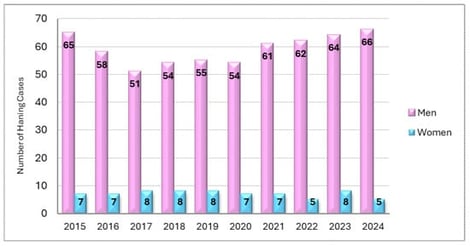
Distribution of Hanging Cases by Year and Sex.
  • Case Report
  • Open Access

German Shepherd Predation of an Elderly Man: A Case Report

  • Antonio Della Valle,
  • Eleonora Lo Muzio and
  • Maria Eleonora Bizzoca
  • + 2 authors

Background and Clinical Significance: Fatal attacks by domestic dogs, particularly against familiar owners, are rare but represent a significant forensic and public health concern. Understanding the dynamics and forensic features distinguishing predatory aggression from postmortem scavenging is essential, especially when cases involve large breeds and vulnerable individuals, such as the elderly. Case Presentation: An 82-year-old man was found dead in his home, presenting extensive mutilation of the head and neck. He lived with his daughter and her four-year-old male German Shepherd. The dog exhibited blood and tissue residues on its mouth, forelimbs, and abdomen. Autopsy findings indicated death due to hemorrhagic shock from deep cervical and facial vessel lacerations. There were no defense wounds or classic bite marks; however, massive excision of musculocutaneous tissue from the neck to the scalp suggested active predation rather than postmortem scavenging. The facial and cervical soft tissues were completely avulsed, exposing deep anatomical structures and causing the loss of the right eye and dental elements. No signs of third-party involvement, intrusion, or external aggression were identified, and the dog appeared healthy and unrestrained. Conclusions: The findings support the theory of a fatal attack by the household German Shepherd occurring shortly after the victim’s meal. This case underscores the potential for lethal aggression in domestic dogs toward familiar humans, even in the absence of provocation or prior behavioral concerns. It highlights the importance of awareness and preventive measures when managing large, powerful dog breeds in environments with elderly or otherwise vulnerable individuals.

9 February 2026

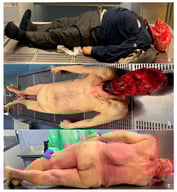
(a–c). The victim, dressed and undressed, in the autopsy room, showing extensive tissue loss only from the base of the neck to the top of the head.

Background/Objectives: Nasal morphology is an important craniofacial feature in forensic anthropology for examining population-level variation and informing biological profiling in living individuals. Despite genetic, historical, and cultural similarities between Malaysian and Indonesian populations, population-specific nasal anthropometric data remain limited. This study integrates nasal anthropometry with multivariate analytical approaches to examine population- and sex-related variation in nasal morphology among Malaysian and Indonesian adults. Methods: A cross-sectional anthropometric study was conducted among Malaysian and Indonesian adults. Nasal breadth and nasal height were measured using standardised techniques, and the nasal index was calculated. Univariate analyses were performed to assess population- and sex-related differences. Multivariate analyses, including principal component analysis (PCA), hierarchical cluster analysis (HCA), and partial least squares (PLS), were applied to eleven nasal parameters and the nasal index to evaluate patterns of population differentiation. Results: Malaysian participants predominantly exhibited leptorrhine nasal types, whereas mesorrhine nasal types were more prevalent among Indonesian participants. Significant differences were observed in nasal height and nasal index between populations, while nasal breadth did not differ significantly. Sex-related variation was evident, with males generally exhibiting larger nasal dimensions and higher nasal indices than females. Multivariate analyses demonstrated clear population separation, with modelling indicating that population group contributed more strongly to morphological differentiation than sex. Conclusions: The findings provide population-specific soft-tissue nasal data for Malaysian and Indonesian groups and support the use of multivariate analytical frameworks in forensic anthropological research.

8 February 2026

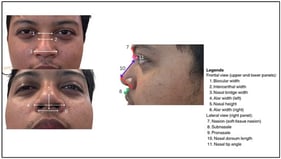
Nasal morphology measurement landmarks.

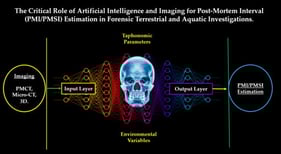
The application of advanced imaging techniques, particularly computed tomography (CT), photogrammetric scanning, and three-dimensional reconstructions of body surfaces and skeletal remains, is becoming a crucial component of Forensic Anthropology. These tools enable a non-invasive and highly standardized analysis of both intact cadavers and human remains recovered from terrestrial or aquatic environments, providing reliable support in identification processes, traumatological reconstruction, and the assessment of taphonomic processes. In the context of estimating the Post-Mortem Interval (PMI) and the Post-Mortem Submersion Interval (PMSI), digital imaging allows for the objective and reproducible documentation of morphological changes associated with decomposition, saponification, skeletonization, and taphonomic patterns specific to the recovery environment. Specifically, CT enables the precise assessment of gas accumulation, transformations in residual soft tissues, and structural bone modifications, while photogrammetry and 3D reconstructions facilitate the longitudinal monitoring of transformative processes in both terrestrial and underwater contexts. These observations enhance the reliability of PMI/PMSI estimates through integrated models that combine morphometric, taphonomic, and environmental data. Beyond PMI/PMSI estimation, imaging techniques play a central role in anthropological bioprofiling, facilitating the estimation of age, sex, and stature, the analysis of dental characteristics, and the evaluation of antemortem or perimortem trauma, including damage caused by terrestrial or fauna. Three-dimensional documentation also provides a permanent, shareable archive suitable for comparative analyses, ensuring transparency and reproducibility in investigations. Although not a complete substitute for traditional autopsy or anthropological examination, imaging serves as an essential complement, particularly in cases where the integrity of remains must be preserved or where environmental conditions hinder the direct handling of osteological material. Future directions include the development of AI-based predictive models for PMI/PMSI estimation using automated analysis of post-mortem changes, greater standardization of imaging protocols for aquatic remains, and the use of digital sensors and multimodal techniques to characterize microstructural alterations not detectable by the naked eye. The integration of high-resolution imaging and advanced analytical algorithms promises to further enhance the reconstructive accuracy and interpretative capacity of Forensic Anthropology.

5 February 2026

(A) Terrestrial decomposition within the context of Post-Mortem Interval (PMI) estimation. (B) Marine decomposition within the context of Post-Mortem Submersion Interval (PMSI) estimation.

News & Conferences

Issues

Open for Submission

Editor's Choice

Get Alerted

Add your email address to receive forthcoming issues of this journal.

XFacebookLinkedIn
Forensic Sci. - ISSN 2673-6756