Skip Content
You are currently on the new version of our website. Access the old version .
  • Tracked for
    Impact Factor
  • 2.9
    CiteScore
  • 23 days
    Time to First Decision

Forensic Sciences

Forensic Sciences is an international, peer-reviewed, open access journal on all aspects of forensic science published quarterly online by MDPI.
The Portuguese Association of Forensic Sciences (APCF) is affiliated with Forensic Sciences and their members receive a discount on the article processing charges.

All Articles (266)

Background/Objectives: Nasal morphology is an important craniofacial feature in forensic anthropology for examining population-level variation and informing biological profiling in living individuals. Despite genetic, historical, and cultural similarities between Malaysian and Indonesian populations, population-specific nasal anthropometric data remain limited. This study integrates nasal anthropometry with multivariate analytical approaches to examine population- and sex-related variation in nasal morphology among Malaysian and Indonesian adults. Methods: A cross-sectional anthropometric study was conducted among Malaysian and Indonesian adults. Nasal breadth and nasal height were measured using standardised techniques, and the nasal index was calculated. Univariate analyses were performed to assess population- and sex-related differences. Multivariate analyses, including principal component analysis (PCA), hierarchical cluster analysis (HCA), and partial least squares (PLS), were applied to eleven nasal parameters and the nasal index to evaluate patterns of population differentiation. Results: Malaysian participants predominantly exhibited leptorrhine nasal types, whereas mesorrhine nasal types were more prevalent among Indonesian participants. Significant differences were observed in nasal height and nasal index between populations, while nasal breadth did not differ significantly. Sex-related variation was evident, with males generally exhibiting larger nasal dimensions and higher nasal indices than females. Multivariate analyses demonstrated clear population separation, with modelling indicating that population group contributed more strongly to morphological differentiation than sex. Conclusions: The findings provide population-specific soft-tissue nasal data for Malaysian and Indonesian groups and support the use of multivariate analytical frameworks in forensic anthropological research.

8 February 2026
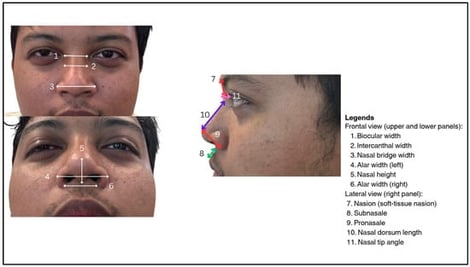
Nasal morphology measurement landmarks.

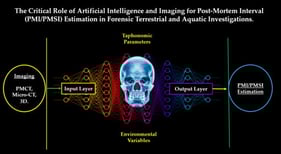
The application of advanced imaging techniques, particularly computed tomography (CT), photogrammetric scanning, and three-dimensional reconstructions of body surfaces and skeletal remains, is becoming a crucial component of Forensic Anthropology. These tools enable a non-invasive and highly standardized analysis of both intact cadavers and human remains recovered from terrestrial or aquatic environments, providing reliable support in identification processes, traumatological reconstruction, and the assessment of taphonomic processes. In the context of estimating the Post-Mortem Interval (PMI) and the Post-Mortem Submersion Interval (PMSI), digital imaging allows for the objective and reproducible documentation of morphological changes associated with decomposition, saponification, skeletonization, and taphonomic patterns specific to the recovery environment. Specifically, CT enables the precise assessment of gas accumulation, transformations in residual soft tissues, and structural bone modifications, while photogrammetry and 3D reconstructions facilitate the longitudinal monitoring of transformative processes in both terrestrial and underwater contexts. These observations enhance the reliability of PMI/PMSI estimates through integrated models that combine morphometric, taphonomic, and environmental data. Beyond PMI/PMSI estimation, imaging techniques play a central role in anthropological bioprofiling, facilitating the estimation of age, sex, and stature, the analysis of dental characteristics, and the evaluation of antemortem or perimortem trauma, including damage caused by terrestrial or fauna. Three-dimensional documentation also provides a permanent, shareable archive suitable for comparative analyses, ensuring transparency and reproducibility in investigations. Although not a complete substitute for traditional autopsy or anthropological examination, imaging serves as an essential complement, particularly in cases where the integrity of remains must be preserved or where environmental conditions hinder the direct handling of osteological material. Future directions include the development of AI-based predictive models for PMI/PMSI estimation using automated analysis of post-mortem changes, greater standardization of imaging protocols for aquatic remains, and the use of digital sensors and multimodal techniques to characterize microstructural alterations not detectable by the naked eye. The integration of high-resolution imaging and advanced analytical algorithms promises to further enhance the reconstructive accuracy and interpretative capacity of Forensic Anthropology.

5 February 2026

(A) Terrestrial decomposition within the context of Post-Mortem Interval (PMI) estimation. (B) Marine decomposition within the context of Post-Mortem Submersion Interval (PMSI) estimation.

Unveiling Hidden Pollutants: An Environmental Forensics Approach to Water Contamination

  • Gayathri Narayanan Prabhadevi,
  • Muhammed Siddik Abdul Samad and
  • Geena Prasad
  • + 3 authors

Emerging contaminants (ECs) are trace-level chemical and biological compounds detected in the environment, particularly in water, including personal care products, microplastics, nanoplastics, antibiotic resistance genes, etc., which have the potential to endanger ecosystems and human health. Forensic techniques, which are used to detect and trace the sources of ECs with specificity and accuracy, like gas and liquid chromatography coupled with mass spectrometry, Fourier transform infrared spectroscopy, inductively coupled plasma mass spectrometry, isotope ratio mass spectrometry, remote sensing, geographical information systems, and statistical and machine learning approaches are discussed in this study. The present analysis also outlines the types of emerging contaminants, along with their possible sources, including domestic and municipal wastewater, wastewater from healthcare institutions, urban runoff and stormwater, industrial and commercial discharges, effluents from agricultural and animal husbandry, and pollution from recreational activities in water. The review concludes by emphasizing the future need for real-time detection systems, integrated data analysis, and stronger regulatory frameworks to manage ECs more effectively.

2 February 2026

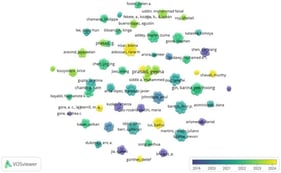
Temporal evolution of research themes in emerging contaminant studies, highlighting the transition toward analytical and environmental forensic approaches.

Background: In forensic ballistics, identifying ammunition types on physical evidence is critical, particularly when metallic residues are minimal. This study comparatively analyzes the elemental signatures deposited by two common projectiles—Full Metal Jacket (FMJ) (Cu/Zn jacket) and Lead Round Nose (LRN) (exposed Pb core)—on complex targets, including pig bone/tissue and mango wood. Methods: Using a semi-automatic handgun at an intermediate range of 5.0 m, residues were examined through high-resolution benchtop Micro-XRF (M4 Tornado) for micro-spatial analysis and Portable XRF (Elio) for rapid field characterization. Additionally, fresh pork leg samples were subjected to a 3-month environmental degradation period to assess trace persistence. Results: Observations indicated that LRN projectiles exhibit markedly elevated Lead (Pb) concentrations along the wound track in bone, hence confirming Pb as a reliable indicator for unjacketed ammunition; specifically, the median Pb concentrations at bullet wiping were 10.39 wt% for M4 and 7.34 wt% for Elio. Conversely, FMJ traces remain strictly confined to the surface bullet wipe area, with median concentrations of Pb, Cu, and Zn being 2.21 wt%, 0.24 wt%, and 0.59 wt% via M4, respectively. Statistical analysis showed a strong correlation for high-concentration elements on tissue, but significantly greater variance on wooden surfaces where FMJ traces exhibited a very weak negative correlation (r = −0.2774) due to minimal and irregular metal transfer. Taphonomic evaluation revealed that the Pb signature from LRN is exceptionally stable (r ≈ 0.9999) even after decomposition, while FMJ signatures are highly sensitive to environmental exposure. Conclusions: This research underscores the necessity of high-sensitivity Micro-XRF (M4) for definitive ammunition verification, providing a refined analytical framework for shooting incident reconstruction even involving degraded remains or complex environmental scenes.

2 February 2026

Experimental setup for the firing protocol (5.0 m distance).

News & Conferences

Issues

Open for Submission

Editor's Choice

Get Alerted

Add your email address to receive forthcoming issues of this journal.

XFacebookLinkedIn
Forensic Sci. - ISSN 2673-6756