

Journal Menu
► ▼ Journal Menu-
- Foods Home
- Aims & Scope
- Editorial Board
- Reviewer Board
- Topical Advisory Panel
- Instructions for Authors
- Special Issues
- Topics
- Sections & Collections
- Article Processing Charge
- Indexing & Archiving
- Editor’s Choice Articles
- Most Cited & Viewed
- Journal Statistics
- Journal History
- Journal Awards
- Society Collaborations
- Conferences
- Editorial Office
Journal Browser
► ▼ Journal BrowserNeed Help?
Announcements
13 May 2026
Foods | Invitation to Read the Editor’s Choice Articles in Q1 of 2026
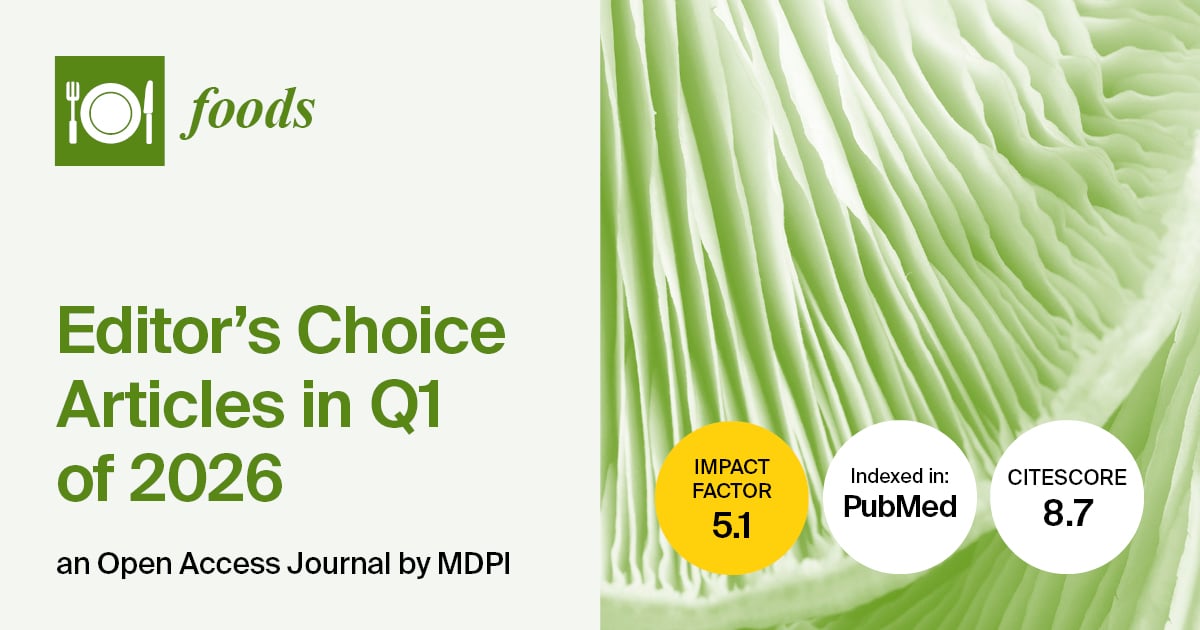
Editor’s Choice Articles are selected based on suggestions from Foods’ Academic Editors worldwide. The Editors select a small number of recently published articles that they consider to be particularly interesting to our readers or important in their respective fields of research. You are welcome to read the updated 2026 Q1 Editor’s Choice Articles, a curated list of high-quality articles from Foods (ISSN: 2304-8158).
The full list of Editor’s Choice Articles can be viewed at the following link: https://www.mdpi.com/journal/foods/editors_choice.
A list of these papers is provided below:
1. “Protection of Anthocyanins by Food Matrix During Simulated Digestion: Comparative Analysis of Whole-Açaí Powder and Extracts”
by Ravish Kumkum, Kathryn Aston-Mourney, Bryony A. McNeill and Leni R. Rivera
Foods 2026, 15(2), 263; https://doi.org/10.3390/foods15020263
Full text available online: https://www.mdpi.com/2304-8158/15/2/263
2. “The Germination Paradox in Sorghum: A Review”
by Yogita Sharma, Nidhish Francis, Christopher Blanchard and Abishek Bommannan Santhakumar
Foods 2026, 15(3), 569; https://doi.org/10.3390/foods15030569
Full text available online: https://www.mdpi.com/2304-8158/15/3/569
3. “Brazilian Consumer Attitude Towards the Concept of Meat Products with Claims of Naturalness, Healthiness and Sustainability”
by Hellencris Cassin Rocha, Sabrina Souza França, Danielle Rodrigues Magalhães, Alessandra Lopes de Oliveira and Marco Antonio Trindade
Foods 2026, 15(3), 572; https://doi.org/10.3390/foods15030572
Full text available online: https://www.mdpi.com/2304-8158/15/3/572
4. “Integrating a Convolutional Neural Network and MultiHead Attention with Long Short-Term Memory for Real-Time Control During Drying: A Case Study of Yuba (Tofu Skin)”
by Jiale Guo, Jie Wu, Lixuan Zhang, Ziqin Peng, Lixuan Wei, Wuxia Li, Jingzhi Shen and Yanhong Liu
Foods 2026, 15(2), 245; https://doi.org/10.3390/foods15020245
Full text available online: https://www.mdpi.com/2304-8158/15/2/245
5. “Current Progress and Future Directions of Enzyme Technology in Food Nutrition: A Comprehensive Review of Processing, Nutrition, and Functional Innovation”
by Yu-Yang Yao, Yuan Ye, Ke Xiong, Shu-Can Mao, Jia-Wen Jiang, Yi-Qiang Chen, Xiang Li, Han-Bing Liu, Lin-Chang Liu, Bin Cai et al.
Foods 2026, 15(2), 402; https://doi.org/10.3390/foods15020402
Full text available online: https://www.mdpi.com/2304-8158/15/2/402
6. “Integrated Mechanisms of Flavor and Quality Development in Braised Pork: A Study on Volatile Profiles, Texture Dynamics, Nucleotide Catabolism, and Protein Oxidation”
by Zhuowen Wang, Jinxuan Cao, Jinpeng Wang, Yuemei Zhang, Wendi Teng, Shuai Zhuang and Ying Wang
Foods 2026, 15(3), 503; https://doi.org/10.3390/foods15030503
Full text available online: https://www.mdpi.com/2304-8158/15/3/503
7. “Structural Transformation and Functional Improvement of Potato Protein–Gallic Acid Conjugates: Multispectroscopy and Molecular Dynamics Simulations”
by Zhenjing Huang, Jiahao Luo, Xiaoyun Fei, Deming Gong, Xing Hu and Guowen Zhang
Foods 2026, 15(3), 556; https://doi.org/10.3390/foods15030556
Full text available online: https://www.mdpi.com/2304-8158/15/3/556
8. “Effect of Various Thermal Treatments on Erythromycin Residues and Degradation Products in Turbot Fish Meat: Implications for Food Safety”
by Haonan Jiang, Rong Liu, Xuhui Huang and Lei Qin
Foods 2026, 15(4), 724; https://doi.org/10.3390/foods15040724
Full text available online: https://www.mdpi.com/2304-8158/15/4/724
9. “Modulating the Physicochemical Properties and Internal Structure of Maize Starches with Differing Amylose Contents via Non-Covalent Interaction with Tea Polyphenols”
by Jin Zhang, Jingxuan Sun, Zihan Liu and Hao Lu
Foods 2026, 15(4), 766; https://doi.org/10.3390/foods15040766
Full text available online: https://www.mdpi.com/2304-8158/15/4/766
10. “Advances in Zosteric Acid: Antifouling Properties and Green Biosynthesis Toward Food Safety Applications”
by Binghuang Zhu, Jie Zhou and Xiaomin Li
Foods 2026, 15(5), 850; https://doi.org/10.3390/foods15050850
Full text available online: https://www.mdpi.com/2304-8158/15/5/850
11. “Cellulose Nanocrystals-Stabilized Acidic W1/O/W2 Emulsions for Anthocyanins Encapsulation”
by Jieru Wu and Liuping Fan
Foods 2026, 15(5), 899; https://doi.org/10.3390/foods15050899
Full text available online: https://www.mdpi.com/2304-8158/15/5/899
12. “Fabrication, Characterization, and Transcriptomic Analysis of Oregano Essential Oil Liposomes for Enhanced Antibacterial Activity and Sustained Release”
by Zhuo Wang, Yuanxin Bao, Jianguo Qiu, Shanshan Li, Hong Chen and Cheng Li
Foods 2026, 15(1), 157; https://doi.org/10.3390/foods15010157
Full text available online: https://www.mdpi.com/2304-8158/15/1/157
13. “Ancestral Sequence Reconstruction for Novel Bifunctional Glutathione Synthetase with Enhanced Thermostability and Catalytic Efficiency”
by Jieru Zhao, Binhao Wang, Junhua Di, Jieyu Zhou, Jinjun Dong, Ye Ni and Ruizhi Han
Foods 2026, 15(2), 309; https://doi.org/10.3390/foods15020309
Full text available online: https://www.mdpi.com/2304-8158/15/2/309
14. “Technological Optimization of Fermented Siniperca chuatsi Fish Processing Focused on Formation of Garlic Clove-Structural Muscle Flakes and Flavor Profiles”
by Zhangqin Lai, Mi Tang, Hai Chen, Xiaoyi Tan and Yuhao Zhang
Foods 2026, 15(3), 460; https://doi.org/10.3390/foods15030460
Full text available online: https://www.mdpi.com/2304-8158/15/3/460
15. “Mechanistic Insights into Levilactobacillus brevis JYX2-Mediated Chinese Sauerkraut Fermentation: Nitrite Degradation and Flavor Enhancement”
by Ying Ren, Weihong Tao, Wei Li, Tengda Xue, Zhijie Li, Yiwei Dai and Beiwei Zhu
Foods 2026, 15(3), 485; https://doi.org/10.3390/foods15030485
Full text available online: https://www.mdpi.com/2304-8158/15/3/485
16. “Exploration of Natural Protein–Polysaccharide–Polyphenol Ternary Complexes from Grape Pomace for Clean-Label Pickering Emulsions Through pH Adjustment”
by Zixuan Du, Zhengyang Jia, Jianyu Yang, Yue Zhao, Jiachen Zang and Guanghua Zhao
Foods 2026, 15(3), 564; https://doi.org/10.3390/foods15030564
Full text available online: https://www.mdpi.com/2304-8158/15/3/564
17. “Preparation and Identification of the Novel Umami Peptides from Sea Cucumber Viscera Hydrolysate”
by Xinmiao Ren, Yiling Zhong, Changyun Wang, Qingping Liang, Shuang Li, Rongqiang Chen, Dongyu Li, Changliang Zhu, Xiaodan Fu and Haijin Mou
Foods 2026, 15(4), 673; https://doi.org/10.3390/foods15040673
Full text available online: https://www.mdpi.com/2304-8158/15/4/673
18. “Effects of Ultrasonication Combined with Enzymatic Treatment on the Structure and Function of Soy Protein Isolate”
by Wen Guo, Yongqiang Xu, Yanrong Ma, Zhigang Chen and Yue Wu
Foods 2026, 15(4), 793; https://doi.org/10.3390/foods15040793
Full text available online: https://www.mdpi.com/2304-8158/15/4/793
19. “The Wine Ecosystem as a Reservoir for Potential Probiotics: A Comparative In Vitro Evaluation of Lactiplantibacillus plantarum and Oenococcus oeni Isolates”
by Chong Yuan, Yuanyuan Liu, Gongchen He, Tongxin Xu, Ping Wang, Jingyue Liu, Shuwen Liu and Kan Shi
Foods 2026, 15(6), 1025; https://doi.org/10.3390/foods15061025
Full text available online: https://www.mdpi.com/2304-8158/15/6/1025
20. “Resveratrol Content Profiles and Their Correlation with Multidimensional Quality in Different Peanut Cultivars”
by Yumeng Hu, Jiaxin Guo, Tian Li, Mengjiao Zhang, Zefang Jiang, Qiang Wang and Qin Guo
Foods 2026, 15(7), 1172; https://doi.org/10.3390/foods15071172
Full text available online: https://www.mdpi.com/2304-8158/15/7/1172
21. “Comprehensive Assessment of Harvesting Method Effects on FAEE, Waxes, Fatty Acids, Phenolics, Volatiles, and Sensory Characteristics of Buža Virgin Olive Oil”
by Karolina Brkić Bubola, Marina Lukić, Iva Pastor, Igor Lukić, Gašper Kozlovič, Milena Bučar-Miklavčič, Olivera Koprivnjak and Marin Krapac
Foods 2026, 15(1), 160; https://doi.org/10.3390/foods15010160
Full text available online: https://www.mdpi.com/2304-8158/15/1/160
22. “Production Performance and Properties of Eggs from Hens Fed Diets Differing in Corn Grain Hardness, Vitamin A Supplementation Level, and Mineral Form”
by Kristina Kljak, Dora Zurak, Goran Kiš, Zlatko Janječić, Dalibor Bedeković, Helga Medić, Vasil Pirgozliev and Nives Marušić Radovčić
Foods 2026, 15(4), 692; https://doi.org/10.3390/foods15040692
Full text available online: https://www.mdpi.com/2304-8158/15/4/692
23. “Per- and Polyfluoroalkyl Substance Levels in Commercial and Home-Produced Eggs in Croatia”
by Nina Bilandžić, Ines Varga, Jelena Kaurinović, Bruno Čalopek, Maja Đokić, Ivana Varenina, Božica Solomun Kolanović, Marija Sedak, Luka Cvetnić, Damir Pavliček and Elena Fattore
Foods 2026, 15(5), 889; https://doi.org/10.3390/foods15050889
Full text available online: https://www.mdpi.com/2304-8158/15/5/889
24. “Cross-Platform Evaluation of Established NGS-Based Metabarcoding Methods for Detecting Food Fraud in Pistachio Products”
by Sina Rammouz, Jochen Riehle, Ansgar Ferner, Markus Fischer and Christian Schäfers
Foods 2026, 15(1), 124; https://doi.org/10.3390/foods15010124
Full text available online: https://www.mdpi.com/2304-8158/15/1/124
25. “Isolation of a New Acetobacter pasteurianus Strain from Spontaneous Wine Fermentations and Evaluation of Its Bacterial Cellulose Production Capacity on Natural Agrifood Sidestreams”
by Vasiliki Adamopoulou, Vasiliki Karakovouni, Panagiota Michalopoulou, Panagiota M. Kalligosfyri, Agapi Dima, Theano Petsi, Despina P. Kalogianni and Argyro Bekatorou
Foods 2026, 15(1), 154; https://doi.org/10.3390/foods15010154
Full text available online: https://www.mdpi.com/2304-8158/15/1/154
26. “Shelf Life Extension of Fresh Buffalo Meat Using Spice Powders and Lavender Essential Oil During Storage Under Refrigeration”
by Athanasia P. Marangeli, Vassilios K. Karabagias, Glykeria E. Angelaki, Dimitrios G. Lazaridis, Nikolaos D. Andritsos, Olga Malisova and Ioannis K. Karabagias
Foods 2026, 15(5), 947; https://doi.org/10.3390/foods15050947
Full text available online: https://www.mdpi.com/2304-8158/15/5/947
27. “Effect of Wheat Gluten Films Infused with Mint and Clove Essential Oils on the Shelf Life of Fresh Minced Chicken”
by Arsenios Anthomelides, Alexia Gkourogianni, Ioanna S. Kosma and Anastasia V. Badeka
Foods 2026, 15(2), 390; https://doi.org/10.3390/foods15020390
Full text available online: https://www.mdpi.com/2304-8158/15/2/390
28. “Bovine Milk Polar Lipids: Lipidomics Advances and Functional Perspectives”
by Giulia Fappani, Zhiqian Liu, Simone Rochfort and Gabriele Rocchetti
Foods 2026, 15(2), 256; https://doi.org/10.3390/foods15020256
Full text available online: https://www.mdpi.com/2304-8158/15/2/256
29. “Effect of Plant Water Deficit Irrigation on the Postharvest Nutritional Quality Parameters and Antioxidant Pathway of ‘Soreli’ Kiwifruits”
by Micaela Lembo, Elvira Ferrara, Danilo Cice, Roberto Forniti, Vanessa Eramo, Milena Petriccione and Rinaldo Botondi
Foods 2026, 15(3), 520; https://doi.org/10.3390/foods15030520
Full text available online: https://www.mdpi.com/2304-8158/15/3/520
30. “From Functional Ingredients to Functional Foods: Focus on Brassicales Plant Species and Glucosinolates”
by Eleonora Pagnotta, Roberto Matteo and Luisa Ugolini
Foods 2026, 15(3), 537; https://doi.org/10.3390/foods15030537
Full text available online: https://www.mdpi.com/2304-8158/15/3/537
31. “Chemical and Functional Properties of Chickpea (Cicer arietinum L.)-Based Fermented Beverages Produced Using Different Lactic Acid Bacteria”
by Angela Pazzanese, Silvia Tagliamonte, Maria Aponte, Giuseppe Blaiotta, Manuela Flavia Chiacchio, Prakriti Khanal and Paola Vitaglione
Foods 2026, 15(3), 523; https://doi.org/10.3390/foods15030523
Full text available online: https://www.mdpi.com/2304-8158/15/3/523
32. “Upcycling Strategies to Improve the Nutritional Value of Staple Food”
by Chiara Russo, Matteo Alessandro Del Nobile and Amalia Conte
Foods 2026, 15(4), 620; https://doi.org/10.3390/foods15040620
Full text available online: https://www.mdpi.com/2304-8158/15/4/620
33. “A Sustainable CE-DAD Screening Method for Multi-Class Polyphenol Profiling in Rosehip-Based Herbal Tea and Supplement”
by Giulia Simonetti, Francesca Buiarelli, Sara Astolfi, Fabio Candiano, Andrea Fricano, Maria Presutti, Carmela Riccardi, Donatella Pomata and Patrizia Di Filippo
Foods 2026, 15(5), 892; https://doi.org/10.3390/foods15050892
Full text available online: https://www.mdpi.com/2304-8158/15/5/892
34. “Processability of Ancient Wheats for Novel Value Chains and Agro-Food Biodiversity”
by Francesca Nocente, Diana DeSantis, Marta Naso, Gaia Blandizzi, Margherita Modesti, Serena Ferri, Gabriele Chilosi and Laura Gazza
Foods 2026, 15(5), 929; https://doi.org/10.3390/foods15050929
Full text available online: https://www.mdpi.com/2304-8158/15/5/929
35. “Effects of Storage Temperature on the Microbial Flora, Odor, and Quality of Shucked Pacific Oysters Under Mimicked Commercial Shipping Conditions”
by Nao Watakabe, Kazuho Sakaguchi, Mikiko Tomatsu, Akane Matsumoto, Ayumi Furuta, Takashi Okazaki and Shota Tanimoto
Foods 2026, 15(4), 603; https://doi.org/10.3390/foods15040603
Full text available online: https://www.mdpi.com/2304-8158/15/4/603
36. “Changes in the Amino Acid Composition of Bee-Collected Pollen During 15 Months of Storage in Fresh-Frozen and Dried Forms”
by Aurita Bračiulienė, Rosita Stebuliauskaitė, Mindaugas Liaudanskas, Vaidotas Žvikas, Neringa Sutkevičienė and Sonata Trumbeckaitė
Foods 2026, 15(2), 207; https://doi.org/10.3390/foods15020207
Full text available online: https://www.mdpi.com/2304-8158/15/2/207
37. “Uncovering the Protein Conversion Potential of Alfalfa (Medicago sativa L.) and Duckweed (Lemna minor L.) Through Enzymatic Hydrolysis and Digestibility Assessment”
by Ingrida Pauliukaitytė, Milita Žygytė, Alvija Šalaševičienė and Karolina Almonaitytė
Foods 2026, 15(5), 885; https://doi.org/10.3390/foods15050885
Full text available online: https://www.mdpi.com/2304-8158/15/5/885
38. “Influence of pH and Heat Treatment on the Physicochemical, Interfacial, and Emulsifying Properties of Hemp Seed Protein Dispersions”
by Odelli, Davide, Lingxin You, Jennyfer Fortuin, Jérôme Bour, Marcus Iken, Axel Archaimbault and Christos Soukoulis
Foods 2026, 15(2), 257; https://doi.org/10.3390/foods15020257
Full text available online: https://www.mdpi.com/2304-8158/15/2/257
39. “Development of a pH-Responsive Delivery System Suitable for Naringenin and Other Hydrophobic Flavonoids Using the Interactions Between Basil Seed Gum and Milk Protein Complexes”
by Ruwanthi Premathilaka, Matt Golding, Jaspreet Singh and Ali Rashidinejad
Foods 2026, 15(2), 201; https://doi.org/10.3390/foods15020201
Full text available online: https://www.mdpi.com/2304-8158/15/2/201
40. “The Quality of Meat Derived from Turkey Females Reared Under Extensive Conditions”
by Justyna Batkowska, Mirosław Słowiński, Ewa Januś, Małgorzata Karwowska and Antoni Brodacki
Foods 2026, 15(2), 195; https://doi.org/10.3390/foods15020195
Full text available online: https://www.mdpi.com/2304-8158/15/2/195
41. “From Production to Application: Postbiotics in Meat, Meat Products, Other Food Matrices, and Bioactive Packaging”
by Miłosz Trymers, Patryk Wiśniewski, Katarzyna Tkacz and Arkadiusz Zakrzewski
Foods 2026, 15(3), 501; https://doi.org/10.3390/foods15030501
Full text available online: https://www.mdpi.com/2304-8158/15/3/501
42. “Analysis of Changes in Selected Physicochemical Parameters and Elemental Composition of Honey as a Result of Adulteration with Sugar Additives”
by Magdalena Gajek, Karolina Moj, Piotr Wysocki, Elżbieta Kuśmierek and Małgorzata Iwona Szynkowska-Jóźwik
Foods 2026, 15(3), 562; https://doi.org/10.3390/foods15030562
Full text available online: https://www.mdpi.com/2304-8158/15/3/562
43. “From Waste to Worth: The Role of Fermentation in a Sustainable Future”
by Morena Gabriele, Laryssa Peres Fabbri, Maria Ventimiglia and Anna Łepecka
Foods 2026, 15(4), 664; https://doi.org/10.3390/foods15040664
Full text available online: https://www.mdpi.com/2304-8158/15/4/664
44. “Novel Applications of Starch and Starch Derivatives in the Food and Alcoholic Beverages Industry: A Review”
by Alice Vilela, Berta Gonçalves, Carla Gonçalves, Fernanda Cosme and Teresa Pinto
Foods 2026, 15(2), 277; https://doi.org/10.3390/foods15020277
Full text available online: https://www.mdpi.com/2304-8158/15/2/277
45. “Development and Characterisation of Pasta Enriched with Carrot Powder”
by Sofia G. Florença, Ana C. Ferrão, Filipa P. Costa and Raquel P. F. Guiné
Foods 2026, 15(2), 289; https://doi.org/10.3390/foods15020289
Full text available online: https://www.mdpi.com/2304-8158/15/2/289
46. “Making Mealtime Easier: Nutrition and Texture in Foods for the Elderly with Swallowing Difficulties in Formal and Informal Care”
by Cristina M. M. Almeida, Juliana Beltrame, Joana Marto and Lídia Pinheiro
Foods 2026, 15(4), 708; https://doi.org/10.3390/foods15040708
Full text available online: https://www.mdpi.com/2304-8158/15/4/708
47. “Water Activity Effect on Microbial Behavior During Hyperbaric Storage at Room Temperature of Watermelon Juice as a Case Study”
by Vasco Lima, Carlos A. Pinto and Jorge A. Saraiva
Foods 2026, 15(4), 741; https://doi.org/10.3390/foods15040741
Full text available online: https://www.mdpi.com/2304-8158/15/4/741
48. “Genetic Engineering and Encapsulation Strategies for Lacticaseibacillus rhamnosus Enhanced Functionalities and Delivery: Recent Advances and Future Approaches”
by Leontina Grigore-Gurgu, Florentina Ionela Leuștean-Bucur and Gabriela-Elena Bahrim
Foods 2026, 15(1), 123; https://doi.org/10.3390/foods15010123
Full text available online: https://www.mdpi.com/2304-8158/15/1/123
49. “Comparative Evaluation of Wild Plum (Prunus spinosa L.) Stone Fruits and Leaves: Insights into Nutritional Composition, Antioxidant Properties, and Polyphenol Profile”
by Petru Alexandru Vlaicu, Iulia Varzaru, Raluca Paula Turcu, Alexandra Gabriela Oancea and Arabela Elena Untea
Foods 2026, 15(1), 142; https://doi.org/10.3390/foods15010142
Full text available online: https://www.mdpi.com/2304-8158/15/1/142
50. “The Impact of Adding Sunflower Seed Oil Bodies to a Sugar-Free Plant-Based Ice Cream Formulation”
by Flavius George Viorel, Cristian Szekely, Andruța Elena Mureșan, Andreea Pușcaș and Vlad Mureșan
Foods 2026, 15(3), 472; https://doi.org/10.3390/foods15030472
Full text available online: https://www.mdpi.com/2304-8158/15/3/472
51. “Impact of Farm Management Practices on Salmonella Occurrence at the Farm Level—A Blend of Traditional Methods and Artificial Intelligence”
by Diana Marcu, Igori Balta, Michael Harvey, David McCleery, Adela Marcu, Gratiela Gradisteanu-Pircalabioru, Todd Callaway, Tiberiu Iancu, Ioan Pet, Florica Morariu et al.
Foods 2026, 15(4), 676; https://doi.org/10.3390/foods15040676
Full text available online: https://www.mdpi.com/2304-8158/15/4/676
52. “Utilization of Tomato Pomace Powder as a Bioactive Ingredient in Semi-Hard Cheese Production: A Study on Nutritional Profile and Sensory Qualities”
by Florina Stoica, Roxana Nicoleta Rațu, Iuliana Motrescu, Gabriela Râpeanu, Oana Emilia Constantin, Irina Gabriela Cara, Denis Țopa and Gerard Jităreanu
Foods 2026, 15(3), 542; https://doi.org/10.3390/foods15030542
Full text available online: https://www.mdpi.com/2304-8158/15/3/542
53. “Identification of Volatile Organic Compounds as Natural Antifungal Agents Against Botrytis cinerea in Grape-Based Systems”
by Mitja Martelanc, Tatjana Radovanović Vukajlović, Melita Sternad Lemut, Lenart Žežlina and Lorena Butinar
Foods 2026, 15(1), 119; https://doi.org/10.3390/foods15010119
Full text available online: https://www.mdpi.com/2304-8158/15/1/119
54. “Rosemary Essential Oil as a Natural Additive in Food Industry: Recent Developments in Encapsulation Techniques”
by Pavle Simić and Nataša Poklar Ulrih
Foods 2026, 15(5), 893; https://doi.org/10.3390/foods15050893
Full text available online: https://www.mdpi.com/2304-8158/15/5/893
55. “Centrifugation-Assisted Ultrafiltration as an Innovative Methodology to Enhance Phenolic Compound Bioaccessibility and Bioavailability from Winery By-Product Extracts”
by Juan Antonio Nieto, Laura Jaime, Marin Prodanov and Susana Santoyo
Foods 2026, 15(1), 141; https://doi.org/10.3390/foods15010141
Full text available online: https://www.mdpi.com/2304-8158/15/1/141
56. “The Influence of the Site of Recording and Benchtop and Portable NIRS Equipment on Predicting the Sensory Properties of Iberian Ham”
by Revilla, Isabel, Ana María Vivar-Quintana, Iván Martínez-Martín, Pedro Hernández-Ramos, Miriam Hernández-Jiménez, Justyna Grabska, Krzysztof B. Beć and Christian W. Huck
Foods 2026, 15(3), 436; https://doi.org/10.3390/foods15030436
Full text available online: https://www.mdpi.com/2304-8158/15/3/436
57. “Effects of Fertigation Programs and Substrates on Growth, Fruit Quality, and Yield of Bell Pepper (Capsicum annuum) in Greenhouse Conditions”
by Ángel R. Pimentel-Pujols, José M. García, Fernando Borrás and Juana Fernández-López
Foods 2026, 15(3), 505; https://doi.org/10.3390/foods15030505
Full text available online: https://www.mdpi.com/2304-8158/15/3/505
58. “Rapid Monitoring and Quantification of Primary and Secondary Oxidative Markers in Edible Oils During Deep Frying Using Near-Infrared Spectroscopy and Chemometrics”
by Taha Mehany, José M. González-Sáiz and Consuelo Pizarro
Foods 2026, 15(3), 557; https://doi.org/10.3390/foods15030557
Full text available online: https://www.mdpi.com/2304-8158/15/3/557
59. “Microbiological Quality of Spanish Aged Cheeses and the Antimicrobial Resistance Profiles of Associated Enterococci, Staphylococci and Enterobacterales”
by Celia Arraiz-Fernandez, Alba Martinez-Laorden, Gonzalo Ibañez-Torija and Elena Gonzalez-Fandos
Foods 2026, 15(4), 721; https://doi.org/10.3390/foods15040721
Full text available online: https://www.mdpi.com/2304-8158/15/4/721
60. “Technical Feasibility, Quality and Environmental Impact of a Partial Replacement of Cocoa Nibs with Cocoa Bean Hulls in Chocolate Bars”
by Ivana Salvatore, Claudio Beretta, Maria Rudel, Evelyn Kirchsteiger-Meier, Corinna Bolliger, Matthias Stucki and Nadina Müller
Foods 2026, 15(3), 558; https://doi.org/10.3390/foods15030558
Full text available online: https://www.mdpi.com/2304-8158/15/3/558
12 May 2026
Foods Webinar | Beneficial Microbes and Antimicrobial Metabolites Shaping the Future of Fermented Foods, 25 May 2026
Message from the webinar Chairs:
Dear colleagues,
Consumers increasingly seek safe, nutritious, and sustainably produced foods, renewing scientific interest in traditional and modern fermentation. This webinar will explore how food fermentation, beneficial microorganisms, and natural antimicrobial strategies can shape the future of food systems.
Beneficial microbes, such as lactic acid bacteria, bifidobacteria, yeasts, and next‑generation probiotic strains, enhance food quality, safety, and functionality. Their metabolic products, including postbiotics, contribute to improved flavor, extended shelf life, and bioactive compounds with potential health benefits.
At the same time, natural antimicrobials generated during fermentation, including organic acids and bacteriocins, offer promising alternatives to synthetic preservatives. But we need to remember the presence of bacteriophages and their role, positive or negative.
By bringing together interdisciplinary research, this webinar aims to advance our understanding of how beneficial microorganisms and their antimicrobial activities can support safer, healthier, and more sustainable food production.
Kind regards,
Prof. Dr. Svetoslav Dimitrov Todorov
Prof. Dr. Emília Maria França Lima
Date: 25 May 2026 at 2:00 p.m. (CEST) | 8:00 a.m. (EDT)
Webinar ID: 842 7977 4564
Register now for free!

Program:
|
Speaker/Presentation |
Time in CEST |
Time in EDT |
|
Anna-Vanesa Hrenyuk |
2:00–2:10 p.m. |
8:00–8:10 a.m. |
|
Prof. Svetoslav Todorov |
2:10–2:20 p.m. |
8:10–8:20 a.m. |
|
Prof. Dr. Michael Chikindas |
2:20–2:40 p.m. |
8:20–8:40 a.m. |
|
Dr. Beatriz Martinez |
2:40–3:00 p.m. |
8:40–9:00 a.m. |
|
Prof. Svetoslav Todorov |
3:00–3:20 p.m. |
9:00–9:20 a.m. |
|
Dr. Emilia Lima |
3:20–3:40 p.m. |
9:20–9:40 a.m. |
|
Q&A Session |
3:40–3:55 p.m. |
9:40–9:55 a.m. |
|
Prof. Svetoslav Todorov |
3:55–4:00 p.m. |
9:55–10:00 a.m. |
After registering, you will receive a confirmation email containing information on how to join the webinar. Registrations with academic institutional email addresses will be prioritized.
Unable to attend? Register anyway, and we will let you know when the recording is available to watch.
Webinar Chair and Keynote Speakers:
- Prof. Svetoslav Todorov, Universidade de São Paulo, Brasil;
- Prof. Dr. Michael Chikindas, Rutgers State University, USA;
- Dr. Beatriz Martinez, Instituto de Productos Lacteos de Asturias, Spain;
- Dr. Emilia Lima, Universidade de São Paulo, São Paulo, Brasil.
Relevant Special Issue:
“Beneficial Microbes and Antimicrobial Metabolites Shaping the Future of Fermented Foods”
Guest Editors: Svetoslav Todorov and Emília Maria França Lima
Deadline for manuscript submissions: 15 September 2026
6 May 2026
MDPI INSIGHTS: The CEO's Letter #34 - MDPI US Office, Coatings 2026, Media and Partnerships, Recapping Poland Summit & Serbia Salon

Welcome to the MDPI Insights: The CEO's Letter.
In these monthly letters, I will showcase two key aspects of our work at MDPI: our commitment to empowering researchers and our determination to facilitating open scientific exchange.
Opening Thoughts

MDPI Opens First US Office in Philadelphia
I am delighted to highlight an important milestone in MDPI’s continued global development: the recent opening of our first office in the United States, located in Philadelphia.
This marks a significant step in building our engagement with one of the world’s most important research communities. The new office will serve as a hub for supporting scholars across the US, creating closer connections and more localized support.
As highlighted in recent coverage by our press release in InPublishing, this expansion reflects MDPI’s broader commitment to growing our international presence while remaining focused on the needs of the research community.
A Key Market for Research and Collaboration
The United States continues to play a central role in global research. To date, MDPI has published more than 237,000 articles affiliated with US institutions, and we collaborate with nearly 12,000 Editorial Board Members across the country. These relationships are fundamental to our mission of supporting Open Access and advancing scientific communication.
The opening of this office is not just about geography; it is about proximity to the communities we serve. It allows us to better understand the evolving needs of researchers while continuing to build collaboration and trust within the academic ecosystem.
The Team Behind this Milestone

This milestone reflects the efforts of teams across MDPI. I extend a special thank-you to Bob Vrooman (Head of Business Development, MDPI), who is leading this expansion, as well as to our colleagues in Toronto and across our North American teams for their continued support.
Bob shared: “MDPI is already a trusted partner of the North American research community, due in no small part to our dedicated team in Canada. Launching our first US office in Philadelphia is a great first step towards expanding MDPI’s market share and recognition in the US. I’m thrilled to be a part of this new phase in MDPI’s journey.”
As we continue to grow, our focus remains on supporting researchers globally and advancing Open Access with integrity.
Impactful Research

Coatings 2026: Highlights from Our Latest MDPI Conference (20-22 April)
I am pleased to share the successful completion of MDPI conference Coatings 2026, which took place last week in Athens from 20 to 22 April 2026. This conference brought together a diverse international community of researchers, industry experts, and partners, highlighting MDPI’s role not only as a publisher but also as a platform for scientific exchange and collaboration.
Conference Highlights
Coatings 2026 in numbers:
- The event attracted approximately 140 participants from 25 countries
- 143 submissions and a strong scientific program of talks and posters
- 2 keynote speakers and a wide range of invited contributions
- 7 sponsors and 11 media partners supporting the event
|
|
|
|
|
|


Scientific Programme
The program centered on “Safe and Sustainable by Design,” reflecting the growing importance of sustainability, regulatory frameworks, and technological innovation in materials science. Topics ranged from advanced coating technologies and additive manufacturing to AI-driven simulations and strategies to phase out potentially harmful substances in industrial processes.
Importantly, the conference brought together both academic and industrial perspectives, creating a space for dialogue on how research can translate into real-world impact. This is important as industries navigate environmental challenges, evolving regulations, and the need for more sustainable and circular approaches to production.
Thank You!
I would like to thank the entire conference team for their work in organizing this successful event. As we continue to grow, conferences like this play an important role in building our connection with global research communities, supporting interdisciplinary collaboration, and positioning MDPI at the intersection of science, technology, and societal impact.
 Members from Exelisis and MDPI EU Conference & Social Media team at the Coatings 2026 Conference in Athens, Greece.
Inside MDPI

Recent Media Coverage and Partnerships
Over the past two months, news from MDPI has enjoyed strong visibility across international publishing and academic media, reflecting our continued expansion and the increasing relevance of our work within the research community.
Below are some highlights covering partnerships, institutional agreements, and milestones that continue to shape our position in publishing – some of which are featured in leading industry platforms such as InPublishing, which is highly selective and reflects the growing recognition of MDPI’s growth within the publishing ecosystem.
Key Press Releases & Coverage (March–April 2026)
-
MDPI × Sikt (Norway): Partnership Renewal
We renewed our national Open Access agreement with Sikt, a key consortium partnership, continuing to support researchers across Norway through this partnership. The renewal was covered by several international publishing trade outlets.
Covered by: Research Information, STM Publishing News, ALPSP, Europe Says
-
MDPI × Jisc (UK): New Two-Year Open Access Agreement
A new two-year agreement with Jisc significantly expands MDPI’s footprint across UK academic institutions. Coverage appeared across major publishing industry titles in the UK and internationally.
Covered by: InPublishing, Research Information, STM Publishing News, ALPSP
-
MDPI Opens First US Office
The opening of our first US office marks an important milestone in our North American expansion to build engagement with one of the world’s leading research communities.
Coverage by: EurekAlert!, InPublishing, EdTech Innovation Hub, STM Publishing News, ALPSP
-
MDPI × SIGG: Italian Society of Gerontology and Geriatrics
We established a new partnership with the Italian Society of Gerontology and Geriatrics (SIGG), adding to our growing portfolio of society collaborations.
Coverage by: EurekAlert!, STM Publishing News, ALPSP
-
MDPI × Fast Track Health: New Journal Launch
The launch of a new journal in partnership with Fast Track Health reflects our continued expansion into emerging areas of health innovation.
Coverage by: EurekAlert!, Scienmag, STM Publishing News, ALPSP
-
MDPI 2025 Annual Report
Our 2025 Annual Report was also widely covered across international media, highlighting a 12% increase in submissions and continued investment in research integrity, infrastructure, and partnerships.
Coverage by: EurekAlert!, Research Information, STM Publishing News, ALPSP, Choice 360
Coverage also spanned multiple regions including Poland, Romania and South Korea, reflecting our ongoing efforts to communicate more effectively with regional research communities.
Looking Ahead
This coverage shows that MDPI is growing and building on its position through partnerships, visibility, and engagement across regions. As we continue to expand, our focus remains on supporting researchers globally, building on our institutional collaborations, and advancing Open Access with integrity.
Thank you to all teams involved in delivering these initiatives, and to our External Affairs team for ensuring our work is effectively communicated across the global publishing landscape!
Coming Together for Science

Recapping MDPI Poland Summit 2026 in Krakow (23 April)
On 23 April 2206, we hosted the first MDPI Poland Summit 2026 in Kraków, bringing together an engaged group of editors, researchers, and academic leaders from the country.
The Poland Summit welcomed some 45 participants, including Editors-in-Chief, Associate Editors, and Editorial Board Members, many with strong academic track records and international recognition.
Our engagements were open and constructive, focusing on MDPI’s positioning and reputation in Poland, alongside community interest in supporting our development, with active participation across our sessions, including Q&A and panel discussions.
|
|
|
|


MDPI Poland Summit Programme
From research integrity and peer review quality to AI in publishing and the future of academic communication, the agenda featured important topics currently shaping our industry.
During the day, MDPI colleagues shared a series of presentations covering:
- MDPI’s performance, growth, and impact in Poland: Stefan Tochev (CEO)
- Engagement with Academic Community: Dr. Marta Colomer (Public Affairs Lead)
- Research Integrity and Publication Ethics: Anna Pena (Research Integrity Manager)
- MDPI Editorial Process and Peer-Review Quality Metrics: Dr. Liliane Auwerter (Conference Organizer)
- AI in the Publishing Industry – Challenges, Innovation and MDPI’s vision: Dr. Enric Sayas (AI Product Owner)
- Panel Session: The Future of Academic Publishing, moderated by Dr. Marta Colomer
|
|
|
|
|
|
|
|


Poland as a Key Market for Open Access
The summit also highlighted the importance of Poland within the global research landscape.
In 2025:
- 75% of publications in Poland were made in Open Access
- 71% of those in Gold Open Access
- and over 344,000 publications produced in the last five years
MDPI plays a significant role in the Polish publishing ecosystem:
- #1 Open Access publisher in Poland
- 17% share of Open Access publications in 2025
- More than 12,500 publications from Polish institutions in 2025
- More than 91,000 publications overall since 1996
Looking Ahead
Events like the Poland Summit are an important part of how we evolve as an organization. They allow us to share the latest developments of MDPI and listen directly to our researchers and editors to better understand the market and align our development with the needs of the local community.
As MDPI continues to grow, this type of engagement will remain essential in ensuring that we are not only scaling globally, but doing so in a way that is aligned, trusted, and collaborative.

With Igor Matic (Office Manager, Krakow, Poland, MDPI) at the MDPI Poland Summit in Krakow.
Closing Thoughts

Recapping MDPI Serbia Salon 2026 in Belgrade (22 April)
On 22 April 2026, we hosted the MDPI Serbia Salon 2026 in Belgrade. The Salon welcomed over 50 participants, including more than 40 invited scholars from leading Serbian institutions, alongside colleagues from MDPI. The event also marked two important milestones: 30 years of MDPI and 10 years of our presence in Serbia, making it a celebration and an opportunity for reflection.

A Platform for Exchange
The Salon was designed not just as a series of presentations, but as a place for dialogue. Throughout the day, discussions focused on important topics around publishing today: research integrity and editorial standards, journal indexing and visibility, the evolving role of artificial intelligence, and funding and support for Open Access publishing.
|
|
|
|
|
|
|
|


Program Overview
- Opening the Salon MDPI Serbia 2026 – Serbia results and direction: Emir Ramadani (Operations Manager)
- Update on MDPI’s performance and growth: Stefan Tochev (CEO)
- Collaboration with MDPI – A personal perspective: Prof. Dr Srećko Stopić (Editorial Board Member)
- Linking Scientific Quality and Visibility: The role of indexing in publishing
- Research integrity and editorial ethics: Ana Stanković (Research Integrity Specialist)
- Artificial Intelligence in Scientific Publishing – Challenges, innovations and vision of MDPI: Dr Miloš Čučulović (Head of Technology Innovation)
It was encouraging to see the high level of engagement and discussion with the local academic community.
|
|
|
|
|
|
|
|


Publishing in Serbia
With 10 years of MDPI in Serbia (since 2016) and over 620 colleagues across 10 departments spread across offices in Belgrade and Novi Sad, MDPI continues to invest in the long-term development of the research community in Serbia and beyond.
Some high-level indicators illustrate both the strength of the local research ecosystem and MDPI’s role within it:
- 12,910 total publications in Serbia in 2025, of which 8,708 (67%) were Open Access (of which, in turn, 75% were Gold OA)
- A total of more than 55,000 publications (2021–2025), with 68% published Open Access
- 2,122 MDPI publications from Serbian institutions in 2025
- 25% of all Open Access publications in Serbia are published with MDPI
- More than 11,000 MDPI publications from Serbian institutions since 1996
- More than 75 Editorial Board Members from Serbia, including Editors-in-Chief and Associate Editors.
These figures reflect the growth of OA publishing in Serbia and the strong collaboration between MDPI and Serbia's research community.
Top 5 Publishers in Serbia (MDPI #1 with steady growth)

Looking Ahead
Research integrity and artificial intelligence will remain central topics for the industry. At the same time, clear communication of editorial processes will be essential in building trust and transparency.
Workshops and direct engagement remain among the most effective ways to strengthen these connections. As Open Access funding models continue to evolve, new opportunities for collaboration are emerging across institutions, publishers, and the broader research community.
Thank You!
The excellent feedback from participants shows the value of creating spaces where ideas can be exchanged openly and constructively. Sincere thanks to everyone who contributed to the success of this event: our speakers, participants, and especially the MDPI Serbia team for their great organization and support.

Chief Executive Officer
MDPI AG
24 April 2026
Prof. Dr. William Gerwick Appointed Chair of the 2026 Tu Youyou Award Committee
We are honored to announce that Prof. Dr. William Gerwick will serve as the Chair of the 2026 Tu Youyou Award Committee.
A world-renowned authority in marine natural products chemistry and pharmacology, Professor Gerwick is a Distinguished Professor at both the Scripps Institution of Oceanography and the Skaggs School of Pharmacy and Pharmaceutical Sciences at the University of California San Diego (UCSD). His pioneering work at the intersection of ocean sciences and drug discovery makes him a fitting leader for an award centered on transformative medicinal breakthroughs.
Under Professor Gerwick’s stewardship, the 2026 Tu Youyou Award Committee will focus on recognizing innovative and impactful research in natural products chemistry and medicinal chemistry, particularly work with the potential to drive meaningful advances in both scientific understanding and human health.
To provide further insight into his perspectives, we include below an interview with Professor Gerwick, in which he reflects on his scientific journey, his views on the field, and his vision for the Tu Youyou Award.
A Conversation with the Chair

1. Could you please introduce yourself and your research journey?
My research focuses on the natural products of marine algae and cyanobacteria, their application in medicine, their biosynthesis using genomic approaches, and innovative methods in the structure elucidation of natural products.
I received my BS degree from the University of California at Davis, my PhD from the University of California at San Diego, and conducted postdoctoral work at the University of Connecticut. After a couple of years in a junior faculty position at the Department of Chemistry at the University of Puerto Rico, I spent 21 years as Professor of Pharmacy at Oregon State University. In 2005, I returned to my PhD institution at the Scripps Institution of Oceanography and the Skaggs School of Pharmacy and Pharmaceutical Sciences at UC San Diego, where I am currently a Distinguished Professor of Oceanography and Pharmaceutical Sciences.
Throughout my career, I have been dedicated to advancing the field through both leadership and mentorship. I have served as president of the American Society of Pharmacognosy, chaired and co-chaired several major research conferences, and served as an associate editor for the Journal of Natural Products. I am a Fellow of the American Association for the Advancement of Science (AAAS) and of the American Society of Pharmacognosy. I have trained over 100 doctoral and postdoctoral students, and my research group has published nearly 500 papers and more than 25 patents on topics in the natural product sciences and medicinal chemistry.
2. What motivated you to accept the role of Chair of the 2026 Tu Youyou Award Committee?
Of course, I am a huge supporter of all awards that are given in recognition of excellent scientific research, and especially so in the natural products sciences and medicinal chemistry. However, this award is truly special in that it recognizes scientific excellence as well as impact, and is given in the name of an individual, Tu Youyou, who clearly had many challenges along the path to reach the pinnacle of her success. Not only was she the first Chinese person to win a Nobel prize in this area, but she was also the first Chinese woman to receive a Nobel prize, and this was achieved without graduate education in China or elsewhere. It’s a true testament to what can be achieved by hard work, determination, and vision. To read the history of her extraordinary approach to discovering novel antimalarial compounds from Traditional Chinese Medicine is truly inspirational. It is, therefore, the inspiration provided by the extraordinary life and career of Tu Youyou that motivated me to accept the Chair of the Award Committee for 2026.
3. How do you view the role of natural products chemistry and medicinal chemistry in today’s scientific landscape, and what major advances over the past decade have shaped this field?
A quite remarkable integration of fields is currently transforming natural products science and medicinal chemistry. In natural products, we are seeing integration of different omics methods, from metabolites to proteins to nucleic acids. Sophisticated biological and pharmacological approaches are driving the discovery of exquisitely potent and selective natural products. Advances are being made to integrate molecular-level recognition of natural products with chemical ecological studies, and sophisticated methods of structure determination using Artificial Intelligence or pioneering new tools such as microED are being applied with increasing frequency. High-level synthetic methodologies, such as protecting group-free synthetic routes, are enhancing medicinal chemistry, accelerating the identification of lead molecules with attractive pharmaceutical properties at an increasing pace.
4. How do you consider the balance between fundamental discovery (e.g., new molecules or mechanisms) and practical impact (e.g., therapeutic applications)?
Many individuals are excellent scientists and mentors, and have essential roles in developing our culture that values science and the scientific method. It should also be pointed out that not all scientific discoveries are going to have a broad societal impact, but they are nevertheless critical to the overall body and structure of science. But it is a truly remarkable individual who makes a key scientific discovery, recognizes its potential value to society in general, and then has the skills and determination to bring it forward as a useful product. That was the type of person the Tu Youyou is, and that is the type of person who is honored by the prize in her name.
5. What do you see as the key challenges or opportunities currently facing the field?
We are on the crux of an amazing revolution in many of the sciences, including natural products and medicinal chemistry; the purposeful application of Artificial Intelligence to solving many of the difficulties involved in the search for new pharmaceuticals from Nature. AI is transforming how we select organisms for study, what pharmaceutical targets to go after, rapidly resolving the chemical structures of new compounds, identifying efficient routes to their chemical synthesis, understanding their molecular mechanisms of action, and finally, designing their clinical application. The role of people in these pursuits is changing. Increasingly, the human role will be providing overall vision: what can we do? What should we do? And it is important to remember that AI is providing hypotheses, not truth. Scientists with expert domain knowledge will be critical for discerning the correctness of hypotheses put forth by AI. Altogether, advances in technology, expanding knowledge, and the appropriate use of AI methods are preparing society to be able to address emerging diseases, such as pandemics, as well as conditions that are not effectively treated by currently existing therapeutics.
6. How do you expect the Tu Youyou Award to contribute to the advancement of natural product chemistry, medicinal chemistry, and human health over the coming years?
The Tu Youyou Award is potentially transformative for the broad fields of natural products science and medicinal chemistry as it brings a significantly increased level of visibility to these topics and their contributions to human health. It will be crucial to have excellent communication to news agencies, social media and other communication outlets so that the general public is informed and educated on the high impact of these natural product/medicinal chemistry contributions. This will bring increased funding, attract promising students, and generally enrich the interface of these fields with the health sector.
7. What message would you like to convey to the research community and the public during this open nomination phase?
This prize gives broad societal visibility to the role that natural products have had in shaping a majority of our current medicines, as well as understanding the life forms with whom we share the planet. Further, it recognizes a woman scientist working under sub-optimal conditions who could persevere and make discoveries of global impact. The prize and what it represents, therefore, inspires current and future generations to engage in the study of Nature and its relationship to Human Health, to overcome adversity, and to aspire to making one’s life impactful.
About the Tu Youyou Award
Established in 2016, the Tu Youyou Award seeks to honor those who excel in the fields of natural products chemistry and medicinal chemistry. This award offers a total prize of CHF 100,000, which will be equally divided among the winners if there is more than one, with each recipient receiving an award medal and a certificate.
The 2026 Tu Youyou Award is open for nominations until 31 October 2026. We encourage all eligible candidates to participate in this prestigious recognition, as this award not only honors individual achievement but also encourages further scientific exchange, exploration and discovery in critical areas of medicine.
If you are interested in participating, please visit the Tu Youyou Award website for more information on the nomination requirements.
16 April 2026
MDPI’s Newly Launched Journals in the First Quarter of 2026
Our portfolio of journals available for publishing up-to-date research in immediate open access format has been further expanded. In the first quarter of 2026, nine new journals released their inaugural issues and three transferred journals released their first issue as part of MDPI, covering the subjects of clinical medicine, chemistry, computer science & mathematics, engineering, environment & ecology, and social sciences & psychology.
We extend our gratitude to the Editors-in-Chief, Associate Editors, and Editorial Board Members who will shape the future course of these brand-new journals. Each journal is dedicated to upholding strong editorial standards through a thorough peer review process, ensuring impactful open access scholarship.
Please feel free to browse and discover more about the new journals below.
|
New Journals |
Founding Editor(s)-in-Chief |
Journal Topics (Selected) |
|
|
Prof. Dr. Matt Oehlschlaeger, |
AI-based chemical data analysis, prediction, and discovery; AI-enabled chemical reaction prediction, synthesis planning, and retrosynthesis; AI in bioorganic chemistry and chemical biology; digital twins and simulation of chemical processes; AI-powered chemical education and pedagogy | |
|
|
Prof. Dr. Guang Jia, |
occupational hazards and exposure science; occupational health effects and susceptibility; occupational risk assessment and management; occupational health intervention, promotion, and policy | |
|
|
Prof. Dr. Alessandro Miani, |
environmental exposures and health; the built environment and public health; One Health approach; environmental justice and health equity; environmental policies and interventions | |
|
|
Prof. Dr. Miriam H. A. Bopp, |
neuroimaging technology and tool; multimodal neuroimaging integration and analysis; |
|
|
Prof. Dr. Raul A. Urrutia, |
personalized translational and clinical oncology research that contribute to a deeper understanding of cancer diagnoses, prognoses, prevention, and treatment specifically for individual patients | |
|
|
Prof. Dr. Pierre Boulanger, |
AI in disease detection, diagnosis, prediction, and treatment; medical informatics; AI in genomics and precision medicine; AI in drug discovery and development; |
|
|
Prof. Dr. Zhaokui Wang, |
astrodynamics; spacecraft technology; satellite technology; space transportation; space vehicle design, propulsion, and avionics; space energy, power and propulsion | |
|
|
Prof. Dr. Richard J Hauer, |
park design, planning, and evaluation; park and art; park, industrialization, urbanization, and civilization; park and education; park and smart society; park role in SDGs; park services for humans | |
|
|
Prof. Dr. Stacey L. Connaughton, |
conflict resolution; peacebuilding; peacemaking; mediation, reconciliation, and transitional justice; sustaining peace | |


|
Transferred Journals |
Editor(s)-in-Chief |
Journal Topics (Selected) |
|
|
Prof. Dr. Gianluigi Vendemiale, |
physiology and pathology of aging; biogerontology; epidemiology; clinical geriatrics; pharmacology; geriatric nursing | |
|
|
Prof. Dr. Michele Maffia, |
cellular and developmental biology; physiology, pathophysiology and endocrinology; diagnostic tools, therapies and public health | |
|
|
Dr. Warren S. Joseph, |
foot and ankle medicine; podiatric medicine | |


We would like to thank everyone who has supported the development of open access publishing. If you would like to create a new journal, you are welcome to send an application here or contact the New Journal Committee (newjournal-committee@mdpi.com).
2 April 2026
2026 Tu Youyou Award—Open for Nominations

We are delighted to announce that nominations are now open for the 2026 Tu Youyou Award. Named after Nobel Laureate Tu Youyou, whose discovery of artemisinin has saved millions of lives, this award recognizes researchers whose work advances the fields of natural products chemistry and medicinal chemistry, while also contributing to human health.
Prize
– CHF 100,000;
– A medal;
– A certificate.
The monetary prize will be shared equally should there be multiple recipients.
Who May Be Nominated?
– Scientists with outstanding achievements and contributions in the fields of natural products chemistry and medicinal chemistry.
Nominees must be individuals; team or group nominations are not permitted. Nominations are valid only for the current award cycle.
Who May Submit a Nomination?
– The director of the nominee’s host research institution or recognized scientists within the field.
Self-nominations will not be considered.
Nomination Materials
– A biographical sketch;
– A detailed description of the nominee’s contributions;
– 5–10 representative academic publications;
– A list of academic honors, awards, and funded projects;
– A nomination letter signed by two nominators.
How to Submit?
Submit nominations online via the following link: https://tuyouyouprize.org/nomination
Important Dates
– Nomination Deadline: 31 October 2026
– Winner Announcement: March 2027
For further information, please visit the Tu Youyou Award website (https://tuyouyouprize.org/). For any inquiries, please contact the Tu Youyou Award Team at tuyouyouaward@mdpi.com.
31 March 2026
MDPI INSIGHTS: The CEO’s Letter #33 - 2025 Annual Report, Preprints.org, IWD, Recapping Viruses 2026 & Romania Salon
Welcome to the MDPI Insights: The CEO's Letter.
In these monthly letters, I will showcase two key aspects of our work at MDPI: our commitment to empowering researchers and our determination to facilitating open scientific exchange.
Opening Thoughts

Scaling Open Access with Integrity: MDPI Annual Report 2025
I am pleased to share the release of MDPI’s 2025 Annual Report, reflecting our continued progress as one of the world’s leading open access publishers. The report highlights not only our growth, but also the continued evolution of our publishing model and our commitment to quality, transparency, and collaboration.
You can explore the full report here: https://mdpi-res.com/data/mdpi_annual_report_2025_0401.pdf?1775045421
Or visit the interactive page: https://www.mdpi.com/annual-report-2025/
A Year of Growth and Responsibility
2025 was a year of significant growth for MDPI. We received over 669,000 manuscript submissions, the highest in our history, while maintaining a rejection rate above 60%, reinforcing our commitment to both scale and quality.
We published 261,576 peer-reviewed open access articles across a portfolio of 500 journals, supported by a global community of more than 68,000 Editorial Board Members and 209,000 reviewers.
Scaling with Integrity
Growth alone is not the objective; how we grow matters.
Our 2025 Annual Report, Scaling Open Access with Integrity, reflects our continued focus on building the systems and processes that support reliable and trustworthy publishing. As submission volumes increase globally, so too does the importance of robust editorial workflows, research integrity frameworks, and the infrastructure required to support them.
In 2025, we continued to invest in:
- Research integrity and quality assurance processes
- Editorial support and reviewer engagement
- Transparency across the publishing workflow
These efforts ensure that scale does not come at the expense of rigor, but rather reinforces it.
Validation Through Indexing and Visibility
As MDPI continues to grow, validation of quality remains essential.
In 2025, the number of MDPI journals indexed in the Web of Science Core Collection increased from 298 to 329, while Scopus coverage reached 355 journals, including 45 new acceptances. Coverage in major biomedical databases (PMC/Medline/PubMed) expanded to 95 journals, and indexing in Ei Compendex increased significantly.
These milestones reflect the strength of our editorial processes and the trust placed in our journals by independent indexing bodies.
Importantly:
- 96% of all MDPI articles are indexed in Web of Science databases
- More than 1.75 million articles are indexed, with an average of 13 citations per article
Recognition through Journal Citation Reports also continues to grow:
- 298 journals received Impact Factors
- 65% ranked in the top half of their categories
- 61 journals achieved top-quartile positions
These developments demonstrate that growth and quality are advancing together, supported by strong editorial oversight and consistent performance across our journal portfolio.
Strengthening Partnerships and Community
Open access is a collaborative endeavor.
In 2025, we expanded our institutional partnerships to more than 1,000 IOAP agreements, helping simplify publishing for researchers and institutions worldwide.
We also hosted 60 in-person conferences and virtual events, bringing together more than 28,000 participants to exchange ideas, share research, and strengthen connections across the global scientific community.
At the heart of everything we do is this community of authors, editors, reviewers, and partners who make open science possible.
Looking Ahead
Open access continues to move toward becoming the standard model for sharing research globally. With that growth comes increased responsibility.
Our focus moving forward is to continue building a publishing ecosystem that is:
- Collaborative, to serve the research community
- Rigorous, to ensure quality
- Transparent, to support trust
- Scalable, to meet global demand
We believe that open access, when combined with strong editorial standards and integrity, is the most effective way to accelerate scientific progress.
Thank you to all the scholarly community who collaborated with us and our MDPI staff for your continued dedication and contributions in making 2025 a successful year.
Impactful Research

Celebrating Ten Years of Preprints.org: Accelerating Open Research
In 2026, MDPI’s preprints server Preprints.org marked its 10th anniversary as a platform dedicated to accelerating the dissemination of research. Since its launch, Preprints.org has grown into a global platform that hosts more than 120,000 preprints contributed by hundreds of thousands of researchers worldwide, generating tens of millions of views and downloads and demonstrating the value of sharing research openly and rapidly.
At MDPI, we are proud to celebrate ten years of Preprints.org supporting the mission of open science. Over the past decade, we have seen how early sharing of research can accelerate collaboration and help ideas move more quickly from discovery to impact.
The Evolution of Preprints
While Preprints.org launched in 2016, the idea behind it has deeper roots. The concept of rapid research dissemination has existed for decades, with early preprint servers showing how open sharing can accelerate scientific progress.
Over the past decade, preprints have become an increasingly important part of scholarly communication. Researchers across disciplines are looking at faster ways to share their discoveries, exchange ideas, and receive feedback from the global scientific community.
Preprints in a Growing Research Ecosystem
The global preprint landscape has expanded significantly over the past decade, with multiple platforms serving different research communities. The figure below (sourced from James Butcher newsletter), based on data from Dimensions (Digital Science), shows the growth of preprint outputs across several major platforms over time.

Among these platforms, arXiv (the pioneering preprint server) has experienced great growth in recent years. At the same time, other platforms have continued to expand their reach across disciplines, capturing increasing global interest in early research sharing.
Preprints.org contributes to this evolving ecosystem by providing a multidisciplinary platform that works in synergy with academic journals, helping researchers bridge the gap between rapid dissemination and the formal publication process.
Celebrating the First Decade
To commemorate this milestone, Preprints.org launched a 10th Anniversary celebration hub highlighting the impact of preprints and the researchers who contribute to them.

One of the central initiatives is the Popular Preprints of the Decade Award, recognizing influential preprints published between 2016 and 2026 across multiple research fields. Through community voting, the award will recognize research that has generated high engagement and visibility within the global research community.
Looking Ahead: The Next Decade of Preprints
As research communication continues to evolve, preprints will continue to play an important role in enabling faster collaboration, improving transparency, and expanding access to knowledge. The next decade may bring further integration between preprint platforms and journals, new tools for discovery and evaluation, and greater global participation in open science.
At MDPI, we remain committed to supporting researchers through platforms that encourage the open exchange of ideas. The success of Preprints.org over the past ten years reflects the engagement and trust of the global research community – authors, readers, reviewers, and collaborators who believe in the value of sharing knowledge openly.
Congratulations to everyone involved in the development and growth of Preprints.org over the past decade!
Inside MDPI

Beyond International Women’s Day: Supporting Women in Research
International Women’s Day (IWD) offers an opportunity to recognize the achievements of women around the world and reflect on how we can continue building a more inclusive future. In research and academia, this conversation carries particular importance, as scientific progress depends on diverse perspectives, and supporting women in science is essential to strengthening the global research ecosystem.
For MDPI, IWD is an opportunity to celebrate the achievements of women in research and highlight the initiatives, conversations, and collaborations that help support researchers across disciplines and career stages.
Highlighting Women in Science Across MDPI
This year, MDPI marked International Women’s Day with a global campaign highlighting research, awards, and perspectives that support women in science. Throughout the week, our teams shared content across MDPI’s social media channels sharing the work of women researchers and encouraging engagement across the academic community.

As part of this initiative, MDPI published several blog articles exploring important themes related to gender equity in research. One article, Give Support, Gain Progress: Retaining Women in Science, discusses the importance of mentorship, institutional support, and inclusive research environments in helping women build sustainable scientific careers.
Another featured article, Bridging the Gap in Women’s Health Research, highlights the ongoing need to address disparities in health research and ensure that women’s health receives the scientific attention and investment it deserves.
These topics capture the notion that supporting women in science benefits not only individual researchers but the entire scientific community. When researchers from diverse backgrounds can contribute their perspectives and ideas, the scope and impact of scientific discovery expand.
Creating Spaces for Dialogue
Beyond online content, MDPI is also supporting conversations about women in research through community engagement.

On 10 March, MDPI UK hosted the “Women in Research” event, bringing together researchers and professionals to share experiences and discuss the opportunities and challenges women face throughout their scientific careers. Events like these are an opportunity for open dialogue, mentorship, and networking to create more inclusive research communities.
Looking Beyond a Single Day
While IWD is an important moment of recognition, progress requires ongoing effort.
Supporting women in research involves many forms of engagement: from mentorship and collaboration to creating inclusive environments in which diverse voices are heard and valued. Publishers, institutions, and researchers all play a role in building this ecosystem.
At MDPI, we remain committed to supporting the global research community and to promoting open access publishing as a foundation for accessible and inclusive knowledge-sharing.
As we reflect on IWD this year, we recognize the many women who contribute to research as authors, reviewers, editors, mentors, and educators; we also recognize the impact they continue to have on the advancement of science. The influence of women in research extends far beyond a single day of recognition, reminding us that supporting them is a commitment that continues throughout the year.
Coming Together for Science

Highlights from Viruses 2026 – New Horizons in Virology (11–13 March)
Through 11–13 March, we successfully delivered the Viruses 2026 – New Horizons in Virology MDPI conference in Barcelona, bringing together an international community of researchers, editors, and partners dedicated to advancing the field of virology.
Conference Highlights
Viruses 2026 in numbers:
- 198 total registrations, with 171 attendees on site
- 233 submissions, with 122 accepted
- 42 short talks, 9 flash talks, and 80 posters
- 13 invited speakers and 1 keynote speaker

The strong level of participation and quality of submissions once again demonstrate the relevance of the Viruses community.
A standout moment was the keynote lecture by Dr. Ho, which also attracted an NBC documentary film crew, highlighting the broader impact of the research being presented.
Scientific Programme
The conference programme covered areas across modern virology, including viral replication, pathogenesis, immunology, and public health. Sessions explored topics on antiviral therapeutics and vaccines, innate immunity, virus–host interactions, and the structure and mechanisms of virus replication.
Together, these discussions highlighted both the fundamental biology of viruses and the translational challenges of addressing emerging infectious diseases, reflecting the breadth and continued importance of virology research in a global context. The programme also included a sponsored workshop on research data management in virology, further emphasizing the importance of data practices in advancing the field.
Thank You
Feedback from participants has been very positive, and I would like to thank the Conference team for the organization and delivery of this year’s event.

Thank you to our Viruses journal team and all colleagues involved behind the scenes in supporting the delivery of the event. As noted by Dr. Eric Freed (EiC of Viruses), the success of this edition gives us strong momentum as we look ahead to the next conference in 2028, with opportunities to further expand participation and engagement.
Closing Thoughts

Recap from MDPI Romania Salon in Cluj-Napoca (24 March)
On 24 March, we had the opportunity to meet with members of the Romanian research community in Cluj-Napoca at our MDPI Romania Salon. The event was a space for presentations, open discussion, and the exchange of perspectives on publishing and the research landscape in Romania.

We welcomed 39 participants, including 27 researchers from institutions across Romania, representing cities such as Cluj-Napoca, Timișoara, and Reșița. Among them were Editorial Board Members, Associate Editors, and Guest Editors, all of whom play an important role in collaborating with MDPI and shaping the quality and direction of academic publishing.
|
|
|
|



A Shared Commitment to Research Excellence
These events reflect MDPI’s commitment to connecting with and supporting researchers by means of transparency, dialogue, and collaboration. During the day, MDPI colleagues shared a series of presentations covering different parts of our publishing ecosystem:
- MDPI’s presence in Romania – Anamaria Vartolomei (Journal Relationship Specialist (JRS), Section Managing Editor (ME))
- MDPI’s performance, growth, and impact in Romania – Stefan Tochev (CEO)
- Academic services, initiatives, and projects supporting researchers – Ioana Preda (JRS, Section ME)
- Best practices and standards in publication ethics – Lavinia Rogojina (Research Integrity Manager)
- Panel session on ethics, AI, and peer review – Lavinia Rogojina, Ioana Preda, Doris Larisa Albu (JRS, Section ME), Cristina Georgiana Spelmezan (JRS, Section ME)
- Closing remarks – Lavinia Dumitrela Cozma (Operations Manager, Section ME)

Feedback from participants was very positive, particularly regarding the quality of discussions, the relevance of the topics, and the opportunity to engage directly with MDPI colleagues. What stood out most was the openness of the discussion. These events are important not only for the purposes of presenting what we do, but also as an opportunity to listen, understand concerns, and continue to build alignment with the research community.
Romania and the Growth of Open Access Publishing
The Romanian research landscape continues to show growth in open access (OA) publishing.
In 2025:
- 72% of all publications in Romania were published as OA
- Of these, 74% were Gold Open Access
Over the past five years, Romania has produced more than 109,000 publications, with approximately 71% available openly, highlighting a sustained shift toward accessibility and knowledge-sharing.
Within this landscape, MDPI continues to play a significant role:

- MDPI is the leading OA publisher in Romania, contributing 42% of all OA publications in 2025
- More than 37,000 articles have been published with MDPI by Romanian institutions since 1996
- This figure includes over 7,500 publications in 2025 alone
- More than 400 Editorial Board Members from Romania collaborate with MDPI across disciplines
These trends show the growth of OA and the strength of collaboration between MDPI and the Romanian research community.
Looking Ahead
As academic publishing continues to evolve, maintaining open and transparent communication with researchers is essential. Events such as our Salons and Summits provide great opportunities to exchange perspectives and to build trust and collaboration.
Thank you to all participants who joined us in Cluj, and to our teams in Romania for delivering a successful event. A special thank-you to Alina-Florina Agafitei (Marketing Specialist) for her care and attention to detail in delivering the Salon.
Chief Executive Officer
MDPI AG
25 March 2026
Acknowledging the Contributions of Our Reviewers in 2025

As a pioneer in open access publishing, MDPI maintains rigorous publication standards. This mission relies on the dedication and expertise of our reviewers, who invest their time and knowledge to ensure the quality and integrity of the research we publish.
In 2025, over 209,000 reviewers contributed to the peer-review process at MDPI, providing more than 1.3 million review reports for our journals. To express our gratitude, MDPI’s Reviewer Recognition Program highlights reviewers across over 400 journals, featuring those who have assessed at least one manuscript and agreed to be acknowledged.
In addition, MDPI has identified its Top 1000 Reviewers of 2024 to recognize those whose expertise, dedication, and thoughtful evaluations were particularly outstanding.
Many journals have also established Outstanding Reviewer Awards to honor our reviewers’ commitment to publication excellence. Together with the Exceptional Reviewer List, we showcase the importance of reviewers’ work and their time and dedication.
These initiatives serve to express our deepest appreciation and gratitude towards the whole reviewer community. In recognition of their contributions, we also welcome new researchers to join this community. If you would like to contribute to open access publishing, learn more about the reviewers’ benefits and sign up to join us.
12 March 2026
Recruiting Editorial Board Members for Foods

Foods (ISSN: 2304-8158) is an international, peer-reviewed, open access journal advancing knowledge in the field of food research. We are currently seeking experts to join our Editorial Board and help us to guide the journal’s development.
Recruitment:
Editorial Board Members will hold the position for two years, with the possibility of renewal for a second term.
Main responsibilities of Editorial Board Members:
- Pre-screening and making decisions on new submissions related to your research interests;
- Setting up one Special Issue during your term on a topic related to your research interests (or supervising Special Issues related to your research field);
- Reviewing manuscripts;
- Attending Board meetings to suggest journal development strategies and provide input or feedback regarding journal policies;
- Helping to attract suitable expert authors and invite young scholars to join the Reviewer Board, Editorial Board and Guest Editor team;
- Helping to promote the journal among your peers or at conferences.
Benefits of becoming an Editorial Board Member:
- Opportunity to contribute to open science and scientific exchange;
- An expanded research network providing new insights, collaborations, and opportunities for future research projects;
- Travel grants are offered to Editorial Board Members who make significant contributions to the journal;
- The opportunity to publish one paper per year free of charge in Foods and potential discounts for authors who you invite to submit papers;
- Advancing your career by being active in your research field through your contribution to the journal;
- A certificate recognizing your position as an Editorial Board Member;
- Organizing or promoting your own conferences using our SciForum platform.
Eligibility criteria for applicants:
- A completed doctorate/PhD and/or MD degree;
- A strong record of publishing impactful work in the field of food research;
- A current academic position as a senior lecturer, associate professor, or professor.
To apply for this position, recommend potential candidates, or request further information, please contact the Foods Editorial Office via foods@mdpi.com and attach the following files:
- A full academic CV;
- A short cover letter that details your interest in this position.
For more information about Foods, please click the following link: https://www.mdpi.com/journal/foods.
We look forward to welcoming new members to help shape the future of Foods.
10 March 2026
Join Us Virtually at the 7th International Electronic Conference on Foods—Future Foods Powered by Smart, Healthy & Emerging Technologies (Foods2026), 28–30 October 2026

We are delighted to announce the 7th International Electronic Conference on Foods—Future Foods Powered by Smart, Healthy & Emerging Technologies (Foods2026), chaired by Prof. Dr. Arun K. Bhunia (Molecular Food Microbiology Laboratory, Department of Food Science, Purdue University, USA), which will take place from 28 to 30 October 2026.
Foods2026 warmly invites researchers from academic institutions and professionals to bring cutting-edge perspectives, focusing on how emerging technologies can deliver nutrition, health, and scientific advances, while exploring viable pathways for “future food”.
We welcome contributions that align with the following critical topics in food science:
A. AI, Technology and Engineering in Food;
B. Nutritional and Functional Foods;
C. Food Physicochemistry and Analysis;
D. Food Microbiology and Biotechnologies;
E. Sustainable Food System and Food Security;
F. Sensory and Consumer Research;
G. Food Safety, Toxicology and Quality;
H. Food Packaging and Storage Technology.
Important deadlines:
Deadline for abstract submission: 18 June 2026;
Notification of acceptance: 8 August 2026;
Early bird registration deadline: 11 August 2026;
Covering author registration deadline: 12 September 2026;
Registration deadline: 22 October 2026.
Guide for authors:
To submit your abstract, click here:
https://sciforum.net/user/submission/create/1735.
To register for the event for free, click here:
https://sciforum.net/event/Foods2026?section=#registration.
For more information, please refer to the following link:
https://sciforum.net/event/foods2026.
For any enquiries regarding the event, please contact us at foods2026@mdpi.com.
We look forward to seeing you at the 7th International Electronic Conference on Foods.
