Skip to Content

Fibers

Fibers is an international, peer-reviewed, open access journal on fiber science, published monthly online by MDPI. 

Quartile Ranking JCR - Q2 (Materials Science, Multidisciplinary)

All Articles (1,051)

This study presents a reliable methodology for analyzing reinforced ultra-high-performance fiber-reinforced concrete (UHPFRC) elements by linking material behavior to structural performance. A non-linear finite element model (NLFEM) is proposed to simulate the tensile response of reinforced UHPFRC elements, with particular emphasis on shrinkage effects. The model operates in two phases: the first simulates shrinkage during specimen storage and the second simulates the mechanical tensile test, using the internal stresses from the first phase as initial conditions. The model was validated through an experimental program involving reinforced UHPFRC ties. The NLFEM accurately reproduced the load–displacement response using average UHPFRC tensile parameters obtained from a simplified Four-Point bending test Inverse Analysis method (4P-IA). It reliably predicted the shrinkage strain range and its impact on stiffness loss during microcrack initiation and stabilization, where tension-stiffening behavior is critical. Additionally, the simulation from the model captured the transition from microcracking to macrocrack formation and the role of fiber bridging in maintaining stiffness. The predicted shrinkage strain aligns with values reported in the literature and represents a conservative upper bound, neglecting the potential effects of creep and relaxation. Overall, the NLFEM effectively simulates the full tension-stiffening behavior of reinforced UHPFRC, including three-dimensional effects, and provides a reliable tool for structural analysis and design.

26 February 2026

(a) Reinforcement disposition and (b) displacement transducers distribution on all four faces of the bar (units in mm) [42].

High-strength concrete (HSC) is vital for large-scale tunnel infrastructure; however, its durability is often compromised by rigorous freeze–thaw cycles in cold-region environments. This study investigates the synergistic effects of incorporating hybrid steel fiber (SF) and polypropylene fiber (PPF) to enhance the frost resistance of HSC. Experimental testing involved 125 freeze–thaw cycles across various fiber dosages and lengths, monitoring mass loss and the relative dynamic modulus of elasticity. Additionally, a concrete damage plasticity (CDP) model was utilized in numerical simulations to analyze thermal stress distribution and damage evolution under coupled freeze–thaw and axial loading. Results indicate that the hybrid fiber integration significantly improved durability, with Group A3 (35 kg/m3 SF and 1.5 kg/m3 of 18 mm PPF) achieving the highest performance. After 125 cycles, Group A3 maintained a relative dynamic modulus of 94.5% and restricted mass loss to 1.42%, a 41% improvement over the fiber-free control. Numerical simulations corroborated these findings, demonstrating that the dual-fiber system preserves load-bearing capacity, limiting compressive strength degradation to just 6.7%. These findings quantitatively validate the synergistic mechanisms of hybrid fibers, providing a robust reference for designing high-durability concrete in cold-climate engineering applications.

24 February 2026

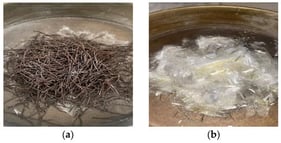
Fiber appearance. (a) SF; and (b) PPF.

The rising environmental concerns over cement-based construction materials have led to the development of sustainable alternatives. Among these, geopolymers represent a promising class of low-carbon binders offering environmental benefits and competitive mechanical properties; however, their intrinsic brittleness limits their tensile and post-cracking performance. This study investigates the adoption of flax fibers as natural reinforcement to enhance ductility and post-peak behavior of metakaolin-based geopolymers. The performance of metakaolin-based geopolymers with flax fibers (MKFLAX) was experimentally evaluated in terms of strength, stiffness, toughness, and failure behavior. The addition of flax fibers enhanced ductility, toughness, and post-peak load-carrying capacity while slightly improving stiffness due to the bridging of cracks and the fiber pull-out mechanism. In comparison with the available literature on sisal, flax, and jute fibers, flax fibers showed improved performance due to the better dispersion within the matrix and higher tensile modulus. These findings highlight that flax fiber-reinforced metakaolin geopolymers show enhanced post-cracking behavior at the laboratory scale and could be of interest for sustainable cementitious materials, subject to further validation at the structural scale. Furthermore, a nonlinear finite element model was adopted based on damage mechanics to simulate the damage localization, stress–strain response and post-peak behavior of geopolymer composites. The numerical results showed a reasonable agreement with the experimental trends, particularly in the elastic and early softening phases. The findings are limited to the studied material system, fiber content, and small-scale samples and should be viewed as trend-level observations rather than generalized performance claims.

14 February 2026

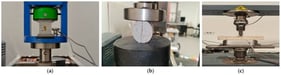
Experimental setup: (a) compression test; (b) splitting test; (c) three-point bending test.

Laser slicing of 4H-SiC wafers offers high efficiency and minimal material loss. While nanosecond lasers are the preferred light source, simultaneously achieving high output power, excellent beam quality (M2 < 1.3), and broad operational tunability remains an outstanding challenge. This study developed a highly efficient nanosecond laser source using hybrid fiber and solid-state multi-stage amplification architecture. With excellent beam quality (M2 < 1.3), it achieves the highest output power, widest continuously tunable pulse width range, and broadest repetition rate range currently reported for 4H-SiC laser slicing. This advancement is poised to advance the continued development of 4H-SiC slicing technology.

14 February 2026

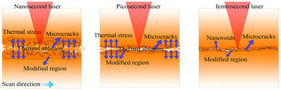
Schematic illustration of the principles of 4H-SiC wafer slicing using nanosecond, picosecond, and femtosecond lasers.

News & Conferences

Issues

Open for Submission

Editor's Choice

Get Alerted

Add your email address to receive forthcoming issues of this journal.

XFacebookLinkedIn
Fibers - ISSN 2079-6439