Skip Content
You are currently on the new version of our website. Access the old version .

Fibers

Fibers is an international, peer-reviewed, open access journal on fiber science, published monthly online by MDPI. 

Quartile Ranking JCR - Q2 (Materials Science, Multidisciplinary)

All Articles (1,042)

Innovative Approach to Textile Pilling Assessment Using Uniform Digital Imaging

  • Juro Živičnjak,
  • Antoneta Tomljenović and
  • Igor Zjakić

During use, the surface of textile fabrics is prone to wear, which can cause changes such as pilling. Pilling (entanglement of fibers) is primarily assessed using the standard visual method EN ISO 12945-4:2020, but it can also be quantitatively measured by instrumental methods with image analysis software. Due to non-uniform digital imaging conditions, such as variations in magnification and analyzed surface area, the assessed area is often inconsistent. As a result, the total percentage of the fabric specimen surface area covered with pills is often omitted. To ensure uniform digital imaging, an innovative apparatus was designed and constructed in this research and applied to woven fabrics made from 100% cotton, wool, viscose, polyamide 6.6, polyester, and acrylic fiber. Pilling in the fabric specimens was induced by rubbing with the Martindale pilling tester (EN ISO 12945-2:2020) using two different abradant materials, through predefined pilling rubs ranging from 125 to 30,000. Pilling assessment was conducted using both the visual method and the improved instrumental method, following established grading classes based on the total percentage of the fabric specimen surface area covered with pills. The research results highlight the importance of uniform digital imaging and digital grading, as these demonstrate the high comparability of pilling grades assigned by the standard visual method while providing better distinction between consecutive grades.

2 February 2026
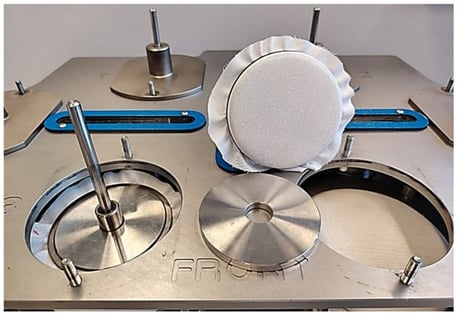
Induction of surface pilling on viscose fabric specimens by rubbing against standard wool abradant fabric using the Martindale pilling tester 2561 E, Mesdan S.p.A., Raffa, Italy.

One of the most critical damage modes affecting the structural performance of traditional composite materials, and therefore their durability, is the occurrence of interlaminar cracks (delamination), which are prone to grow under different loading conditions. In this study, the feasibility of repairing carbon fiber reinforced polymer (CFRP) laminates using structural adhesives was experimentally investigated by evaluating the Mode I interlaminar fracture toughness. Two unidirectional AS4 CFRP systems were analyzed, manufactured with epoxy 8552 and epoxy 3501-6 matrix resins. Mode I delamination behavior was characterized using Double Cantilever Beam (DCB) specimens. Three commercial structural adhesives were used in the repair process: two epoxy-based systems, (Loctite® EA 9460™, manufactured by Henkel adhesives (Düsseldorf, Germany), and Araldite® 2015 manufactured by Huntsman Advanced Materials (The Woodlands, TX, USA) and one low-odor acrylic adhesive, 3M Scotch-Weld® DP8810NS manufactured by 3M Company (St. Paul, MN, USA). Adhesive joints were applied to previously fractured specimens, and the results were compared with those obtained from baseline composite specimens. The results indicate that repaired joints based on the 8552 matrix exhibited higher strain energy release rate (GIc) values, approaching those of the original material. The 3501-6 system showed increased fiber bridging, contributing to higher apparent fracture toughness. Among the adhesives evaluated, the acrylic-based adhesive provided the highest delamination resistance for both composite systems.

2 February 2026

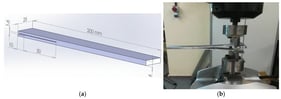
(a) Specimen geometry and dimension; (b) Test with the type of grip used.

In this study, the process of preparing ABS-ZnO (Acrylonitrile Butadiene Styrene-Zinc Oxide) composite materials as FDM printing materials was elaborated, and the influence of printing process parameters on the tensile properties and surface roughness of the materials was analyzed. It was concluded through orthogonal experiments that among all the parameters studied, the infill rate had the most significant effect on the tensile strength, followed by layer thickness and layer width, while the printing speed had the least effect. When the printing parameters were set as follows: infill rate (90%), layer thickness (0.2 mm), layer width (0.4 mm), and printing speed (200 mm/s), the tensile strength of the sample reached the maximum value of 48.37 MPa. Scanning electron microscopy (SEM) analysis revealed that a high infill rate could make the internal structure of the material denser and the bonding between fibers more sufficient. In contrast, with the increase in layer thickness and layer width, the internal structure of the material exhibited a porous morphology, which led to a decrease in tensile properties. By investigating the effects of printing temperature and layer thickness on the surface roughness of the samples, the optimal surface roughness was achieved when the printing temperature was set at 230 °C, and the layer thickness was 0.3 mm.

2 February 2026

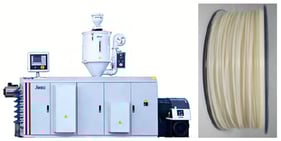
The single-screw extruder and the prepared ABS-ZnO composite material.

Shrinking Chitosan Fibers in Concrete: A Macroscale Durability and Strength Assessment

  • Mohammad A. Abdul Qader,
  • Shannon Hughes and
  • Mandar M. Dewoolkar
  • + 1 author

This study evaluates the mechanical properties and durability of novel self-shrinking chitosan fibers incorporated into a High-Performance Concrete (HPC) matrix. The cementitious system comprised a 75–25% blend of Portland Limestone Cement (PLC) and Ground Glass Pozzolan (GGP). Two variants of chitosan—food-grade and high-grade—were processed into fibers and integrated at dosages of 0.36%, 0.73%, and 1.45% by weight of binder, alongside a 0% control group. The experimental program assessed eight distinct mixtures through extended freeze–thaw testing (up to 602 cycles), electrical resistance monitoring, and compressive strength evaluation at 56 and 90 days. Results indicated that food-grade chitosan fibers caused a substantial reduction in compressive strength, ranging from 40% to 70% depending on the dosage. Despite this mechanical loss, these mixtures showed localized improvements in freeze–thaw resistance and electrical resistivity. Conversely, the high-grade chitosan fibers exhibited severe performance degradation under freeze–thaw cycling; all reinforced groups fell below 80% relative dynamic modulus, with two mixtures dropping below the 60% failure threshold. In comparison, the control mixture retained 98% of its dynamic modulus after 602 cycles. Ultimately, the findings suggest that, in their current formulation, self-shrinking chitosan fibers do not provide consistent or reliable enhancements to the structural integrity or durability of high-performance concrete.

29 January 2026

High-grade chitosan powder (left), and the food-grade chitosan powder (right).

News & Conferences

Issues

Open for Submission

Editor's Choice

Get Alerted

Add your email address to receive forthcoming issues of this journal.

XFacebookLinkedIn
Fibers - ISSN 2079-6439