

- Article

A Dual-Function Air Plasma Process for Enhanced PFOA Defluorination and Waste-Activated Sludge Solubilization via Reactive Nitrogen and Oxygen Species
- Zheng Tang,
- Naixing Kang and
- Yongyuan Yang
- + 1 author
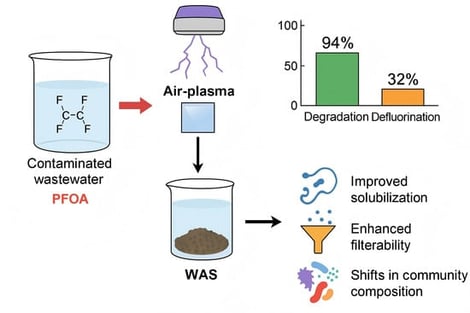
Perfluoroalkyl and polyfluoroalkyl substances (PFASs) have been identified as forever chemicals and pose a serious threat to the environment due to their stable C–F bond. The current methods are ineffective or costly for PFAS remediation. In response, this study develops a dielectric barrier discharge (DBD) air plasma system capable of simultaneously treating perfluorooctanoic acid (PFOA)-contaminated wastewater and enhancing waste-activated sludge (WAS) solubilization through the subsequent use of plasma-activated water (PAW). Air plasma achieved 94% PFOA degradation and 32% defluorination within 40 min—substantially outperforming Ar and N2 plasma—due to the co-generation of hydrated electrons (eaq−), •OH, and reactive nitrogen species (RNS). Scavenging experiments confirmed that eaq− is the primary initiator of C–F bond cleavage, while H2O2 and NO2− synergistically form peroxynitrous acid (ONOOH), further promoting chain-shortening reactions. UPLC-MS identified PFHpA, PFHxA, PFPeA, and PFBA as key intermediates. The air plasma effluent contained high concentrations of NO2−-N and H2O2 under acidic conditions, enabling PAW to induce strong oxidative stress on WAS, resulting in significant extracellular polymeric substance (EPS) release (DOC up to 134 mg/L), improved sludge filterability (capillary suction time (CST) reduced by ~85%), and shifts in microbial community. This study presents a dual-functional air plasma approach that enables both PFAS degradation and sludge treatment, improving the overall competitiveness and applicability of plasma technology for advanced wastewater treatment.
5 February 2026