Skip Content
You are currently on the new version of our website. Access the old version .

Electrochem

Electrochem is an international, peer-reviewed, open access journal on electrochemistry published quarterly online by MDPI.

All Articles (247)

Yttrium-Enhanced Passive Films in Austenitic Stainless Steel

  • Maksym Bichev,
  • Denis Miroshnichenko and
  • Mariia Shved
  • + 6 authors

It has been demonstrated that a monomolecular surface film with semiconducting characteristics forms on an austenitic, corrosion- and heat-resistant chromium–nickel steel with 0.10 wt.% C, 20 wt.% Cr, 9 wt.% Ni, and 6 wt.% Mn (10Kh20N9G6), microalloyed with yttrium, in aqueous 1 M H2SO4. This passive layer exhibits semiconducting behavior, as confirmed by electrochemical impedance and capacitance measurements. For the first time, key electronic parameters, including the flat-band potential, the thickness of the semiconductor layer, and the Fermi energy, have been determined from experimental Mott–Schottky plots obtained for the interphase boundary between the yttrium-microalloyed austenitic Cr–Ni steel (10Kh20N9G6) and aqueous 1 M H2SO4. The results reveal a systematic shift in the flat-band potential toward more negative values with increasing yttrium content in the alloy, indicating a modification of the electronic structure of the passive film. Simultaneously, a decrease in the Fermi energy is observed, suggesting an increase in the work function of the metal surface due to the presence of yttrium. These findings contribute to a deeper understanding of passivation mechanisms in yttrium-containing stainless steels. The formation of a semiconducting passive film is essential for enhancing the electrochemical stability of stainless steels, and the role of rare-earth microalloying elements, such as yttrium, in this process is of both fundamental and practical interest.

16 January 2026
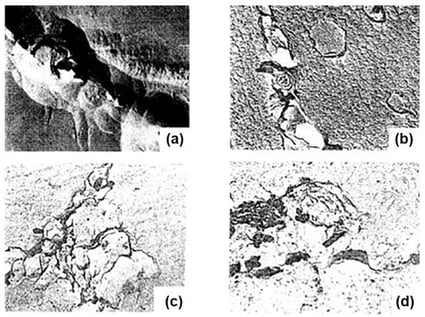
Microstructure of the investigated austenitic Cr–Ni steel × 10,000 (obtained by weld surfacing with electrodes containing REEs in the coating, grain boundaries): (a) without REEs; (b) 1%; (c) 2%; (d) 1%CeO2.

Ageing and Water Detection in Hydroscopic Organic Electrolytes

  • Eva Alonso-Muñoz,
  • Janwa El Maiss and
  • César Pascual García
  • + 4 authors

Electrolyte degradation and trace water contamination critically affect the lifetime and safety of lithium-ion batteries. In organic-based electrolytes such as acetonitrile (MeCN), even small amounts of water can trigger PF6 hydrolysis, producing HF, POF3, and related species that contribute to electrolyte ageing and alter interfacial reactions. This study explores the electrochemical signatures of ageing and moisture contamination in Bu4NPF6- and LiPF6-based MeCN electrolytes through a systematic cyclic voltammetry protocol. Platinum electrodes with different surface morphologies—flat, Nafion-coated, and nanostructured—were compared to assess their sensitivity to water-induced degradation. Cathodic Faradaic currents appearing around −0.7 to −1.0 V vs. Ag/AgCl were attributed to the protonic species generated by PF6-induced hydrolysis. The presence of LiPF6, commonly used in battery electrolytes, further increases the concentration of anions responsible for the protonic species, therefore contributing to the acceleration of the electrolyte degradation. Experiments using a Nafion proton-conductive membrane assess the protonic origin of these peaks. Meanwhile, nanostructured platinum exhibits approximately four times higher current responses and enhanced sensitivity to water additions, reflecting the influence of surface roughness and active area. Overall, the findings indicate that electrode morphology significantly influences the detectability of ageing- and water-driven reactions, supporting the potential of nanostructured Pt as a diagnostic material for in situ monitoring.

16 January 2026

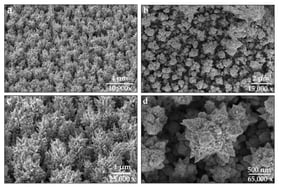
Focused Ion Beam–Scanning Electron Microscopy (FIB-SEM) images of the platinum nanoflower (PtNF) electrodes at different magnifications. Images (a,c) were acquired at 52° tilt and (b,d) at 0° tilt, showing nanostructure morphology.

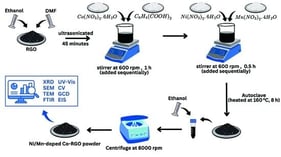
In this study, Ni/Mn-doped cobalt–reduced graphene oxide (Co-RGO) composites were successfully synthesized as advanced electrode materials for supercapacitors. The structural and morphological properties of the composites were characterized using FTIR, XRD, SEM, TEM, and UV–Vis spectroscopy. Their electrochemical performance was evaluated through electrochemical impedance spectroscopy (EIS), cyclic voltammetry (CV), and galvanostatic charge–discharge (GCD). Among the prepared samples, Co-RGO doped with Ni/Mn at a 40:10 ratio exhibited the most outstanding capacitive behavior, achieving a specific capacitance of 7414 F g−1 at a current density of 10 A g−1, along with a high energy density of 565 Wh kg−1 and a power density of 4998 W kg−1. The high capacitance arises from faradaic pseudocapacitive reactions rather than electric double-layer capacitance, eliminating the need for a large surface area. These results confirm that Ni doping significantly enhances pseudocapacitance and conductivity in the Co-RGO matrix, making Ni/Mn (40:10)–Co-RGO a potential material for advanced energy storage systems.

24 December 2025

FTIR analysis of (a) graphite, GO, RGO, and Co-RGO, and (b) Ni/Mn-doped Co-RGO with different Ni/Mn ratios.

Accurate modeling of proton exchange membrane fuel cells (PEMFCs) is essential for predicting system performance under diverse operating conditions. This study introduces a refined semi-empirical modeling that combines experimental validation with an enhanced parameter estimation method based on the Cloud Drift Optimization (CDO) algorithm. The approach focuses on identifying seven key parameters of the nonlinear PEMFC model by minimizing the difference between experimentally measured and simulated cell voltages. To assess its effectiveness, the proposed CDO-based estimator was compared with several established metaheuristic algorithms, including the particle swarm optimizer and the tetragonula carbonaria optimization algorithm. The evaluation was performed using three commercial PEMFC stacks rated at 250 W, 500 W, and the NedStack PS6, as well as experimental data obtained from the Renewable Energy Laboratory at A’Sharqiyah University. Results demonstrate that the CDO algorithm consistently produced the lowest sum of squared errors (SSE) of 1.0337 and exhibited stable convergence across multiple independent runs with a standard deviation of 1.2114 × 10⁻⁷. Its reliable performance under both normal and degraded conditions confirms the algorithm’s robustness and adaptability, establishing CDO as an efficient and dependable technique for PEMFC modeling and parameter identification.

17 December 2025

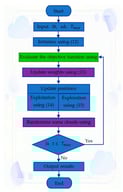
Flowchart of the CDO algorithm.

News & Conferences

Issues

Open for Submission

Editor's Choice

Reprints of Collections

Electrochemical Energy Storage Materials
Reprint

Electrochemical Energy Storage Materials

Editors: Huang Zhang, Yuan Ma
Electromaterials for Environment & Energy Volume II
Reprint

Electromaterials for Environment & Energy Volume II

Editors: Marc Cretin, Sophie Tingry, Zhenghua Tang

Get Alerted

Add your email address to receive forthcoming issues of this journal.

XFacebookLinkedIn
Electrochem - ISSN 2673-3293