Skip to Content
You are currently on the new version of our website. Access the old version .

Electricity

Electricity is an international, peer-reviewed, open access journal on electrical engineering published quarterly online by MDPI.

All Articles (234)

Currently, the smart grid concept represents the modern vision of an automated and highly adaptable electrical grid. Supervisory control and data acquisition (SCADA) systems are a fundamental component of a smart grid, enabling communication between field equipment and digital environments. For this purpose, they require industrial frameworks, among which IEC 61850 stands out. IEC 61850 has become a widely adopted standard for substation automation systems (SASs). However, despite its widespread adoption, IEC 61850 faces significant implementation challenges, including the potential complexity of data modeling, which often leads to discrepancies in semantic interpretation and, consequently, different readings among SAS configuration users. A disparity in the semantic interpretation of a process can negatively affect SAS operation, leading to execution errors or interoperability issues. Translating and analyzing SAS configurations can identify and resolve semantic interpretation discrepancies across these systems. The purpose of this research was to determine the degree to which a user interface was perceived as useful to support the translation and analysis of SAS configurations based on the IEC 61850 standard. To this end, a software tool was proposed as the central artifact to address the socio-technical dimension of a custom-built SCADA system at a Latin American state enterprise. The tool serves as the local, intelligent, and real-time operational layer in that system and was rated by users experienced with IEC 61850 as highly usable. The consistently obtained results suggest potential support for those performing the SAS configuration.

10 February 2026
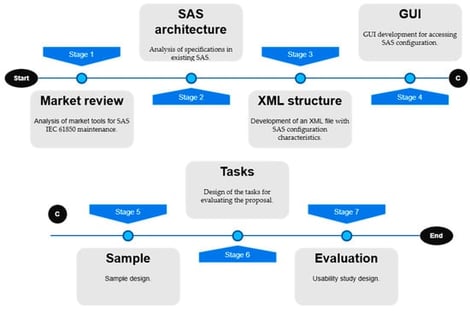
The study method.

Edge Computing Architecture for Optimal Settings of Inverse Time Overcurrent Relays in Mesh Microgrids

  • Gustavo Arteaga,
  • John E. Candelo-Becerra and
  • Fredy E. Hoyos
  • + 2 authors

This paper presents a novel edge-computing-based architecture for optimal inverse time overcurrent relays installed to protect mesh microgrids (MGs) with distributed generation. The procedure employs graph theory to automate the detection of network changes, fault locations, and relay pairs in an MG. In addition, an automated process obtains the initial protection settings based on the operating conditions of the MG. Furthermore, the Continuous Genetic Algorithm (CGA), Salp Swarm Algorithm (SSA), and Particle Swarm Optimization (PSO) were implemented to determine the optimal protection settings to obtain better coordination between primary and backup protection relays. These processes were implemented using PowerFactory 2024 Service Pack 5A and Python 3.13.1. The proposal was validated in 68 operating scenarios that considered the islanded and connected operation modes of the MG, charging and discharging cycles of electric vehicle stations, and the presence or absence of photovoltaic generation. The overcurrent protection relays were organized into 100 primary–backup relay pairs to ensure proper coordination and selectivity. The total miscoordination time (TMT) index was used to measure when all pairs of relays were coordinated, with a minimum time close to zero. The results of the graph theory show that all the meshes, fault locations, and relay pairs were identified in the MG. The approach successfully coordinated 100 relay pairs across 68 scenarios, demonstrating its scalability in complex real-world MGs. The automation process obtained an average TMT of 12.2%, while the optimization obtained a TMS of 91.6% with the CGA, and a TMT of 99% was obtained with the SSA and PSO, demonstrating the effectiveness of the optimization process in ensuring selectivity and appropriate fault clearing times.

9 February 2026

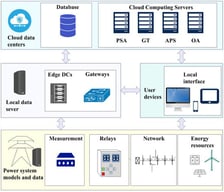
Architecture used to obtain the optimal overcurrent protection settings.

Investigation of Transients Generated by Dry-Contact Switching of LED Lamps

  • Alisson L. Agusti,
  • Giane G. Lenzi and
  • Angelo M. Tusset
  • + 1 author

LED lamps have not been demonstrating the durability claimed by their manufacturers. One hypothesis is that switching transients may contribute to this. This study investigated switching-induced transients in LED lamps operated through dry contacts: manual switches and contactors. Using an oscilloscope, automated acquisition of waveform records was performed while several lamps were switched on in a 220 VRMS/60 Hz electrical network. LED lamps of different models and manufacturers, one incandescent lamp, and a group of 48 LED lamps, subdivided into six sets of eight lamps, were all switched simultaneously. A total of 56 waveform-record files were obtained from the oscilloscope, comprising 2920 captured screens and 170 measurements. Transient voltage peaks of 380 and 391 V at the supply side, and 357 and 370 V at the lamp side, as well as voltage slew rates of up to 12 and 13 V/µs at the supply side and up to 16 and 19.5 V/µs at the lamp side, were measured, without considering statistical variations, which may indicate values exceeding the ordinary sinusoidal voltage peak (≅311 V) and its typical worst-case slew rate (≅0.12 V/µs). Future studies are suggested, such as tests in real installations, investigations of transient amplification or attenuation within electrical networks, assessment of the effects of wiring and impedance discontinuities, switch bounce, and semiconductor degradation, among others, to continue these studies.

3 February 2026

Oscilloscope DSOX2014A.

Enhanced Optimization-Based PV Hosting Capacity Method for Improved Planning of Real Distribution Networks

  • Jairo Blanco-Solano,
  • Diego José Chacón Molina and
  • Diana Liseth Chaustre Cárdenas

This paper presents an optimization-based method to support distribution system operators (DSOs) in planning large-scale photovoltaic (PV) integration at the medium-voltage (MV) level. The PV hosting capacity (PV-HC) problem is formulated as a mixed-integer quadratically constrained program (MIQCP) without linearizing approximations to determine PV sizes and locations while enforcing operating limits and planning constraints, including candidate PV locations, per-unit PV capacity limits, active power exchange with the upstream grid, and PV power factor. Our method defines two HC solution classes: (i) sparse solutions, which allocate the PV capacity to a limited subset of candidate nodes, and (ii) non-sparse solutions, which are derived from locational hosting capacity (LHC) computations at all candidate nodes, and are then aggregated into conservative zonal HC values. The approach is implemented in a Hosting Capacity–Distribution Planning Tool (HC-DPT) composed of a Python–AMPL optimization environment and a Python–OpenDSS probabilistic evaluation environment. The worst-case operating conditions are obtained from probabilistic models of demand and solar irradiance, and Monte Carlo simulations quantify the performance under uncertainty over a representative daily window. To support integrated assessment, the index Gexp is introduced to jointly evaluate exported energy and changes in local distribution losses, enabling a system-level interpretation beyond loss variations alone. A strategy was also proposed to derive worst-case scenarios from zonal HC solutions to bound performance metrics across multiple PV integration schemes. Results from a real MV case study show that PV location policies, export constraints, and zonal HC definitions drive differences in losses, exported energy, and solution quality while maintaining computation times compatible with DSO planning workflows.

2 February 2026

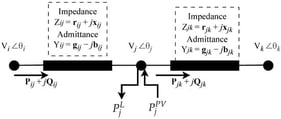
Distribution line model.

News & Conferences

Issues

Open for Submission

Editor's Choice

Reprints of Collections

Optimal Operation and Planning of Smart Power Distribution Networks
Reprint

Optimal Operation and Planning of Smart Power Distribution Networks

Volume I
Editors: Pavlos S. Georgilakis
Power System Dynamics and Stability
Reprint

Power System Dynamics and Stability

Editors: Da Xie, Yanchi Zhang, Dongdong Li, Chenghong Gu, Ignacio Hernando-Gil, Nan Zhao

Get Alerted

Add your email address to receive forthcoming issues of this journal.

XFacebookLinkedIn
Electricity - ISSN 2673-4826