- Article

The Impact of Pet Videos on Emotional Face Processing
- Xingyu Zhu,
- Xiaojing Shi and
- Jingyuan Lin
- + 3 authors
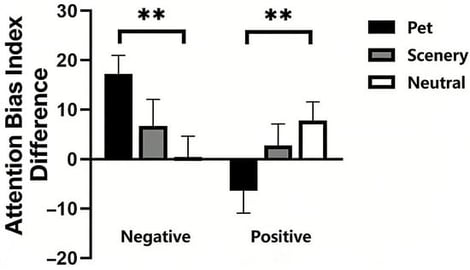
In recent years, the number of people viewing pet videos and images online has risen. Although numerous studies have shown that owning pets positively impacts human mental health, the potential mental health benefits of prolonged exposure to pet media content remain debated. This study conducted three experiments to investigate how viewing pet videos affects human emotional face processing and to clarify the associated emotional regulatory mechanisms. Experiment 1 examined how viewing pet videos influences attentional bias toward emotional faces. Experiment 2 assessed the impact of watching pet videos on the valence perception of emotional faces. Experiment 3 analyzed how exposure to pet videos affects the valence perception of emotional text. The results showed that watching pet videos increased attentional bias toward subsequent positive emotional faces and decreased bias toward negative ones. This effect resulted from higher perceived valence ratings for both positive and neutral emotional faces. Importantly, this effect was only observed in facial stimuli with social attributes. These findings indicate that watching pet videos modulates emotional processing, and prolonged exposure to pet media content may affect mental health through this mechanism.
9 February 2026