Skip Content
You are currently on the new version of our website. Access the old version .

Diversity

Diversity is a peer-reviewed, open access journal on the science of biodiversity (from molecules, genes, populations, and species to ecosystems), and is published monthly online by MDPI.

Quartile Ranking JCR - Q2 (Biodiversity Conservation)

All Articles (6,002)

The obligate symbiosis between aphids and their primary bacterial symbionts (Buchnera) is ecologically and evolutionarily significant, yet the genetic patterns underlying these associations require further clarification. This study investigated the coevolutionary relationships of two aphid species, Cinara formosana and Tuberolachnus salignus, with their Buchnera symbionts using COI (mitochondrial cytochrome c oxidase subunit I) and bacterial 16S rRNA (16S ribosomal RNA) markers revealed substantial genetic divergence between the two aphid species, with interspecific genetic distances ranging from 0.131 to 0.138. In contrast, populations of T. salignus from different regions showed minimal intraspecific variation (genetic distance 0.006). Phylogenetic analyses confirmed that populations of each aphid species formed distinct, monophyletic clusters. Crucially, the phylogenetic relationships inferred from the aphid COI gene were fully congruent with those derived from the Buchnera 16S rRNA gene sequences. This concordance further supports the application of the COI gene as a reliable marker for species identification within the studied Lachninae aphids. Our findings provide novel insights into the coupled genetic divergence and coevolution of aphids and their obligate symbionts, offering a molecular framework for the precise identification and population monitoring of these aphids, which can inform sustainable management strategies.

7 February 2026
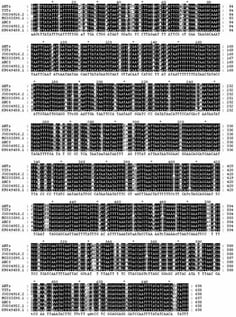
Multiple Sequence Alignment of COI (cytochrome c oxidase subunit I) Gene in Aphididae (* in the figure denote fully conserved positions; Colors: Black denotes fully conserved nucleotide sites, gray denotes partially conserved nucleotide sites, and white denotes variable nucleotide sites in the alignment).

Haloxylon ammodendron plantations constitute a dominant vegetation component of the desert–oasis ecotone in the arid and semi-arid regions of northwest China, playing a critical role in maintaining oasis stability and ecological security. However, the effects of converting natural desert ecosystems into plantations on the soil food webs of arthropods remain poorly understood, particularly with respect to how these effects vary across plantation age. To address this knowledge gap, we conducted a field investigation in the desert–oasis ecotone of the middle reaches of the Hexi Corridor, Gansu Province. Using pitfall trapping, we sampled two key arthropod taxa (arachnids and soil mesofauna) from control areas (natural deserts) and H. ammodendron plantations representing different ages (young and old). The results indicated that both young and old plantations were associated with significantly higher abundance and richness of arachnids, soil mesofauna, mites, and springtails compared with natural deserts, with springtail richness exhibiting a further significant increase in old plantations. Arachnid responses to plantation conversion were strongly structured by body size. Medium arachnid abundance increased in both young and old plantations, whereas large arachnid abundance increased only in young plantations and declined in older ones. In contrast, small arachnid abundance exhibited significant increases exclusively in old plantations. In addition, relationships between arachnid, mite and springtail abundance varied with plantation age: the ratio of large arachnids to mites and springtails declined significantly in old plantations relative to young ones, while the corresponding ratio for small arachnids showed an opposite pattern. Variations in soil mesofauna community composition were primarily explained by shrub cover, herbaceous cover, coarse sand proportion, silt-clay content, and soil soluble salt, which together accounted for 48.9% of observed variation. For arachnids, soil mesofauna as a food resource significantly enhanced abundance and richness. Moreover, shrub cover and silt-clay content were also drivers of arachnid community variation, jointly explaining 6.7% of variance. Overall, the establishment of H. ammodendron plantations promoted the diversity of both arachnids and soil mesofauna, but their relationships shifted dynamically with plantation age, leading to a reorganization of detrital food web structure and functioning.

6 February 2026

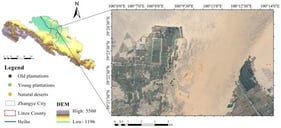
Location of the study sites.

Wetlands play essential roles in sustaining biodiversity, maintaining hydrological stability, and regulating the climate. Subalpine wetlands are particularly rare in Northeast China, yet their floristic composition and diversity patterns remain poorly studied. To fill this knowledge gap and address the lack of baseline plant data for this region, this study conducted systematic field surveys in the subalpine wetlands of Fenghuangshan, Heilongjiang Province, with the aim of assessing plant diversity, dominant floristic types, and community differentiation. The result showed a total of 100 vascular plant species were recorded, belonging to 38 families and 69 genera. Four nationally protected Class II species were also identified, underscoring the region’s conservation importance. Across the three representative plant associations, the Carex limosa-Carex lasiocarpa association exhibited markedly higher species richness, Simpson diversity, and Shannon diversity than both the Salix sericeo-cinerea and Pinus pumila-Rhododendron aureum associations, reflecting pronounced community-level variation in biodiversity. The floristic characteristics at the species level also pointed to a predominantly temperate distribution and showed a pronounced vascular plant flora, which is characterized by the ecotone between temperate and boreal biogeographical zones, directly underpinning the different composition of the communities. This study presents a detailed baseline assessment of plant diversity and floristic composition in the Fenghuangshan subalpine wetland ecosystem. In response to the limited understanding of such ecosystems in East Asia, this research provides crucial foundational data. Furthermore, by contextualizing these results with ecological patterns observed in Northern European wetlands, the study places the local findings into a broader, global perspective. The results offer essential scientific support for biodiversity monitoring, ecological conservation planning, and the future restoration of subalpine wetlands in Northeast China.

6 February 2026

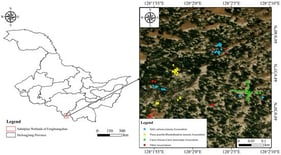
Location of the study area and distribution of sampling plots representing different plant associations in the subalpine wetlands of Fenghuangshan, Heilongjiang Province.

Tallgrass prairie ecosystems in North America sustain globally important plant and animal biodiversity while providing ecosystem services, including biomass production, forage for livestock, and carbon sequestration. Land use change has left less than 1% of North American prairies intact, and opportunities are needed for their restoration. There has been increasing interest in the establishment of prairies on degraded former minelands, where significant challenges exist in reestablishing historic vegetation communities. We examined how the productivity and diversity of mineland prairies were influenced by varying restoration treatments that had been applied nearly a decade previously. We utilized an existing prairie research plot network established using seed mixes containing from one to seven different species and differing fertilization and tillage treatments. We calibrated a non-destructive method to assess prairie biomass and used it to assess the productivity and diversity across 312 research plots. The results showed that, with the exception of C4 grasses, few originally seeded species were present. Significant differences in species richness existed as a function of the interacting effects of seed mix type and fertilization treatment. Unfertilized plots generally had a higher species richness, particularly where larger numbers of species were included in the mixes. Prairie biomass was significantly greater in seed mixes containing big bluestem (Andropogon gerardii) and was also significantly related to Shannon diversity. Our results suggest that the establishment of (Andropogon gerardii) is fundamental to maximizing the diversity and productivity of mineland prairies, especially in the absence of follow-up management. The results also suggest that caution should be exercised when considering the use of fertilizer, as this may reduce the diversity of native species by favoring competitive non-native species such as some C3 grasses.

6 February 2026

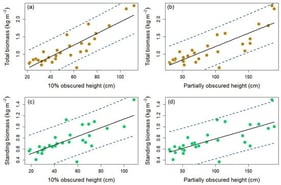
(a–d) Relationship between total or standing biomass and selected structural indices recorded by the FuelRule and calculated in Pobscured. Standing biomass excludes layers of litter or thatch lying on the soil surface but does include all standing live and dead foliage. The predicted relationship is shown as a solid line, while dashed lines are 95% prediction intervals. Regression equations are presented in Table 2.

News & Conferences

Issues

Open for Submission

Editor's Choice

Reprints of Collections

Plant Invasion
Reprint

Plant Invasion

Editors: Bruce Osborne, Panayiotis G. Dimitrakopoulos

Get Alerted

Add your email address to receive forthcoming issues of this journal.

XFacebookLinkedIn
Diversity - ISSN 1424-2818