Skip Content
You are currently on the new version of our website. Access the old version .

Digital

Digital is an international, peer-reviewed, open access journal on digital technologies and digital application, particularly with how such technologies affect our health, education and economy, published quarterly online by MDPI.

All Articles (192)

An Efficient and Automated Smart Healthcare System Using Genetic Algorithm and Two-Level Filtering Scheme

  • Geetanjali Rathee,
  • Hemraj Saini and
  • Mohamed Chahine Ghanem
  • + 2 authors

This paper proposes an efficient and automated smart healthcare communication framework that integrates a two-level filtering scheme with a multi-objective Genetic Algorithm (GA) to enhance the reliability, timeliness, and energy efficiency of Internet of Medical Things (IoMT) systems. In the first stage, physiological signals collected from heterogeneous sensors (e.g., blood pressure, glucose level, ECG, patient movement, and ambient temperature) were pre-processed using an adaptive least-mean-square (LMS) filter to suppress noise and motion artifacts, thereby improving signal quality prior to analysis. In the second stage, a GA-based optimization engine selects optimal routing paths and transmission parameters by jointly considering end-to-end delay, Signal-to-Noise Ratio (SNR), energy consumption, and packet loss ratio (PLR). The two-level filtering strategy, i.e., LMS, ensures that only denoised and high-priority records are forwarded for more processing, enabling timely delivery for supporting the downstream clinical network by optimizing the communication. The proposed mechanism is evaluated via extensive simulations involving 30–100 devices and multiple generations and is benchmarked against two existing smart healthcare schemes. The results demonstrate that the integrated GA and filtering approach significantly reduces end-to-end delay by 10%, as well as communication latency and energy consumption, while improving the packet delivery ratio by approximately 15%, as well as throughput, SNR, and overall Quality of Service (QoS) by up to 98%. These findings indicate that the proposed framework provides a scalable and intelligent communication backbone for early disease detection, continuous monitoring, and timely intervention in smart healthcare environments.

28 January 2026
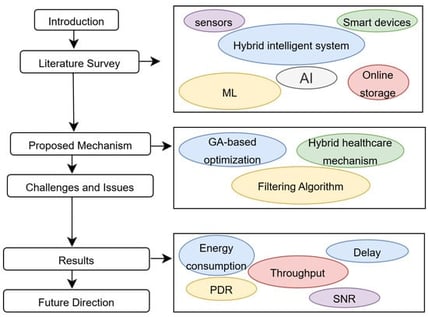
General flow of the proposed framework.
  • Correction
  • Open Access

The authors would like to make the following corrections to the published paper [...]

28 January 2026

This paper investigates the use of large language models (LLMs) as evaluators in multidimensional machine translation (MT) assessment, focusing on the English–Indonesian language pair. Building on established evaluation frameworks, we adopt an MQM-aligned rubric that assesses translation quality along morphosyntactic, semantic, and pragmatic dimensions. Three LLM-based translation systems (Qwen 3 (0.6B), LLaMA 3.2 (3B), and Gemma 3 (1B)) are evaluated using both expert human judgments and an LLM-based evaluator (GPT–5), allowing for a detailed comparison of alignment, bias, and consistency between human and AI-based assessments. In addition, a classroom calibration study is conducted to examine how rubric-guided evaluation supports alignment among novice evaluators. The results indicate that GPT–5 exhibits strong agreement with human evaluators in terms of relative quality ranking, while systematic differences in absolute scoring highlight calibration challenges. Overall, this study provides insights into the role of LLMs as reference-free evaluators for MT and illustrates how multidimensional rubrics can support both research-oriented evaluation and pedagogical applications in a mid-resource language setting.

22 January 2026

This article presents a comprehensive bibliometric analysis of the indexed academic literature on the application of distributed ledger technology (DLT) and blockchain in the tourism industry. Using the bibliometrix library within the RStudio environment, key bibliometric indicators were examined in order to characterize the evolution, structure, and thematic focus of this emerging field of research. The systematic literature review, which adhered to PRISMA guidelines, involved retrieving publications from the Web of Science and Scopus databases. A curated dataset of 100 relevant documents was identified and analyzed in terms of annual scientific production, leading journals, influential authors, and highly cited publications. The results indicate that blockchain technology dominates the literature, with a strong emphasis on its potential to enhance trust, transparency, and efficiency in tourism-related processes. In particular, identity management, secure transactions, and disintermediation emerge as central research themes, reflecting blockchain’s capacity to support decentralized, immutable, and privacy-preserving interactions between tourists and service providers. Overall, the findings reveal a rapidly growing and increasingly structured body of knowledge, highlighting emerging research directions and technological challenges for future studies on DLT applications in tourism.

19 January 2026

News & Conferences

Issues

Open for Submission

Editor's Choice

Get Alerted

Add your email address to receive forthcoming issues of this journal.

XFacebookLinkedIn
Digital - ISSN 2673-6470