Skip to Content

Dairy

Dairy is an international, peer-reviewed, open access journal on dairy science published bimonthly online by MDPI.

Quartile Ranking JCR - Q1 (Agriculture, Dairy and Animal Science)

All Articles (339)

This cross-sectional study investigated the associations between the acute-phase proteins (APP) serum amyloid A (SAA) and haptoglobin (Hp), herd-level factors, and the seroprevalence of respiratory pathogens in Estonian dairy herds. Serum samples were analysed from 938 cows (95 herds) and 921 heifers (94 herds). Seroprevalence was tested for bovine herpesvirus 1 (BHV-1), bovine respiratory syncytial virus (BRSV), bovine parainfluenza virus 3, bovine viral diarrhoea virus, bovine coronavirus, bovine adenovirus, and Mycoplasma bovis (M. bovis). Farm visits included questionnaires on herd management practices. Linear random-intercept regression models showed higher serum SAA concentrations in cows from farms with BHV-1 seroprevalence of >50% and on BRSV-positive farms (p < 0.05), while farms employing a veterinarian had lower serum SAA concentrations. Cows had higher serum Hp concentrations in M. bovis-positive herds (p = 0.030). In heifers, serum SAA concentrations increased with low to moderate BHV-1 seroprevalence, decreased with higher M. bovis seroprevalence, and were higher in free-stall or mixed housing compared to tie-stall housing. Heifers’ serum Hp concentrations were lower in BHV-1-positive herds, but higher in herds with breeding bulls and larger herd sizes. To conclude, APP may reflect the herd health status and management-related effects on animals, supporting their use in herd-level monitoring.

19 February 2026
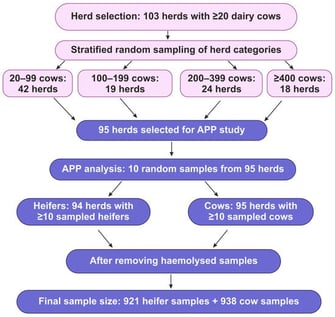
Flowchart showing the study herd selection principles and study sample selection for acute-phase proteins analysis.

The transition from energy sufficiency to deficiency triggers complex metabolic and immune adaptations that have traditionally been viewed through a reductionist pathological lens. During early lactation, coordinated mobilization of adipose tissue, muscle protein, and bone minerals supports milk synthesis, with ketogenesis specifically arising from hepatic oxidation of non–esterified fatty acids. This review introduces the Keto–Inflammatory Network (KIN), a novel framework positioning ketonemia as an evolutionarily conserved adaptive response rather than inherent metabolic dysfunction. The KIN integrates β–hydroxybutyrate (BHB) signaling with immune modulation, epigenetic regulation, circadian rhythms, and microbiota interactions. Through mechanisms including NLRP3 inflammasome inhibition, HDAC–mediated epigenetic modifications, and HCAR2 receptor activation, ketone bodies orchestrate anti–inflammatory responses while maintaining metabolic flexibility. Building upon important precedent work recognizing beneficial roles of ketones in ruminant metabolism, this review synthesizes recent advances in immunometabolism and systems biology into an integrated framework. The KIN encompasses calcium–ketone integration through the Calci–Keto–Inflammatory Code (CKIC), temporal regulation via the Ketoinflammatory Clock, and trans–kingdom signaling through microbiota interactions. In dairy cattle, this perspective reframes periparturient ketonemia as existing on a continuum from adaptive to pathological, with biological meaning determined by integrated metabolic–inflammatory patterns rather than absolute ketone concentrations. The CKIC paradigm, while requiring prospective validation, suggests novel therapeutic approaches leveraging ketone signaling for inflammatory diseases, autoimmune conditions, and metabolic disorders while challenging traditional threshold–based ketosis management strategies. This systems–level understanding opens new avenues for precision interventions that work with, rather than against, evolved adaptive mechanisms refined through millions of years of mammalian evolution. By distinguishing ketonemia (measurable ketone elevation) from pathological ketosis (dysregulated ketone accumulation), and by integrating evidence from both ruminant and monogastric models, this review provides a comprehensive framework for next–generation metabolic medicine.

16 February 2026

Antimicrobial Resistance in Enterococci of Dairy Origin—A Review

  • Tijana Ledina,
  • Matija Munjić and
  • Jasna Lončina
  • + 2 authors

Enterococci are ubiquitous lactic acid bacteria frequently detected in dairy environments, where they represent an important component of the non-starter lactic acid bacteria community, particularly in artisanal cheeses produced from raw milk. Due to their metabolic versatility, enterococci may contribute to cheese ripening and the development of characteristic sensory attributes; however, their technological relevance is accompanied by growing concern regarding their role as opportunistic pathogens and reservoirs of antimicrobial resistance. This review critically summarizes current knowledge on antimicrobial resistance in enterococci isolated from milk and dairy products, with emphasis on both intrinsic and acquired resistance traits and their reported prevalence across different dairy matrices and geographical regions. Particular attention is given to artisanal cheeses, in which heterogeneous and region-specific resistance patterns have been described. Advances in whole-genome sequencing have substantially improved understanding of the genetic basis of antimicrobial resistance in dairy enterococci and have largely corroborated earlier findings obtained through phenotypic antimicrobial susceptibility testing combined with targeted resistance gene detection. Nevertheless, available data remain fragmented due to variability in study design, analytical approaches, and reporting practices. Overall, the evidence highlights the need for harmonized surveillance strategies integrating phenotypic and genomic data within a One Health framework to improve risk assessment and to better understand the role of dairy enterococci in the dissemination of antimicrobial resistance along the food chain.

14 February 2026

Differential Average Daily Gain of Pregnant Holstein × Gyr Heifers: Effects on Future Milk Production

  • Antônio Paulo de Oliveira Neto,
  • Tássia Barrera de Paula e Silva and
  • Polyana Pizzi Rotta
  • + 5 authors

This study examined the effects of average daily gain (ADG) during gestation on growth, nutrient digestibility, metabolic response, and subsequent milk yield and composition in dairy heifers. Twenty pregnant Holstein × Gyr heifers (450 ± 5.0 kg; 18 ± 1.1 months) were randomly assigned to moderate (MOD; target 0.35 kg/day) or high (HIG; target 0.70 kg/day) ADG groups, and received a total mixed ration from day 70 of gestation until calving. Body growth, blood metabolites, and lactation performance after birth were measured. At calving, HIG heifers had greater body weight (p < 0.01) and thoracic perimeter (p = 0.02). Nutrient digestibility and most blood metabolites were not affected by ADG (p > 0.05), except for triiodothyronine concentrations, which differed between treatments over time (p < 0.01). Milk yield and energy-corrected milk were not affected by gestational ADG (p > 0.10), while milk fat and total solids showed numerical treatment × week interactions (p ≤ 0.10). These results indicate that higher ADG during gestation increases body reserves at calving but does not affect milk yield. The moderate ADG for Holstein × Gyr heifers during gestation may improve milk quality through higher fat and solids content, emphasizing the importance of tailoring growth strategies for heifers during gestation.

10 February 2026

News & Conferences

Issues

Open for Submission

Editor's Choice

Get Alerted

Add your email address to receive forthcoming issues of this journal.

XFacebookLinkedIn
Dairy - ISSN 2624-862X