Skip to Content
You are currently on the new version of our website. Access the old version .

Current Oncology

Current Oncology is an international, peer-reviewed, open access journal that since 1994 represents a multidisciplinary medium for clinical oncologists to report and review progress in the management of this disease, and published monthly online by MDPI (from Volume 28, Issue 1 - 2021). 
The Canadian Association of Medical Oncologists (CAMO), Canadian Association of Psychosocial Oncology (CAPO), Canadian Association of General Practitioners in Oncology (CAGPO), Cell Therapy Transplant Canada (CTTC) and others are affiliated with Current Oncology and their members receive discounts on the article processing charges.
Indexed in PubMed | Quartile Ranking JCR - Q2 (Oncology)

All Articles (5,267)

  • Case Report
  • Open Access

A Perplexing Plexopathy After Pembrolizumab Therapy in Early-Stage Triple-Negative Breast Cancer

  • Toluwalogo Baiyewun,
  • Brian McNamara and
  • Seamus O’Reilly
  • + 6 authors

Background: In triple-negative breast cancer (TNBC), the addition of immunotherapy has significantly improved outcomes. Immune-related adverse events (irAEs) can be accelerated in patients with pre-existing autoimmune (AI) conditions. The treatment-response standardized protocol used in clinical care raises concerns about the need for right-sizing strategies. As the use of immunotherapy expands, recognizing toxicity from recurrence and optimizing response-adapted approaches are essential to balance cure with quality of survival. Case Presentation: A 38-year-old pregnant woman with a distant history of uveitis and psoriasis was discovered to have pregnancy-associated TNBC. Postnatally, she was treated with neoadjuvant chemotherapy and pembrolizumab, followed by wire-guided left breast wide local excision and sentinel lymph node biopsy of the left axilla. After surgery, residual cancer was noted. She continued adjuvant pembrolizumab and adjuvant radiotherapy 40.05 Gy/15 fr to the breast and nodes, followed by a 13.35 Gy/5 fr boost to the tumour bed (breast). Despite a persistent residual tumour, pembrolizumab was continued as per protocol in a response-agnostic manner. At the end of one year of adjuvant pembrolizumab, she developed progressive numbness and weakness in the ipsilateral arm, initially raising suspicion for local recurrence. Comprehensive MRI and PET-CT imaging did not identify recurrent tumour or new metastatic disease. Electromyography confirmed a lower-trunk brachial plexopathy without a structural cause. An immune-mediated process was diagnosed by a process of elimination. Despite treatment with 1st-line high-dose corticosteroids and 2nd-line intravenous immunoglobulin (IVIG), improvement was limited. Therapeutic plasmapheresis led to marked functional recovery and symptom resolution 20 months later. Discussion: Four main challenges are identified: (1) the diagnostic difficulty in identifying local recurrence or radiation injury from immune-related neuropathy; (2) the emerging therapeutic role of plasmapheresis in steroid-refractory irAEs; (3) the possible inconsistencies between rare toxicities observed in clinical trials vs. clinical practice; and (4) the limitations in response in adjuvant therapy, particularly in patients with coexisting AI conditions. Conclusions: Early recognition and accurate distinction from tumour recurrence, as well as support for plasmapheresis as a potential option in steroid-refractory presentations, have been shown to improve patient survival and symptom reduction. With increasing use of immunotherapy, real-world toxicity data, predictive biomarkers, and personalized treatment strategies are urgently needed to balance cure with long-term functional outcomes.

20 February 2026
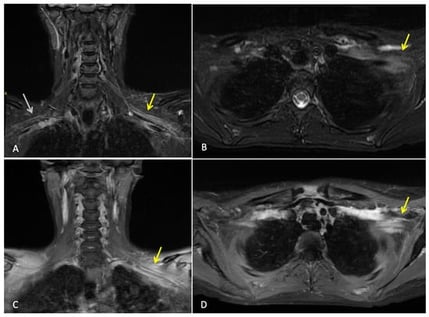
MRI brachial plexus: This is a figure. Images (A,B) are coronal and axial T2 STIR images that demonstrate thickening and increased T2 signal of the brachial plexus on the left (yellow arrows). Normal size and signal of the brachial plexus on the right for comparison (white arrow). Images (C,D) are coronal and axial T1 fat-saturated post-contrast images, which demonstrate abnormal hyperenhancement of the thickened brachial plexus on the left side (yellow arrows). Findings are consistent with left brachial plexitis.

The treatment landscape for endometrial carcinoma (EC) is undergoing a paradigm shift from traditional histopathological dualism to precision medicine grounded in the Cancer Genome Atlas (TCGA) molecular classification. The “No Specific Molecular Profile” (NSMP) subgroup, the largest molecular cohort, has emerged as a particularly promising target for endocrine-based strategies. While endocrine therapy (ET) has been a mainstay for over 60 years due to its favorable safety profile, its efficacy as monotherapy remains modest. This review provides a comprehensive overview of current endocrine strategies, including traditional agents like progestins and aromatase inhibitors, and focuses on novel combination therapies designed to overcome resistance. Recent clinical trials have demonstrated that integrating molecularly targeted agents, such as CDK4/6 and mTOR inhibitors, significantly improves clinical outcomes. Specifically, patients with TP53 wild-type status and CTNNB1 mutations exhibit exceptional responses to these combinations. Furthermore, we discuss the potential of next-generation selective estrogen receptor degraders (SERDs) and the importance of refining patient selection through robust predictive biomarkers. Driven by molecular insights, endocrine therapy is transitioning from a secondary palliative option into a definitive cornerstone of precision oncology, offering a personalized and effective treatment for patients with advanced or recurrent endometrial carcinoma.

19 February 2026

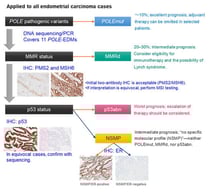
Practical workflow of the TCGA-surrogate molecular classification approach. The molecular classification of endometrial carcinoma is illustrated according to the 2025 ESGO/ESTRO/ESP guidelines. All endometrial carcinomas, regardless of histologic subtype, are candidates for molecular classification. The first step is to assess POLE exonuclease domain mutations (currently, at least 11 pathogenic variants have been described) to identify the POLEmut subgroup. The next step is immunohistochemistry for mismatch repair (MMR) proteins to identify the MMRd subgroup, followed by p53 immunohistochemistry to categorize p53abn and NSMP tumors. Further subclassification of NSMP based on ER immunohistochemistry into ER-positive and ER-negative NSMP has also been proposed. Tumors with multiple classifiers are assigned according to the highest-priority upstream classifier—for example, a tumor harboring both a POLE mutation and MMR deficiency is classified as POLEmut.

Background: Gemcitabine–cisplatin (GC) combined with a programmed death-ligand 1 (PD-L1) inhibitor has become an important first-line regimen for advanced intrahepatic cholangiocarcinoma (ICC). However, overall efficacy remains modest, and inter-patient heterogeneity in outcomes is substantial, highlighting the need for simple biomarkers for pretreatment risk stratification. The systemic immune-inflammation index (SII), derived from peripheral neutrophil, lymphocyte, and platelet counts, has been associated with prognosis in various malignancies, but its clinical relevance in advanced ICC treated with first-line GC plus PD-L1 inhibitor remains unclear. Aims: To evaluate the association of baseline SII with objective response and survival outcomes in patients with advanced ICC receiving first-line GC plus PD-L1 inhibitor. Methods: We retrospectively analyzed 193 consecutive patients with advanced ICC who received first-line GC plus a PD-L1 inhibitor at our center. Baseline clinicopathologic characteristics and laboratory parameters were collected, and SII was calculated as platelet count (×109/L) × neutrophil count (×109/L)/lymphocyte count (×109/L). Receiver operating characteristic (ROC) analysis was performed to assess the discriminative ability of baseline SII for objective response and to determine an internally derived cut-off value. Patients were categorized into low- and high-SII groups accordingly. Logistic regression was used to identify factors associated with objective response rate (ORR). Progression-free survival (PFS) and overall survival (OS) were estimated by the Kaplan–Meier method and compared using the log-rank test. Multivariable Cox proportional hazards models were constructed to evaluate the independent prognostic significance of SII for PFS and OS. Results: Among the 193 patients included, 55 achieved complete or partial response and 138 had stable or progressive disease, yielding an ORR of 28.5%. Baseline SII showed good discrimination for objective response (AUC = 0.91), and the optimal cut-off value was 495.75. Patients in the low-SII group had a significantly higher ORR than those in the high-SII group (p < 0.001). Kaplan–Meier analysis demonstrated that both PFS and OS were longer in the low-SII group than in the high-SII group (median OS: 13.0 vs. 8.0 months, log-rank p < 0.001; median PFS: 8.5 vs. 6.0 months, p = 0.025). In multivariable Cox models adjusting for differentiation, CA19-9, tumor multiplicity, and distant metastasis, SII grouping remained independently associated with PFS and OS, and distant metastasis was consistently associated with increased risks of progression and death. Conclusions: Baseline SII is a readily available prognostic biomarker associated with objective response and survival in patients with advanced ICC treated with first-line GC plus PD-L1 inhibitor. Given the retrospective single-center design, the absence of a non-immunotherapy comparator cohort, and internal cut-off derivation, these findings should be interpreted as hypothesis-generating and warrant external validation.

19 February 2026

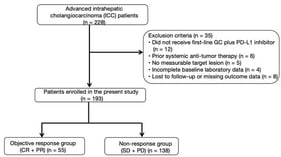
Flowchart of patient selection and overall treatment response. Flowchart summarizing patient selection and treatment response in the study cohort. A total of 228 patients with advanced intrahepatic cholangiocarcinoma (ICC) were screened for eligibility. Patients who did not receive first-line gemcitabine–cisplatin (GC) plus a PD-L1 inhibitor, had prior systemic anti-tumor therapy, lacked measurable target lesions, or had incomplete baseline or outcome data were excluded. Finally, 193 patients were included in the analysis. Among them, 55 achieved complete or partial response (CR/PR) and 138 had stable or progressive disease (SD/PD), yielding an overall objective response rate (ORR) of 28.5%. Abbreviations: ICC, intrahepatic cholangiocarcinoma; GC, gemcitabine–cisplatin; PD-L1, programmed death-ligand 1; CR, complete response; PR, partial response; SD, stable disease; PD, progressive disease.

ER-low breast cancer (1–9% ER expression) represents a biologically and clinically distinct entity at the interface between ER-positive and ER-negative disease. Although traditionally managed as hormone receptor-positive, mounting evidence indicates that ER-low tumors share molecular signatures, aggressive behavior, and chemotherapeutic responsiveness with triple-negative breast cancer. Accurate ER assessment is hindered by methodological variability and interpretative challenges, leading to potential misclassification and suboptimal treatment choices. While the benefit of endocrine therapy remains uncertain, ER-low tumors consistently show sensitivity to chemotherapy and promising responses to neoadjuvant chemo-immunotherapy, paralleling outcomes observed in triple-negative breast cancer cohorts. Emerging artificial intelligence tools, including digital pathology and multimodal deep learning, may enhance ER quantification, reduce observer variability, and enable more precise patient stratification. This review synthesizes current pathological and clinical insights into ER-low breast cancer and highlights evolving therapeutic strategies, with a forward-looking perspective on AI-driven approaches to optimize personalized treatment for this challenging subtype.

18 February 2026

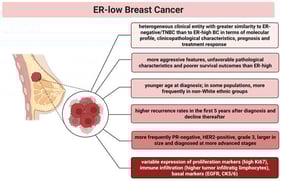
Main clinical and pathological features of ER-low BC. The figure was created with www.biorender.com, and the appropriate license for publication was obtained.

News & Conferences

Issues

Open for Submission

Editor's Choice

Reprints of Collections

Evolution of Treatments of Prostate Cancer
Reprint

Evolution of Treatments of Prostate Cancer

From Biology to Current Advanced Technologies
Editors: Fernando Munoz
Recent Advances in Anticancer Strategies
Reprint

Recent Advances in Anticancer Strategies

Editors: Hassan Bousbaa, Zhiwei Hu

Get Alerted

Add your email address to receive forthcoming issues of this journal.

XFacebookLinkedIn
Curr. Oncol. - ISSN 1718-7729