Skip to Content

Condensed Matter

Condensed Matter is an international, peer-reviewed, open access journal on the physics of condensed matter published quarterly online by MDPI.

All Articles (639)

  • Feature Paper
  • Article
  • Open Access

In this paper, we present a comprehensive study of the electronic structure of CeCoGe3 throughout the entire Brillouin zone in the non-magnetic regime using angle-resolved photoemission spectroscopy (ARPES). The electronic structure agrees in large part with first principles calculations, including predicted topological nodal lines. Two new features in the band structure are also observed, namely a surface state and folded bands, the latter of which is argued to originate from a unit cell reconstruction.

25 February 2026
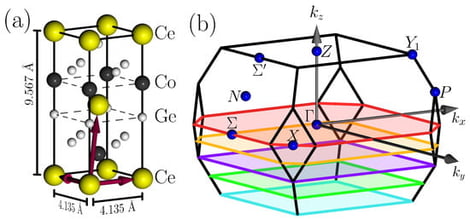
CeCoGe3 (a) crystal structure (conventional unit cell). Ce (yellow), Co (black), and Ge (gray) atoms are labeled on right. Arrows indicate primitive lattice vectors. (b) Brillouin zone with high-symmetry points labeled. Colored planes indicate the momentum regions where calculations and ARPES spectra focus.

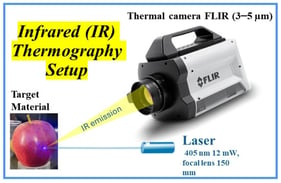
In this work, thermal imaging is employed to study the opto-thermal response of apples (Malus domestica Borkh.), assessing their post-harvest evolution through the estimation of thermal diffusivity. A non-destructive experimental procedure based on mid-wave infrared (MWIR) thermal camera (3–5 µm) and localized heating with a visible laser is developed, enabling spatially and temporally resolved surface temperature measurements. Temperature fields are recorded at different time points and radial distances from the heated spot. A theoretical model based on Fourier thermal diffusion equation is formulated to describe the spatio-temporal evolution of surface temperature. After validation on a reference sample, the method is applied to Golden and Red Delicious apples over a 28-day storage period at room temperature. Red Delicious apple exhibits higher mean diffusivity values without significant temporal changes, whereas a progressive increase in diffusivity is observed for Golden Delicious apples. These results show that thermal diffusivity is sensitive to post-harvest physiological changes in apple tissue and may be associated with intrinsic properties such as tissue density and water content. By relating laser-induced temperature fields to the estimation of thermal diffusivity, this approach enables the non-destructive, quantitative assessment of thermal diffusivity, showing potential for fruit maturity and quality assessment, which are of high importance in agri-food monitoring applications.

18 February 2026

Schematic representation of the IR thermography setup.

Insights into Neutral vs. Deprotonated Phenol Adsorption on Graphene Oxide

  • Jeton Halili,
  • Kledi Xhaxhiu and
  • Avni Berisha
  • + 4 authors

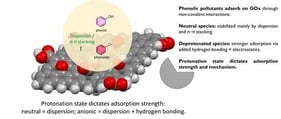
Water pollution from phenols remains a critical concern due to their persistence, toxicity, and industrial prevalence. Graphene oxide (GOx), with its functional groups and large surface area, offers strong adsorption potential. Using density functional theory (DFT), reduced density gradient (RDG), and quantitative structure–activity relationship (QSAR), we examined how protonation and substituents influence phenol adsorption. Deprotonated phenolates bind more strongly to GO than neutral species via electrostatics and H-bonding. Substituents alter affinity: halogens enhance it, bulky alkyls hinder it, and nitro groups show electron-withdrawing effects. Bisphenolate A displayed multidentate binding. QSAR models reproduced DFT energies with R2 > 0.99, enabling fast prediction. These results highlight how pH speciation and substituents govern adsorption on GO, guiding the design of efficient water treatment materials.

6 February 2026

Frontier orbitals (HOMO and LUMO) and electrostatic potential (ESP) surfaces of phenols and their corresponding phenolates. The panels compare phenol, 4-nitrophenol (4-NP), 2,4-dichlorophenol (2,4-DCP), and bisphenol A (BPA).
  • Feature Paper
  • Article
  • Open Access

Two-Carrier Description of Cuprate Superconductors from NMR

  • Daniel Bandur,
  • Abigail Lee and
  • Jürgen Haase
  • + 2 authors

Cuprates currently hold the record for the highest temperature superconductivity at ambient pressure, but the microscopic understanding of these materials remains elusive. Here, we utilize nuclear magnetic resonance (NMR) data of planar oxygen and copper from essentially all hole-doped cuprates to provide a universal phenomenology relating the NMR spin shifts, which measure the electronic spin polarization at a given nucleus, with the superconducting dome and maximum critical temperature. There appear to be two separate contributions to the spin shift in planar copper, only one of which is seen at the oxygen site, and we associate them with two different types of carriers. Upon disentangling these two components, their relative size is shown to correlate not only with the doping dependence of the superconducting dome but also with the variation in maximum superconducting critical temperature, Tc,max, between different families. One of these components is independent of family and resides in the hybridized planar orbitals of Cu and O. The second component, in contrast, is predominately isotropic and encodes the differences between the families. It is thus related to the charge transfer gap and planar hole sharing. Our findings offer universal insight which should prove useful in the continuing development of a comprehensive theory of the cuprates, as well as an indication of how it may be possible to engineer materials with higher critical temperatures.

5 February 2026

The NMR spin shift 
  
    
      K
      i
    
    
      (
      T
      )
    
  
 is proportional to the electronic spin susceptibility 
  
    χ
    (
    T
    )
  
 in accordance with 
  
    
      K
      i
    
    
      (
      T
      )
    
    =
    
      A
      i
    
    
    ·
    
    χ
    
      (
      T
      )
    
  
, cf. (1), where 
  
    A
    i
  
 is the associated temperature-independent hyperfine constant describing the coupling between the electron and nuclear spins (
  
    
      H
      i
    
    =
    I
    
      A
      i
    
    S
  
). (a) A plot of shift 
  
    
      K
      i


      α
    
    
      (
      T
      )
    
  
 versus shift 
  
    
      K
      j


      β
    
    
      (
      T
      )
    
  
 with temperature as an implicit parameter. For different materials (indicated by three different colors), lines fall on top of each other in the case where the relevant hyperfine constants are material-independent. This was initially proposed for the cuprate shifts based upon a few early studies [16,17] but was found to fail as additional materials were investigated. (b) Material-dependent temperature dependencies of any two spin shifts remain proportional to each other so long as they result from the same spin susceptibility. The ratio of the relevant hyperfine constants is the proportionality factor. This scenario has been previously proposed to explain the aforementioned disparate behavior of the shifts in various cuprates [19]. However, the temperature dependencies of, e.g., the spin shifts at planar Cu actually follow the sketch shown in (c). The abrupt changes in slope between the two shifts as a function of temperature are evidence of the action of two susceptibilities. Note that abrupt changes in the hyperfine constants would result in discontinuities in the temperature dependence of individual shifts, which are not observed.

News & Conferences

Issues

Open for Submission

Editor's Choice

Get Alerted

Add your email address to receive forthcoming issues of this journal.

XFacebookLinkedIn
Condens. Matter - ISSN 2410-3896