Skip to Content

Coatings

Coatings is an international, peer-reviewed, open access journal on coatings and surface engineering, published monthly online by MDPI.
The Korean Tribology Society (KTS) and Chinese Society of Micro-Nano Technology (CSMNT) are affiliated with Coatings and their members receive discounts on the article processing charges.
Quartile Ranking JCR - Q2 (Physics, Applied | Materials Science, Coatings and Films)

All Articles (12,138)

In this paper, the regenerated NdFeB magnets were fabricated by Nd85Al15 alloy diffusion, and the influence of alloy content and diffusion temperature on the properties and microstructure was systematically studied. The recovery mechanism of magnetic properties was discussed based on the analyses using scanning electron microscope (SEM), energy dispersive spectrometer (EDS) and electron probe microanalysis (EPMA) observation. The results indicate that the coercivity (Hcj) increases significantly with both alloy addition and temperature, reaching the maximum value of 1087 kA/m (80.9% enhancement) compared with the non-diffused magnet (601 kA/m). The maximum remanence (Br) and maximum energy product (BHmax) of the diffused magnet are 0.99 T and 184.7 kJ/m3, which are 8.8% and 5.9% lower than those (1.085 T and 196.3 kJ/m3) of the non-diffused magnet. The density and compressive strength of the diffused magnet are enhanced by 8.2% (7.25 g/cm3) and 67.47% (628 MPa), respectively. As the compensation of Nd85Al15 melt, the density, Br and BHmax are improved via the liquid filling into pores. Simultaneously, the Hcj is enhanced through the repair of grain boundary defects and the formation of continuous Nd-rich phases.

27 February 2026
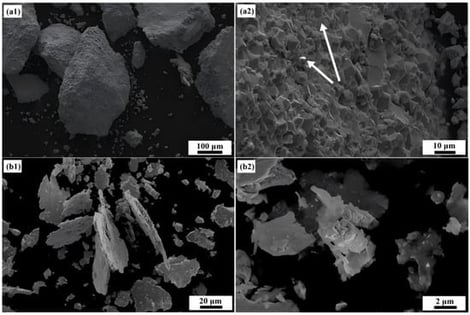
SEM images of the raw materials. (a1) SEM image of the mechanically crushed NdFeB powder; (a2) magnified SEM image of the mechanically crushed NdFeB powder (arrow indicates the separation of surface Nd-rich phase); (b1) SEM image of the ball-milled Nd85Al15 alloy powder; (b2) magnified SEM image of the ball-milled Nd85Al15 alloy powder.

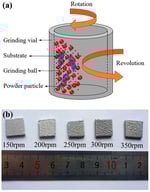
Cr-Al composite coatings were fabricated on Ti-6Al-4V alloy substrates via mechanical alloying using a high-energy planetary ball mill. The coatings exhibited a distinctive bilayer architecture comprising an inner layer with coarse reinforcing particles and an outer layer featuring a refined, homogenized microstructure. Systematic investigations were conducted to elucidate the influence of rotational speed on coating formation, microstructural evolution, phase composition, and high-temperature oxidation performance. The findings revealed that insufficient milling speeds failed to facilitate adequate powder deposition, resulting in poor interfacial adhesion and the formation of porous or thin coatings. Conversely, excessive rotational speeds induced surface roughening and coating delamination. Optimization studies identified 250 r/min as the optimal milling speed, yielding dense, well-adherent coatings with superior oxidation resistance. Cyclic oxidation testing at 850 °C demonstrated that coated specimens exhibited significantly reduced mass gain compared to uncoated substrates. Post-oxidation characterization confirmed the formation of a protective corundum-type oxide scale (α-Al2O3 and Cr2O3) and revealed a four-layered structure in the oxidized coating: (I) a dense oxide film serving as an oxygen barrier, (II) a dense alloyed layer, (III) a porous alloyed layer, and (IV) an inner diffusion zone. These results demonstrate that the mechanically alloyed Cr-Al coatings provide effective protection against high-temperature oxidation for Ti-6Al-4V alloy substrates.

27 February 2026

Schematic illustrations of experimental method (a) and macro morphologies of the coatings fabricated at different rotational speeds (b).

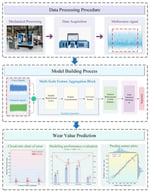
Accurate tool wear monitoring plays a decisive role in machining efficiency, product quality and reliability in modern manufacturing systems. Existing deep learning methods struggle to balance the high-frequency transient features and low-frequency evolution trends in tool wear signals, often losing key temporal evolution details when processing long-range degradation data. Therefore, this paper proposes an online prediction method of tool wear value that combines multi-scale convolution and dual-attention temporal features. This method extracts local mutation and trend features in wear signals through multi-scale convolution, captures wear evolution features through bidirectional cyclic network, and adaptively fuses local detail information and global trend through dual attention mechanism SWGC-DA to generate a multi-scale time series feature-driven prediction model. The ablation experiment based on the PHM2010 public data set verifies the effectiveness of the network structure design and demonstrates the model’s superior predictive ability. Experiments on the self-built TiAl alloy milling dataset achieved a stable prediction of R2 up to 99.1%, with MAE and RMSE of 2.29 and 2.47, respectively. The results show that this method significantly improves the accuracy and robustness of wear prediction.

27 February 2026

Tool wear prediction based on the MS-DATFNet.

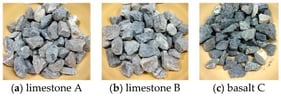
The current gradation design of asphalt mixtures relies solely on sieve passing rates of single-sized aggregates. The quantitative evaluation of aggregate gradation is a challenge, considering the combined action of the geometric characteristics, size and passing rates of the aggregates. Analyzing the multi-dimensional geometric synergistic characteristics of graded aggregate can help to quantify the gradation. The AIMS II system was used to systematically and quantitatively evaluate the shape, angularity and texture of parameter distribution of single-sized aggregates. The synergistic effect of composite geometric characteristics on the mesoscopic interface behaviors was analyzed, and then a calculation model of aggregate gradation characteristic was established based on the gray relational analysis method. The results show that the lithology and source of aggregates govern the geometric characteristics indices of single-sized aggregates, whereas particle size controls the extent to which these geometric characteristics contribute to skeleton stability and interface interactions. A higher proportion of large-sized coarse aggregates results in a greater composite angularity index and a more stable skeleton structure within the asphalt mixture. Texture characteristics and particle size distribution are integrated into a unified composite texture index. As this index increases, the lubrication effect of asphalt on the aggregate skeleton becomes more pronounced. The aggregate gradation characteristic index demonstrates strong discriminative capability for different gradations and exhibits a robust linear correlation with aggregate–asphalt interfacial interaction indices. This index demonstrates strong capability to quantitatively describe the synergistic mechanism of multi-dimensional geometric characteristics and gradation types of asphalt mixtures.

27 February 2026

Three different types of aggregates.

News & Conferences

Issues

Open for Submission

Editor's Choice

Get Alerted

Add your email address to receive forthcoming issues of this journal.

XFacebookLinkedIn
Coatings - ISSN 2079-6412