Skip Content
You are currently on the new version of our website. Access the old version .

Coatings

Coatings is an international, peer-reviewed, open access journal on coatings and surface engineering, published monthly online by MDPI.
The Korean Tribology Society (KTS) and Chinese Society of Micro-Nano Technology (CSMNT) are affiliated with Coatings and their members receive discounts on the article processing charges.
Quartile Ranking JCR - Q2 (Physics, Applied | Materials Science, Coatings and Films)

All Articles (12,068)

Microwave sintering technology is widely regarded as one of the most promising construction techniques for in situ resource utilization in lunar bases due to its high energy efficiency and unique heating mechanism. However, the extremely low-temperature environment on the lunar surface creates a transient temperature gradient of over a thousand degrees Celsius between the sintered body’s surface and its interior. This temperature difference induces significant thermal stress during the cooling process, leading to macroscopic surface cracks and even structural failure, which severely limits the engineering feasibility of this technology. To evaluate the surface integrity of lunar in situ sintered bodies and determine the safe processing window for microwave sintering, this study develops a multiphysics computational model that couples electromagnetic, thermal, and stress fields. The results show that when the cooling rate is below 15 °C/min, the surface stress remains below the material’s tensile strength threshold, effectively preventing crack formation. However, at a cooling rate of 16 °C/min, the surface stress exceeds this threshold, leading to crack initiation. Further analysis reveals that the cooling rate significantly affects the microstructure, with slow cooling maintaining a dense structure, while fast cooling promotes the formation of microcracks, particularly in regions with low Si/Al content. This study provides a reference for the microwave sintering process of lunar regolith and proposes a strategy of controlling the cooling rate below 15 °C/min.

9 February 2026
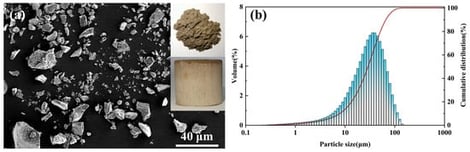
Microstructure and particle size distribution of the lunar regolith simulant: (a) SEM image and photograph; (b) particle size distribution curve.
  • Correction
  • Open Access

In the original publication [...]

10 February 2026

  • Correction
  • Open Access

In the original publication [...]

10 February 2026

Water seepage in saline soils can compromise the stability of landfill cover layers and cause ecological pollution. Biochar, recognized as a novel sustainable material for soil improvement, has garnered significant attention due to its large specific surface area and complex pore structure. Its addition can alter the physico-chemical properties of soil, including pore structure characteristics, compaction behavior, and liquid seepage paths. This study therefore focuses on saline soil, investigating the effects of biochar type and addition rate on the soil’s hydraulic conductivity through variable-head permeability tests. The correlation between changes in microscopic structural characteristics and hydraulic conductivity was analyzed using SEM and MIP techniques. The results indicate the following: (1) Both corn straw and wood biochar affect the hydraulic conductivity of the modified soil, with the degree of influence varying based on the presence and dosage of biochar, generally leading to a reduction. (2) The corn straw biochar-modified soil exhibited a more significant decrease in hydraulic conductivity—by approximately one order of magnitude—compared to wood biochar, reaching a minimum value of 1.04 × 10⁻⁶ cm/s at a 10% addition rate. (3) Analysis from SEM and MIP tests reveals that incorporating biochar alters the original pore structure of the soil, causing macropores to transition towards mesopores and micropores, and resulting in the narrowing or clogging of pore channels, which ultimately reduces the hydraulic conductivity. The finding that biochar amendment decreases hydraulic conductivity provides valuable data to support the design of landfill cover layer schemes.

9 February 2026

News & Conferences

Issues

Open for Submission

Editor's Choice

Reprints of Collections

Laser Cladding Coatings
Reprint

Laser Cladding Coatings

Microstructure, Properties, and Applications
Editors: Kaiming Wang, Dingding Xiang, Jiang Ju, Zhenlin Zhang
New Insights into Earthen Site Conservation
Reprint

New Insights into Earthen Site Conservation

Methods, Techniques, Management, and Key Case Studies
Editors: Stephen S.Y. Lau, Yile Chen, Liang Zheng, Jianyi Zheng

Get Alerted

Add your email address to receive forthcoming issues of this journal.

XFacebookLinkedIn
Coatings - ISSN 2079-6412