


Journal Menu
► ▼ Journal Menu-
- Climate Home
- Aims & Scope
- Editorial Board
- Reviewer Board
- Topical Advisory Panel
- Instructions for Authors
- Special Issues
- Topics
- Sections & Collections
- Article Processing Charge
- Indexing & Archiving
- Editor’s Choice Articles
- Most Cited & Viewed
- Journal Statistics
- Journal History
- Journal Awards
- Society Collaborations
- Conferences
- Editorial Office
Journal Browser
► ▼ Journal BrowserNeed Help?
Announcements
6 November 2025
MDPI Launches the Michele Parrinello Award for Pioneering Contributions in Computational Physical Science

MDPI is delighted to announce the establishment of the Michele Parrinello Award. Named in honor of Professor Michele Parrinello, the award celebrates his exceptional contributions and his profound impact on the field of computational physical science research.
The award will be presented biennially to distinguished scientists who have made outstanding achievements and contributions in the field of computational physical science—spanning physics, chemistry, and materials science.
About Professor Michele Parrinello
"Do not be afraid of new things. I see it many times when we discuss a new thing that young people are scared to go against the mainstream a little bit, thinking what is going to happen to me and so on. Be confident that what you do is meaningful, and do not be afraid, do not listen too much to what other people have to say.”
——Professor Michele Parrinello
 |
Born in Messina in 1945, he received his degree from the University of Bologna and is currently affiliated with the Italian Institute of Technology. Professor Parrinello is known for his many technical innovations in the field of atomistic simulations and for a wealth of interdisciplinary applications ranging from materials science to chemistry and biology. Together with Roberto Car, he introduced ab initio molecular dynamics, also known as the Car–Parrinello method, marking the beginning of a new era both in the area of electronic structure calculations and in molecular dynamics simulations. He is also known for the Parrinello–Rahman method, which allows crystalline phase transitions to be studied by molecular dynamics. More recently, he has introduced metadynamics for the study of rare events and the calculation of free energies. |
For his work, he has been awarded many prizes and honorary degrees. He is a member of numerous academies and learned societies, including the German Berlin-Brandenburgische Akademie der Wissenschaften, the British Royal Society, and the Italian Accademia Nazionale dei Lincei, which is the major academy in his home country of Italy.
Award Committee
 |
The award committee will be chaired by Professor Xin-Gao Gong, a computational condensed matter physicist, academician of the Chinese Academy of Sciences, and professor at the Department of Physics, Fudan University. Professor Xin-Gao Gong will lead a panel of several senior experts in the field to oversee the evaluation and selection process. The Institute for Computational Physical Sciences at Fudan University (Shanghai, China), led by Professor Xin-Gao Gong, will serve as the supporting institute for the award. |
"We hope the Michele Parrinello Award will recognize scientists who have made significant contributions to the field of computational condensed matter physics and at the same time set a benchmark for the younger generation, providing clear direction for their pursuit—this is precisely the original intention behind establishing the award."
——Professor Xin-Gao Gong
The first edition of the award was officially launched on 1 November 2025. Nominations will be accepted before the end of March 2026. For further details, please visit mparrinelloaward.org.
About the MDPI Sustainability Foundation and MDPI Awards 
The Michele Parrinello Award is part of the MDPI Sustainability Foundation, which is dedicated to advancing sustainable development through scientific progress and global collaboration. The foundation also oversees the World Sustainability Award, the Emerging Sustainability Leader Award, and the Tu Youyou Award. The establishment of the Michele Parrinello Award will further enrich the existing award portfolio, providing continued and diversified financial support to outstanding professionals across various fields.
In addition to these foundation-level awards, MDPI journals also recognize outstanding contributions through a range of honors, including Best Paper Awards, Outstanding Reviewer Awards, Young Investigator Awards, Travel Awards, Best PhD Thesis Awards, Editor of Distinction Awards, and others. These initiatives aim to recognize excellence across disciplines and career stages, contributing to the long-term vitality and sustainability of scientific research.
Find more information on awards here.
20 February 2026
MDPI Virtual Academic Publishing Workshop (New Harvest), 25 February 2026
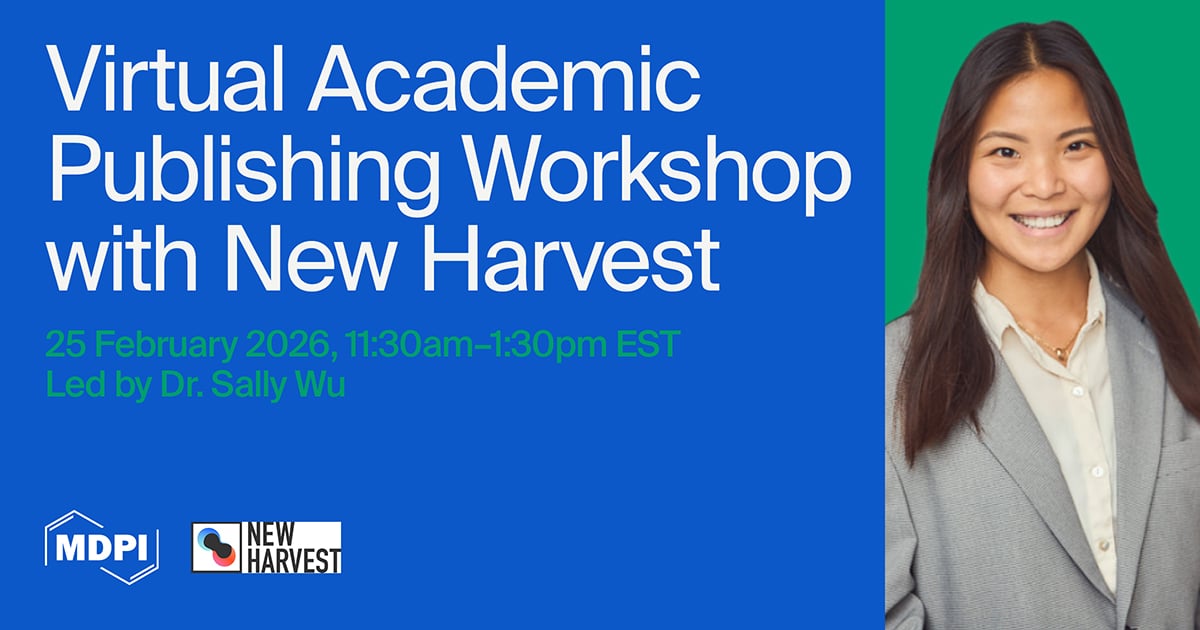
This Academic Publishing Workshop will be led by MDPI Regional Journal Relations Specialist, Dr. Sally Wu, on “Author Training”. Participants will receive practical advice on essential aspects of writing academic articles. Participants will leave with a clearer understanding of the academic publishing landscape and how to successfully contribute to it.
Date: 25 February 2026
Time: 11:30 a.m.–1:30 p.m. EST
Schedule:
|
Speaker |
Program |
Time in EST |
|
Dr. Sally Wu |
Introduction |
11:30–11:40 a.m. |
|
Dr. Sally Wu |
Tips for Writing Great Research Papers
|
11:40 a.m.–12:15 p.m. |
|
Dr. Sally Wu |
How to Respond to Peer Reviewers
|
12:15–12:50 p.m. |
|
Dr. Sally Wu |
AI in Publishing: Challenges and Opportunities
|
12:50–13:30 p.m. |
Speakers:
|
|
Dr. Sally Wu received a PhD in medical science from the University of Toronto in the fall of 2025. She joined MDPI in February 2025 as an Assistant Editor for Cells. She was recently promoted to Regional Journal Relations Specialist position in August. In this role, she works with many journals, liaising with authors, board members, and EiCs. She has attended several conferences across North America, hosted scholar visits, and taken part in other outreach events. |

18 February 2026
MDPI’s Open Access Program Reaches 1,000 Institutions Worldwide

MDPI has surpassed the milestone of 1,000 partners within the Institutional Open Access Program (IOAP). The agreements span 59 countries, covering North and South America, Europe, Asia, Africa, and Oceania.
Last year alone, more than 150 new libraries and academic institutions joined MDPI’s IOAP. With the expansion of an existing consortium deal in Sweden we welcomed a further 75 partners to the program in January 2026, enabling us to surpass the 1,000-partners milestone.
The IOAP supports affiliated researchers by streamlining submission processes, reducing administrative burdens, and offering discounted Article Processing Charges (APCs). Through IOAP membership, more than 61,300 research articles received APC discounts in 2025, driving greater visibility and accessibility for partner institutions and global research communities alike.
"This milestone marks a significant step towards expanding MDPI’s global impact," said Stefan Tochev, MDPI's CEO. "Reaching 1,000 IOAP partnerships is a true testament to the growing trust and collaboration we’ve built with universities, libraries, and research organizations worldwide. We are proud to lead the way in Open Access publishing, ensuring researchers have the support they need to reach global audiences." "The success of our program is reflected in the growing global demand for Open Science and quality publishing services," said Becky Castellon, MDPI institutional partnerships manager. "Equally, institutions are increasingly seeking Open Access publishing options that support funder and national mandates. Joining the IOAP makes compliance simple."
4 February 2026
Acknowledgment to the Reviewers of Climate in 2025

The editorial office of Climate would like to extend its sincere gratitude to all reviewers who contributed to the improvement of the journal quality by providing their expert opinion and evaluation of the submitted research.
We appreciate that thorough peer review demands considerable time and intellectual investment from our reviewers. In 2025, Climate received 1634 review reports from contributors across 89 countries and territories, demonstrating the breadth of international expertise and scholarly engagement that has strengthened our publication standards.
The reviewers who agreed to have their names published this year are listed below in alphabetical order by first name. The editorial team acknowledges with gratitude all reviewers, named and anonymous alike, for their vital role in maintaining the scholarly standards of Climate.
| Abd Wahid Rasib | Lovely Euphrasie-Clotilde |
| Abdulazeez Y. H. Saif-Alyousfi | Loyde Vieira de Abreu-Harbich |
| Adarsh Sankaran | Luchen Wang |
| Adeyeri Oluwafemi | Lucio Souza |
| Adilson Pacheco de Souza | Luminda Niroshana Gunawardhana |
| Adnan Arshad | Lyes Rabhi |
| Adnan Masic | Mahdi Salehi |
| Adolfo Maza | Majid Javari |
| Agustiyara Agustiyara | Mantravadi Venkata Subrahmanyam |
| Ahmet Durap | Manuchehr Farajzadeh |
| Akhouri Pramod Krishna | Marc Davidson |
| Aleksandra Figurek | Marek Zieliński |
| Alessandro Crise | María del Carmen Casas-Castillo |
| Ali Arda Sorman | Mariam Elizbarashvili |
| Ali Danandeh Mehr | Marina Baldi |
| Ali Darub Kassar | Marinos Markou |
| Ali Kadhim Resen | Marta Cebulska |
| Alireza Nouri | Marta Luffarelli |
| Alok Wankar | Mathieu Mure-Ravaud |
| Aman Srivastava | Maurice Osewe |
| Amanullah Khan | Maxim G. Ogurtsov |
| Amitesh Gupta | Md. Mizanur Rahman |
| Amjad Ali | Md. Rafique Ahasan Chawdhery |
| Amy D. Lykins | Mengyun Chung |
| Ana Rodriguez-Olalla | Michael Goss |
| Andre L. Belem | Michel Jancloes |
| Andre Lanfer Marquez | Miguel Imaz |
| André Luiz Toledo | Mikhail Taschilin |
| Andreas Gobiet | Mohammad Nazeri Tahroudi |
| Andres Annuk | Mohammad M. Jaber |
| Andrés M. Vélez-Pereira | Mona Riza Mohd Esa |
| Andrey Lavrinenko | Muhammad Nda |
| Aneta Masternak-Janus | Muhammad Azher Hassan |
| Anirban Middey | Murat Öztürk |
| Anthony Brazel | Mustafa Al-Mukhtar |
| António M. Raimundo | Mustafa Serkan Isik |
| Anxiao Zhang | Mustafa Ustuner |
| Aparna Satsangi | Nazario Tartaglione |
| Argyro Zisiadou | Nektaria Eleni Adaktylou |
| Arif Atak | Nick Martin |
| Arturo Corrales-Suastegui | Nikola M. Milentijević |
| Arturo Sousa | Nina Nikolova |
| Aseem Pal Singh | Nivin Abdelmeguid |
| Ashenafi Yohannes Battamo | Olena Borysiak |
| Ashwani Vasishth | Oluwatoyin Dare Kolawole |
| Asim Qayyum Butt | Pabrício Marcos Oliveira Lopes |
| Atabek Atabekov | Pantazis E. Georgiou |
| Atef M. F. Mohammed | Paolo Ceci |
| Babak Ghazi | Patricia Drach |
| Beata Zofia Filipiak | Paula Stoicea |
| Bernard Stanisław Twaróg | Paweł Rydzewski |
| Borbala Szeles | Peipei Pan |
| Brantley Liddle | Peng Zhao |
| Brian W. Sloboda | Pengle Cheng |
| Cécil J. W. Meulenberg | Peter Nojarov |
| Chandima Dilrukshi Tilakaratne | Petri Räisänen |
| Cheng Li | Philippe C. Forêt |
| Chengzhi Yu | Ping Li |
| Chuanhong Zhao | Piotr Borowski |
| Claudia Bita-Nicolae | Pramod Kumar |
| Claudio Stefanini | Pronob Das |
| Cristian Banciu | Qiang Wei |
| Cristian Gabriel Anghel | Qimin He |
| Csaba Horváth | Qitao Xiao |
| Daniel Kibirige | Quang Chi Truong |
| Daniel Santos | Radhakrishnan Shanthi Priya |
| Dariia Kholiavchuk | Rajendran Shobha Ajin |
| David Pereira Jerez | Rajkumar Guria |
| David Stadelmann | Ranko Gantner |
| David Turbow | Ravindra Madhukar Moharil |
| Defi Yusti Faidah | Riccardo Vecellio Segate |
| Diosey Ramon Lugo-Morin | Richao Cong |
| Djanna Koubodana Houteta | Rick Lader |
| Dmitry Erokhin | Ricky Anak Kemarau |
| Eftstahia Tringa | Ridouane Kessabi |
| Elena Lioubimtseva | Rilka Valcheva |
| Eleonora Nistor | Robert Twardosz |
| Eliza Kalbarczyk | Roberta Valentina Gagliardi |
| Emmanuel Eze | Roberto Avelino Cecílio |
| Ender Buğday | Roberto Franco Plata |
| Erginbay Uğurlu | Romário Oliveira De Santana |
| Erica Russell | Rueiyuan Wang |
| Erick Arturo Betanzo-Torres | Ruth Irwin |
| Ettiyagounder Parameswari | S. Duygu Sever |
| Eugene A. Silow | Saad Aldulaimy |
| Euripides N. Avgoustoglou | Sameera Qayoom |
| Eusebio Mercedes Ingol-Blanco | Sampad Kumar Panda |
| Evan Mallen | Sangeeta Kumari |
| Faten Mouldi Derouez | Sarah M. Hirsh |
| Fengwei Wang | Sergio Ugarte |
| Francesco Mancini | Sevda Zuhal Akyürek |
| Franz Pablo Antezana Lopez | Shaohong Wu |
| Fuguang Zhang | Shaohua Lei |
| Fulya Islek | Shashikant Verma |
| Gabriel Williams | Shenliang Chen |
| Gamil Gamal | Shiming Zhang |
| Gaurav Tiwari | Slaheddine Khlifi |
| George Kwame Agbanyo | Sorin Cace |
| Giada Varra | Sreelash Krishnan Kutty |
| Gideon Uchechukwu Nwafor | Stanislav Myslenkov |
| Gláuber Pontes Rodrigues | Stefanie Kagone |
| Gneneyougo Emile Soro | Stephen Balaka Opiyo |
| Gokmen Ceribasi | Steven Soon Kai Kong |
| Guanxi Yan | Sumit Chakravarty |
| Gustavo J. Nagy | Susana Bastos |
| Hafzullah Aksoy | Susana Paixão |
| Haitao Wang | Szemethy László |
| Hamadjam Abboubakar | Tajen Chu |
| Haonan Zhang | Talha Bin Nadeem |
| Haosu Tang | Tao Zhu |
| Hubert Kryszk | Teerawong Laosuwan |
| Huseyin Cetin | Tiejie Cheng |
| Ifeanyi Chukwudi Achugbu | Tom Elijah Volenzo |
| Inga Grinfelde | Toni Kekez |
| Ioannis Logothetis | Tungyu Hsieh |
| Ishtiaq Hussain | Usman Mazhar |
| Jafar Azizpour | Valentina Davydova Belitskaya |
| James Booker | Valeria Gagiu |
| Janusz Majewski | Vanesa Yael Bohn |
| Jason T. Ortegren | Veli Yavuz |
| Jayanarayanan Brema | Venugopal Reddy Thandlam |
| Jean El Achkar | Veronika V. Vodopianova |
| Jian Liu | Victor Andre Ariza Flores |
| Jian Shang | Victor Hugo Guerra Cobián |
| Jiasheng Li | Victor M. Rodriguez-Moreno |
| Jiaxi Cao | Victor Quej |
| João A. Santos | Viktorija Šipilova |
| John Van Boxel | Vincent Itai Tanyanyiwa |
| Joonho Lee | Vitaliy Salnikov |
| Jordana Marques Kneipp | Vũ Hoàng Thái Dương |
| Jório Bezerra Cabral Júnior | Weichao Yang |
| José Luis Aragón-Gastélum | Weijun Zhao |
| José Sandoval-Díaz | Wenjian Pan |
| Josef Křeček | William P. L. Carter |
| Jouni Räisänen | Xiangyang Zhang |
| Julio Angeles Suazo | Xiaolu Ling |
| Julio Cesar Calvo-Alvarado | Xidong Chen |
| Jun Du | Xinchen Gu |
| Jung-Jun Lin | Xingbi Lei |
| Junichi Ninomiya | Xingyu Xue |
| K. Alphonsa Jose | Xuan Ma |
| K. M. Aarif | Xueliang Wang |
| Katarzyna Baran-Gurgul | Yameng Wang |
| Kazım Onur Demirarslan | Yanfeng Wu |
| Kazimierz Warmiński | Yang Chen |
| Kenneth Karl Mikael Möllersten | Yang Wang |
| Kenneth Okechukwu Ekpetere | Yanling Li |
| Konstantinos A. Dimitriadis | Yigen Qin |
| Kresimir Pavlic | Yudi Zhou |
| Kristina Gartsiyanova | Yurdanur Sezginer Ünal |
| Larry Hughes | Zeinab Salah Abdullah |
| Lei Jiang | Zerihun Berhane Weldegebriel |
| Leke Lin | Zhan Shu |
| Leonardo Nania | Zhijun Li |
| Leszek Sobkowiak | Zhixiang Wu |
| Lidija Tadić | Zhongjun Zhang |
| Lijie Gao | Zikri Abadi Baharudin |
| Lili Ji | Zilong Qin |
| Liyan Sun | Zubia Masood |
2 February 2026
MDPI INSIGHTS: The CEO's Letter #31 - MDPI 30 Years, 500 Journals, UK Summit, Z-Forum Conference, APE

Welcome to the MDPI Insights: The CEO's Letter.
In these monthly letters, I will showcase two key aspects of our work at MDPI: our commitment to empowering researchers and our determination to facilitating open scientific exchange.
Opening Thoughts

MDPI at 30: Three Decades of Open Science, Built Together
As we begin 2026, we approach a meaningful milestone in MDPI’s history: 30 years of advancing Open Science.
What began in 1996 as a small, researcher-driven initiative has grown into a global open-access publisher, supporting hundreds of journals, millions of researchers, and a shared belief that scientific knowledge should be openly available to all. Over these three decades, Open Access has moved from the margins to the mainstream, and MDPI has been proud to help shape that transformation.
To mark this anniversary year, we are pleased to share our MDPI 30th Anniversary logo.
The Anniversary logo is intentionally simple, confident, and enduring, designed to work across cultures, disciplines, and digital environments. It reflects both continuity and progress, honouring MDPI’s established identity while representing the company we are today. The green accent symbolizes our connection to the research communities we serve and the collaborative nature of Open Science itself.
Alongside the visual identity, we are also introducing our 30th Anniversary tagline:
30 Years of Open Science, Built Together.

This phrase captures what has always defined MDPI. Open Science is not the work of a single organization: it is a collective effort shaped by researchers, editors, reviewers, institutions, and the many teams who support the publishing process every day. MDPI’s role has been to provide the infrastructure and commitment that allow this collaboration to thrive.
Throughout 2026, we will mark this anniversary through regional events, global conversations, and editorial initiatives that reflect on MDPI’s evolution, its impact across disciplines, and the communities that make this work possible.
“Open Science is a collective effort”
Whether you have been part of MDPI’s journey for decades or are engaging with us for the first time this year, this milestone belongs to all of us. The past 30 years have shown what is possible when openness, trust, and collaboration are placed at the centre of scholarly communication.
As we look ahead, our focus remains clear: continuing to strengthen quality, integrity, and partnership – so that Open Science can keep moving forward, together.
Impactful Research

A Shared Milestone: MDPI’s Journal Portfolio Reaches 500 Titles
MDPI has reached an important milestone: our journal portfolio grew to more than 500 academic journals last year, spanning the fields of chemistry, engineering, biology, medicine, environmental sciences, the social sciences, and beyond.
The number itself is significant, but what matters more is what supports it: hundreds of scholarly communities that have chosen to collaborate, grow, and publish with MDPI.
From our beginnings nearly 30 years ago with a single Open Access journal (Molecules), MDPI has been guided by a simple aim: advancing Open Science. Reaching 500 journals is not an endpoint. It reflects the diversity of disciplines, ideas, and research cultures that now form part of our shared ecosystem.
Growth with Purpose
Every journal exists because a specific community believes there is a need for focus, visibility, and dialogue in a particular field. As our portfolio has expanded, so has our responsibility to ensure that scale is matched with strong editorial standards, robust research integrity practices, and meaningful academic leadership.
This milestone comes as we enter MDPI’s 30th anniversary year, a fitting moment to reflect on what scale in scholarly publishing truly requires: not only reach, but also dedicated long-term stewardship.
New Journals, New Communities
In December 2025 alone, MDPI welcomed eight newly launched journals and three journal transfers (details below), all of which published their inaugural issues by year-end.

Each of these journals is shaped by its Editors-in-Chief, Associate Editors, and Editorial Board Members, who define its scope, standards, and direction. We are grateful for the time, expertise, and commitment they bring to building these new communities.
Welcoming Transferred and Acquired Journals
We were pleased to publish the first MDPI issues of three recently transferred or acquired journals:
- Cardiovascular Medicine – advancing research on the prevention, diagnosis, and treatment of cardiovascular disease
- Germs – addressing infectious diseases through clinical, public health, and translational perspectives
- Romanian Journal of Preventive Medicine (RJPM) – supporting population health, early detection, and preventive care in collaboration with the Romanian Society of Preventive Medicine
Each of these journals brings an established identity and legacy. Our role is to support their continued development with the same editorial rigor, transparency, and Open Access principles that guide our broader portfolio.
A Collective Achievement
Reaching more than 500 journals is not the achievement of any single team or individual. It is the result of collaboration across the entire scholarly ecosystem. As such, I would like to thank our authors, reviewers, academic editors, and Editorial Board Members, as well as our colleagues across MDPI, who support these communities every day.
As we look ahead, we will continue to expand the breadth and depth of our publishing activities while remaining attentive to the evolving expectations of Open Science, research integrity, and responsible growth.
This milestone is a reminder that Open Access publishing is not only about making research available. It is about building platforms where knowledge can be shared, challenged, improved, and trusted, at scale, and with care.
Inside Research

MDPI UK Summit 2026 in Manchester (21–22 January)
On 21–22 January, we had the pleasure of hosting the MDPI UK Summit 2026 in Manchester. Over two days, we welcomed more than 20 Editors-in-Chief (EiC), Section Editors-in-Chief (SEiC), and Associate Editors for an open, in-depth conversations about how MDPI supports Open Science, editorial independence, and research standards across our journals.
What stood out most was not just the quality of the discussions, but the openness, curiosity, and mutual respect that shaped every session.
|
|
|
|
|
|
|
|


What We Covered
The programme was designed to give insight into how MDPI works behind the scenes and how different teams collaborate to support our journals and editors. Topics included:
- MDPI overview and the evolving Open Access market
- MDPI–UK collaboration and local engagement
- Editorial and peer-review processes
- Research integrity and publication ethics
- Institutional partnerships
- Indexing, journal development, and academic community engagement
Sessions were led by MDPI colleagues across editorial, research integrity, indexing, partnerships, and UK operations, showing how cross-functional our work truly is.
What We Heard
The feedback from editors was both encouraging and grounding:
- 92% rated the Summit Excellent (8% Good)
- 100% said their understanding of MDPI’s values, editorial processes, and local collaborations had significantly improved
- 69% attended primarily to stay informed about academic publishing and research integrity
- 85% felt fully heard and engaged
A few comments that stayed with me:
- “Today’s event truly gave me the opportunity to see the heart of MDPI UK.”
- “The summit was very informative – I really enjoyed seeing the behind-the-scenes operations.”
- “Keep being open to discussions and making editors feel part of the MDPI family.”
These reflections remind us that transparency, listening, and dialogue are not nice-to-haves: they are foundational to trust.
|
|
|
|


Looking Ahead
The UK Summit is one of more than 10 MDPI Summits we are organizing this year across North America, Europe, and APAC. Each one is an investment in relationships, shared understanding, and improvement.
Thank you to the MDPI UK team and supporting colleagues across departments who made this event possible. This was a positive step in strengthening our editorial engagement and kicking off a year of MDPI Summits.
Coming Together for Science

Recapping the Z-Forum 2026 Conference on Sustainability and Innovation (15–16 January 2026)
In January, MDPI supported and participated in the Z-Forum on Sustainability and Innovation, held across Zurich (ETH Zurich) and the city of Baden. With 96 participants and more than 30 speakers and panellists, the forum brought together leaders from government, academia, industry, and innovation ecosystems to explore how sustainability, Open Science, and innovation intersect in practice.
Why this mattered for MDPI
As a Swiss-based publisher with global reach, our investment in Z-Forum reflects a strategic intent: to anchor MDPI more deeply within Swiss research networks while contributing to national and international conversations on sustainability and innovation.
This was not only about visibility; it was also about relationship-building and long-term engagement with institutions shaping research policy and practice in Switzerland.
|
|
|
|
|
|
|
|
|
|


High-level participation and credibility
The forum was supported and sponsored by several key Swiss institutions, including:
- The Swiss National Science Foundation (SNSF) – Switzerland’s central research funding body
- ETH Zurich
- The University of Zurich
- The University of Basel
- Swiss Innovation Park Central
The sponsorship of SNSF lent the forum strong institutional credibility and signalled the relevance of the themes discussed, especially around sustainability, innovation frameworks, and responsible research practices.
|
|
|


Beyond the Room: Extending the Conversation
While attendance was intentionally focused to encourage dialogue, the forum’s reach extended well beyond the venue. Multiple LinkedIn posts before and during the event (e.g., Link 1, Link 2, Link 3, and more) built on the discussions and helped position MDPI as an active and credible contributor within Switzerland’s research and innovation landscape.
A Broader Strategic Signal
Z-Forum is part of a wider effort to:
- Build on MDPI’s Swiss institutional relationships
- Reinforce our leadership in Open Science and sustainability
- Engage proactively with funders, universities, and innovation bodies
- Ensure MDPI remains a visible and constructive partner in the ecosystems where research policy and practice are shaped
Thank you to our Conference team and everyone involved in supporting this event, both behind the scenes and on the ground. These moments of engagement may be small in scale, but they are foundational in impact.

Closing Thoughts

Reflections from the Academic Publishing in Europe Conference
During 13-14 January, I attended the Academic Publishing in Europe (APE) Conference in Berlin, a long-standing forum for discussing scholarly publishing and the deeper principles that support it.

MDPI was proud to be a Gold Sponsor of the 20th Anniversary of the APE conference, reflecting our continued commitment to supporting the scholarly community to engage in critical industry discussions.
This year’s program covered a range of topics, from AI and research integrity to policy, infrastructure, and trust, but one theme stood out clearly for me: academic freedom, and what it means to protect the conditions under which knowledge can be produced, evaluated, and shared responsibly.
Before turning to that, I would like to highlight the opening keynote by Carolin Sutton (CEO, STM), which helped set the tone for the conference.
An Independent Publishing Industry: The Case for Checks and Balances
In her opening remarks, Carolin focused on the importance of continually evolving systems of checks and balances, both operationally and at the marketplace level, to prevent any single actor from dominating knowledge production. Her framing emphasized shared responsibility across publishers, institutions, and research communities, rather than placing the burden on any one group.
As part of this, she revisited the work of sociologist Robert K. Merton, and his CUDOS norms of scientific ethos, first articulated in his 1942 work, The Normative Structure of Science.

Merton outlined four ideals that support healthy scientific systems:
- Communalism – knowledge as a public good
- Universalism – evaluation based on merit, not status or identity
- Disinterestedness – orientation toward truth over personal or financial gain
- Organized Skepticism – systematic, critical scrutiny of claims
While these are ideals, and not guarantees that are perfectly lived up to, they remain powerful reference points today for research systems and organizations as they aim to grow and scale.
It was interesting to see how closely these norms align with foundational principles of Open Access. For example, making research openly available supports communalism. Transparent peer review and editorial processes reinforce universalism and organized skepticism. Strong ethics frameworks and governance help counter conflicts of interest and support disinterestedness.
“Merton’s ideals remain powerful reference points today”
Safeguarding Research: Academic Freedom
Several of the conference sessions touched on the pressures faced by researchers, editors, and institutions: geopolitical tensions, online harassment, misinformation, reputational risk, shrinking resources, and politicized narratives around science.

“Integrity is not static. It must be actively maintained as systems grow.”
A particularly timely presentation came from Ilyas Saliba, who talked about academic freedom. His remarks resonated strongly and underlined the fact that safety in academia is not only physical or digital, but also intellectual.
Academic freedom means safeguarding the ability to ask difficult questions, challenge consensus, publish negative or unexpected results, and participate in scholarly debate without fear of undue personal, political, or commercial consequences. These discussions were a reminder that publishers play an important role in supporting the integrity, accessibility, and credibility of scholarly knowledge, particularly as researchers and institutions face mounting external pressures.
Looking Ahead
The discussions at APE reminded me that integrity is not static. It must be actively maintained as systems grow, expectations evolve, and pressures increase. This applies equally to research integrity, academic freedom, and the broader trust placed in scholarly communication.
I left APE encouraged by the openness of the dialogue and the willingness across publishers, institutions, and communities to engage with difficult questions rather than avoid them. Forums like this play a pivotal role in helping our industry pause, reflect, and recalibrate.
As MDPI continues to grow and as we enter our 30th anniversary, these conversations remind me of the core purpose of science: advancing knowledge for the benefit of society.
Chief Executive Officer
MDPI AG
26 January 2026
MDPI at AGU 2025: Celebrating Open Science and Academic Excellence
From 15 to 19 December 2025, MDPI participated in the American Geophysical Union (AGU) Fall Meeting 2025 held in New Orleans, Louisiana, USA at booth #922 in the Entrance Hall. The conference attracted over 25,000 attendees from more than 100 countries, with academic participants from universities accounting for 70.5% of the total.
Academic Engagement: Dialogue and Collaboration
Meet the Editors
We hosted several insightful sessions with editorial leaders from top journals:
- Prof. Dr. Magaly Koch (Section Editor-in-Chief of Remote Sensing);
- Prof. Dr. Xi Chen (Editorial Board Member of Water);
- Dr. Elizabeth Silber (Guest Editor of Atmosphere);
- Dr. Andrea Zerboni (Guest Editor of Water).
|
|
|
|
|


These discussions fostered meaningful connections between attendees and editors, strengthening our commitment to supporting scholarly exchange.
Environmental and Earth Sciences Journal Editorial Board Meeting

Leaders from MDPI’s environmental and earth sciences journals and editorial board members gathered for an in-person Editorial Board Meeting held on 16 December at the Hilton Riverside Hotel in New Orleans during the conference to exchange updates and discuss editorial practices, peer review developments, and key challenges in the field. The discussion highlighted the importance of collaboration and shared efforts to maintain high scientific and publishing standards. The meeting was attended by Dr. David L. Feldman, Prof. Dr. Zong-Liang Yang, Dr. Paul Kucera, Dr. Pavel Grosiman, Prof. Dr. Carlo De Michele, Prof. Dr. Xi Chen, Dr. May Wu, Prof. Sayed M. Bateni, Prof. Dr. Assefa M. Melesse, Prof. Pietro Milillo, Prof. Peng Fu, Dr. Dongdong Wang, Prof. Dr. Hatim Sharif, Prof. Dr. Jie Shan, Prof. Dr. Soe Win Myint, and Prof. Dr. Brian Horton.
Looking Ahead: Advancing Open Science
Participating in the AGU Annual Meeting was a profoundly enriching experience. We engaged in profound dialogue not only with authors, reviewers, and members of the Editorial Boards associated with MDPI, but also had the invaluable opportunity to disseminate our institutional mission to emerging scholars.
As an entity steadfastly committed to fostering open scientific exchange across all academic disciplines, MDPI reaffirms its unwavering dedication to advancing global scholarship. We earnestly look forward to connecting with researchers from around the world, collaborating in unison to expand the frontiers of knowledge and advocate for open science.
23 January 2026
Meet Us at the Ocean Sciences Meeting 2026, 22–27 Febuary 2026, Glasgow, UK

Conference: Ocean Sciences Meeting 2026
Date: 22–27 Febuary 2026
Location: Glasgow, UK
MDPI will attend the Ocean Sciences Meeting 2026 as an exhibitor. This meeting will be held in Glasgow, UK, from 22 to 27 Febuary 2026.
The Ocean Sciences Meeting (OSM) is a unique gathering, designed to foster connection and collaboration among researchers and solution scientists in the greater ocean-connected community. Every two years, scientists from across the globe gather to share the latest research findings, collaborate on solutions, and establish lasting partnerships, with the goal of advancing scientific knowledge and impacts.
The Ocean Sciences Meeting is an Endorsed Decade Action program with the United Nations Decade of Ocean Science for Sustainable Development. Co-sponsored by the American Geophysical Union (AGU), the Association for the Sciences of Limnology and Oceanography (ASLO), and The Oceanography Society (TOS), we welcome a diverse community of scientists, students, journalists, policymakers, educators, and organizations who are working toward a world where scientific discovery leads to scientific solutions, and where our global collaborations and partnerships can carry us into a sustainable future.
The following open access journals will be represented:
- JMSE;
- Climate;
- Oceans;
- Conservation;
- Ecologies;
- Fishes;
- Hydrobiology;
- Phycology;
- Coasts;
- Environments;
- Geographies;
- Geosciences;
- Remote Sensing;
- Hydrology;
- Marine Drugs.
If you are attending this conference, please feel free to start an online conversation with us. Our delegates look forward to meeting you in person at booth #71 and answering any questions that you may have. For more information about the conference, please visit the following website: https://www.agu.org/ocean-sciences-meeting.
23 January 2026
International Day of Clean Energy—“Clean Energy: For All and for Our Planet”, 26 January 2026

26 January marks the International Day of Clean Energy, a global initiative that aims to drive equitable and sustainable energy transitions, leaving no one behind and protecting our planet. As emphasized by the UN, clean energy is essential for closing the energy access gap (an estimated 1.5 billion people in rural areas still use unsafe, unhealthy and inefficient cooking systems) and for combatting climate change (over 75% of global greenhouse gas emissions are caused by fossil fuel energy production). Clean energy fuels socio-economic progress, empowering vulnerable communities in terms of education, healthcare and livelihoods, while also addressing the issue of polluting fuels, which are linked to 3.2 million premature deaths each year.
Join us in celebrating this International Day of Clean Energy by exploring research that turns global goals, such as Sustainable Development Goal 7, into actionable solutions. Together, these works amplify the UN’s call to action, uniting researchers, policymakers, and innovators to build a future in which clean energy benefits everyone and safeguards our planet.

|
|
|
|
|
|
|
|
|
|
|
|
|
|
|













“Solar, Wind, Hydrogen, and Bioenergy-Based Hybrid System for Off-Grid Remote Locations: Techno-Economic and Environmental Analysis”
by Roksana Yasmin, Md. Nurun Nabi, Fazlur Rashid and Md. Alamgir Hossain
Clean Technol. 2025, 7(2), 36; https://doi.org/10.3390/cleantechnol7020036
“Quantifying Cybersecurity Impacts on Clean Energy Market Volatility: A Time-Frequency Approach”
by Catalin Gheorghe and Oana Panazan
Mathematics 2025, 13(8), 1320; https://doi.org/10.3390/math13081320
“Lifecycle Management of Hydrogen Pipelines: Design, Maintenance, and Rehabilitation Strategies for Canada’s Clean Energy Transition”
by Myo Myo Khaing and Shunde Yin
Energies 2025, 18(2), 240; https://doi.org/10.3390/en18020240
“A Comprehensive Review of Green Energy Technologies: Towards Sustainable Clean Energy Transition and Global Net-Zero Carbon Emissions”
by Vinod Kumar Sharma, Giulia Monteleone, Giacobbe Braccio, Cosmas N. Anyanwu and Nneoma N. Aneke.
Processes 2025, 13(1), 69; https://doi.org/10.3390/pr13010069
“Integration of Crops, Livestock, and Solar Panels: A Review of Agrivoltaic Systems”
by Diego Soto-Gómez
Agronomy 2024, 14(8), 1824; https://doi.org/10.3390/agronomy14081824
“Long-Term Energy System Modelling for a Clean Energy Transition and Improved Energy Security in Botswana’s Energy Sector Using the Open-Source Energy Modelling System”
by Ranea Saad, Fernando Plazas-Niño, Carla Cannone, Rudolf Yeganyan, Mark Howells and Hannah Luscombe
Climate 2024, 12(6), 88; https://doi.org/10.3390/cli12060088
“Long-Term Energy System Modelling for a Clean Energy Transition in Egypt’s Energy Sector”
by Anna Gibson, Zen Makuch, Rudolf Yeganyan, Naomi Tan, Carla Cannone and Mark Howells
Energies 2024, 17(10), 2397; https://doi.org/10.3390/en17102397
“Magnesium-Based Hydrogen Storage Alloys: Advances, Strategies, and Future Outlook for Clean Energy Applications”
by Yaohui Xu, Yang Zhou, Yuting Li, Yechen Hao, Pingkeng Wu and Zhao Ding
Molecules 2024, 29(11), 2525; https://doi.org/10.3390/molecules29112525
“Real-Time Monitoring of Wind Turbine Bearing Using Simple Neural Network on Raspberry Pi”
by Tianhao Wang, Hongying Meng, Rui Qin, Fan Zhang and Asoke Kumar Nandi.
Appl. Sci. 2024, 14(7), 3129; https://doi.org/10.3390/app14073129
“A Sustainability Approach between the Water–Energy–Food Nexus and Clean Energy”
by Gricelda Herrera-Franco, Lady Bravo-Montero, Jhon Caicedo-Potosí and Paúl Carrión-Mero
Water 2024, 16(7), 1017; https://doi.org/10.3390/w16071017
“Energy Management Strategy for DC Micro-Grid System with the Important Penetration of Renewable Energy”
by Christian Bipongo Ndeke, Marco Adonis and Ali Almaktoof
Appl. Sci. 2024, 14(6), 2659; https://doi.org/10.3390/app14062659
“Energy Transition in Vietnam: A Strategic Analysis and Forecast”
by Minh Phuong Nguyen, Tatiana Ponomarenko and Nga Nguyen
Sustainability 2024, 16(5), 1969; https://doi.org/10.3390/su16051969
“Natural Gas Matters: LNG and India’s Quest for Clean Energy”
by Subhadip Ghosh, Rajarshi Majumder and Bidisha Chatterjee
Gases 2024, 4(1), 1-17; https://doi.org/10.3390/gases4010001
“Assessment of Bioenergy Potential from Biomass Waste to Improve Access to Clean Energy for Cooking in Mali”
by Iván Segura-Rodríguez and Ramchandra Bhandari
Sustainability 2024, 16(1), 455; https://doi.org/10.3390/su16010455

|
“Sustainable Valorization of Biomass for Clean Energy and High-Value Products” |
“Clean Energy Technologies for Climate Change Mitigation” |
|
|
|
|
“Unconventional Energy, Clean Energy and Carbon Sequestration: Progress in Technology” |
“New Challenges in Clean Energy Technologies: Waste-to-Energy for Circular Economy” |
|
|
|


|
|
|
|
|


9 January 2026
MDPI’s Newly Launched Journals in December 2025

We have expanded our open access portfolio with eight new journals publishing their inaugural issues in December 2025, as well as three journal transfers. These additions span physical sciences, social sciences, arts and humanities, environmental and Earth sciences, medicine and pharmacology, and public health and healthcare. We extend our sincere thanks to the Editors-in-Chief, Associate Editors, and Editorial Board Members who are shaping these journals’ direction. All journals uphold strong editorial standards through a thorough peer review process, ensuring impactful open access scholarship.
Please feel free to browse and discover more about the new journals below.
|
New Journals |
Founding Editor-in-Chief(s) |
Journal Topics (Selected) |
|
|
Dr. Elisa Felicitas Arias, Université PSL, France |
atomic clocks; time and frequency metrology; GNSS systems; relativity and relativistic timekeeping; fundamental physics in space | |
|
|
Prof. Dr. José F.F. Mendes, University of Aveiro, Portugal |
complex systems; network science; nonlinear dynamics and chaotic behaviour; information theory and complexity; computational complexity | |
|
|
Prof. Dr. Roberto Morandotti, Institut National de la Recherche Scientifique—Énergie, Matériaux et Télécommunications (INRS), Canada |
light generation; light sources and applications; light control and measurement; human responses to light; lighting design | |
|
|
Prof. Dr. Savvas A. Chatzichristofis, Neapolis University Pafos, Cyprus |
generative AI and large language models in education; multimodal and embodied AI; personalization and adaptive systems; assessment, feedback, and academic integrity; learning analytics | |
|
|
Prof. Dr. Jon Andoni Duñabeitia, Universidad Nebrija, Spain |
cognitive psychology; cognitive neuroscience; psycholinguistics; applied linguistics; experimental psychology | |
|
|
Prof. Dr. Caiwu Fu, Wuhan University, China; Prof. Dr. Longxi Zhang, Peking University, China |
cultural practices; cultural theory; cultural policy; cultural heritage; transregional and transnational cultural flows| |
|
|
Dr. Ghassem R. Asrar, iCREST Environmental Education Foundation, USA |
biosphere interactions, processes, and sustainability; ecosystem science and dynamics; biodiversity conservation; global change and environmental adaptation; biogeochemical cycles | |
|
|
Dr. Giuseppe Mulè, University of Palermo, Italy |
cardiorenal syndromes; chronic heart failure and chronic kidney disease; cardiorenalmetabolic syndrome; hypertension and diabetes in relation to the abovementioned syndromes; diagnostic techniques | |








|
Transferred Journals |
Editor-in-Chief |
Journal Topics (Selected) |
|
|
Prof. Dr. Peter Matt, Lucerne Cantonal Hospital (LUKS), Switzerland |
cardiology; cardiovascular and aortic surgery; cardiovascular anatomy, physiology and pathophysiology; congenital heart disease and pediatric cardiology; cardiovascular regenerative and reparative medicine | |
|
|
Prof. Dr. Oana Săndulescu, Carol Davila University of Medicine and Pharmacy, Romania; National Institute for Infectious Diseases “Prof. Dr. Matei Bals”, Romania |
infectious diseases across clinical and public health domains; epidemiology of communicable diseases; clinical microbiology and applied virology; vaccinology and immunization; host–pathogen interactions and immunity | |
|
|
Dr. Roxana Elena Bohiltea, “Carol Davila” University of Medicine and Pharmacy, Romania |
public health; disease prevention; screening and early detection; lifestyle interventions and health education; digital and innovative prevention | |



We would like to thank everyone who has supported the development of open access publishing. If you would like to create more new journals, you are welcome to send an application here, or contact the New Journal Committee (newjournal-committee@mdpi.com).
6 January 2026
Meet Us at the EGU General Assembly 2026, 3–8 May 2026, Vienna, Austria

Conference: EGU General Assembly 2026
Date: 3–8 May 2026
Location: Vienna, Austria
MDPI will attend the EGU General Assembly 2026 as an exhibitor. This meeting will be held in Vienna, Austria, from 3 to 8 May 2026 in a hybrid format.
The EGU General Assembly 2026 is organized by the European Geosciences Union (EGU), aiming to bring together geoscientists from all over the world to one meeting covering all disciplines of the Earth, planetary, and space sciences.
Topics include, but are not limited to, the following:
- Atmosphere, Climate, and Space Sciences;
- Hydrology and Environmental Earth Systems;
- Solid Earth, Hazards and Measurement Technologies.
The following open access journals will be represented:
- Remote Sensing;
- Water;
- Atmosphere;
- Geosciences;
- Earth;
- Hydrology;
- Journal of Non-Destructive Testing (NDT);
- Nitrogen;
- Climate;
- Geomatics;
- ISPRS International Journal of Geo-Information (IJGI) ;
- Journal of Marine Science and Engineering (JMSE);
- Resources;
- Limnological Review;
- Aerobiology;
- Meteorology;
- GeoHazards;
- Forests;
- Soil Systems;
- Land;
- Applied Sciences;
- Quaternary;
- Glacies;
- Oceans;
- Gases;
- Geographies;
- Coasts.
If you are attending this conference, please feel free to start an online conversation with us. Our delegates look forward to meeting you in person at booth #19 and answering any questions that you may have. For more information about the conference, please visit the following website: https://www.egu26.eu/.
