


Skip to Content

Chemosensors

Chemosensors is an international, scientific, peer-reviewed, open access journal on the science and technology of chemical sensors and related analytical methods and systems, published monthly online by MDPI. 

Quartile Ranking JCR - Q2 (Instruments and Instrumentation | Chemistry, Analytical | Electrochemistry)
Get Alerted

Add your email address to receive forthcoming issues of this journal.

All Articles (2,642)
Enhanced Electrochemical Glucose Sensing via AuNP-Assisted Electrodeposition and Yeast Modification

  • Teresė Kondrotaitė-Intė,
  • Domas Pirštelis and
  • Arūnas Ramanavičius
  • + 3 authors

This study investigates the combined effect of electrodeposited gold nanoparticles (AuNPs) and AuNP–polypyrrole (PPy)-modified Saccharomyces cerevisiae on electrochemical glucose sensing. AuNPs were deposited onto electrode surfaces by cyclic voltammetry, and the resulting interfaces were characterized using atomic force microscopy, cyclic voltammetry, and electrochemical impedance spectroscopy. AFM analysis confirmed increased surface roughness and height variability after deposition, indicating substantial restructuring of the electrode interface. Electrochemical measurements showed that AuNP deposition altered interfacial charge storage and transfer and increased the measured charge-transfer resistance. Glucose sensing was evaluated in a ferricyanide-mediated system using yeast layers with or without AuNP and PPy modification over a 0–60 mM concentration range. All configurations exhibited saturating, non-linear glucose responses described by Hill fitting. Among the evaluated yeast-modified electrodes, the AuNP–PPy modified yeast produced the strongest glucose-induced current increase and the best low-concentration performance, achieving a limit of detection of 0.540 mM, compared with 1.016 mM and 1.330 mM for single-modified layers and 3.360 mM for unmodified yeast. These results show that combining AuNP electrodeposition with AuNP–PPy yeast modification improves interfacial properties and enhances mediator-assisted electrochemical glucose sensing.

12 March 2026

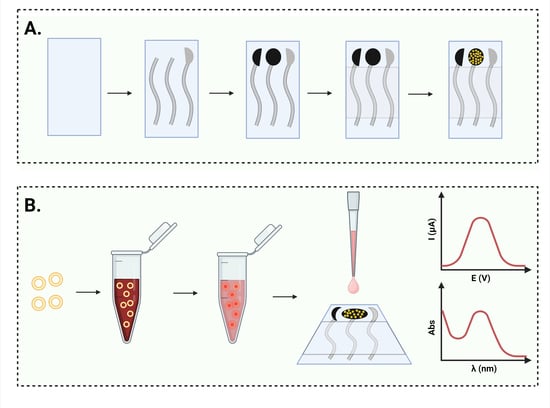
Electrode fabrication workflow and conceptual glucose-to-current transduction. (A) Preparation of AuNP-electrodeposited graphite electrodes followed by PQ immobilization and drop-casting of yeast sensing-layer variants (Sc, Sc:Au, Sc:PPy, Sc:PPy:Au). AuNP deposition was performed by CV (0.0–1.0 V, 0.05 V s−1; 10–70 cycles). (B) Conceptual mediator-assisted mechanism: Glucose metabolism increases intracellular reducing power which is harvested via the immobilized quinone mediator (PQ) and the ferri-/ferrocyanide couple and collected as anodic current at the electrode.
  • Communication
  • Open Access

A New Acridine-Based Fluorescent Sensor for the Detection of CN

  • Yiyuan Zhang,
  • Chen Zhou and
  • Evgeny Kovtunets
  • + 1 author

A novel acridine-based fluorescent sensor (Sensor ANT) for the highly selective and sensitive detection of cyanide ions (CN) was rationally designed and synthesized via the conjugation reaction of acridine-9-amine with 3-nitrophenyl isothiocyanate. The sensing mechanism is triggered by the specific interaction between exogenous CN and the hydrogen-bonding moieties within the sensor’s molecular framework, which induces a distinct fluorescence quenching response. Systematic titration experiments confirmed that Sensor ANT exhibits rapid response kinetics, excellent selectivity, and reliable qualitative/quantitative detection capabilities toward CN. Complementary biocompatibility assays, including in vitro cellular imaging and in vivo zebrafish experiments, further verified the promising application potential of this sensor in practical and biological detection scenarios. The detection limit (DL) of Sensor ANT for CN was calculated to be 2.89 × 10⁻⁷ M, with a 1:1 binding stoichiometry and a binding constant of 1.95 × 10⁴ M−1. These findings demonstrate that Sensor ANT represents a robust candidate for CN detection in environmental and biological systems.

12 March 2026

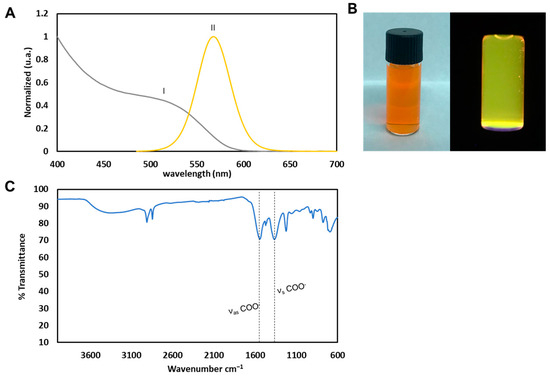
UV–Vis absorption spectra of Sensor ANT (5 × 10⁻⁴ mol/L) in the presence of different ions (5 × 10⁻⁴ mol/L) in ethanol/HEPES-NaOH buffer solution (v/v = 1:1, pH 7.4).

From Natural Pigments to Bioinspired Sensors: The Emerging Role of Melanins

  • Elena Cassera,
  • Anna Angeleri and
  • Andrea Capucciati
  • + 2 authors

The growing demand for sustainable, biocompatible, and multifunctional sensing materials has intensified interest in melanin and its derivatives, including melanin-inspired polymers and composites. Melanin is a naturally occurring biopolymer whose intricate structure and diverse chemical composition give rise to a remarkable combination of optical, electrical, and chemical properties. Key physicochemical characteristics, such as broadband optical absorption, hydration-dependent conductivity, redox activity, and metal ion coordination, are closely linked to melanin’s signal transduction capabilities and underpin its relevance in sensing applications. Recent advances in melanin-based sensing technologies encompass pH, humidity, chemical, biological, and optical platforms, with particular emphasis on hybrid systems incorporating graphene, silicon, or nanomaterials, and printable or wearable device architectures. These developments have enabled enhanced performance and broadened potential application fields. However, persistent challenges, including intrinsic heterogeneity, limited selectivity, relatively low electrical conductivity, and poor long-term operational stability, still limit practical implementation. Emerging molecular engineering and advanced fabrication strategies are being developed to address these limitations. Together, these findings position melanin as a versatile, eco-compatible, and functionally rich material, with a significant potential to underpin the next generation of sustainable sensing technologies.

10 March 2026

Principal classes of melanin polymers and their main source.

Investigation of CO2, NO2, SO2, and H2O Gas Adsorption on Al2O3, TiO2, and SiO2 Surfaces

  • Davron Sh. Kurbanov,
  • Komiljon R. Yakubov and
  • Smagul Zh. Karazhanov
  • + 4 authors

This study presents a unified first-principles investigation of CO2, NO2, SO2, and H2O adsorption on Al2O3 (001), TiO2 (001), and SiO2 (001) surfaces, establishing the first cross-material, chemically consistent benchmark for oxide–gas interactions. Calculated adsorption energies reveal strong chemisorption of SO2 and NO2 on Al2O3 and TiO2, moderate H2O binding—particularly on TiO2 where hydroxylation is favored—and generally weak CO2 interactions across all surfaces. Bader charge analysis provides atom-resolved insight into these trends, showing substantial electron transfer and pronounced oxygen-site polarization for strongly adsorbing gases, in contrast to the minimal charge redistribution characteristic of physisorbed CO2. These charge-transfer signatures distinguish binding mechanisms, clarify the origins of material-specific selectivity, and link adsorption to expected variations in surface conductivity and sensor response. The combined energetic and electronic analysis also reveals competitive effects between humidity and CO2 on surface hydroxylation and local electronic structure, a phenomenon critical for realistic sensing environments but previously unaddressed. Overall, this work delivers a rigorous comparative framework for understanding gas interactions with technologically relevant oxides and provides a solid foundation for future studies involving defects, dopants, surface reconstructions, and advanced functionalization strategies for environmental monitoring and energy-conversion devices.

9 March 2026

Schematic illustrations of the crystal structures for (a) Al2O3, (b) TiO2, and (c) SiO2 unit cells. (d) The adsorption configuration of a single H2O molecule on the anatase TiO2 (001) surface. Molecular structures of atmospheric gases such as (e) H2O, (f) CO2, (g) NO2, (h) SO2.

News & Conferences

Issues

Open for Submission

Editor's Choice

Reprints of Collections

Advanced Nanomaterials-Based (Bio)sensors for Electrochemical Detection and Analysis
Reprint

Advanced Nanomaterials-Based (Bio)sensors for Electrochemical Detection and Analysis

Editors: Iolanda Cruz Vieira, Edson Roberto Santana, João Paulo Winiarski
XFacebookLinkedIn
Chemosensors - ISSN 2227-9040