

- Article

Shade Stability of Dental Ceramics Under Low-Grade Hydrothermal Aging
- Suela Hoxha,
- Teuta Pustina-Krasniqi and
- Fisnik Aliaj
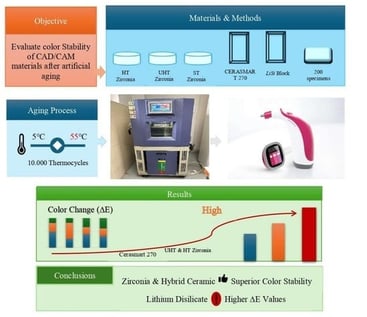
The aim of this in vitro study was to evaluate and compare the color stability of different CAD/CAM ceramic materials after artificial aging induced by thermocycling. Two hundred disk-shaped specimens were fabricated from five CAD/CAM materials: high-translucent zirconia (HT), ultra-high-translucent zirconia (UHT), standard translucent zirconia (ST), a polymer-infiltrated hybrid ceramic (CERASMART 270), and a lithium disilicate glass-ceramic (GC Initial LiSi Block). Color measurements were performed at baseline and after 10,000 thermocycling cycles (5–55 °C) using a VITA Easyshade® spectrophotometer. Color coordinates (CIE L*, a*, b*) and overall color differences (ΔE) were calculated. Statistical analysis was applied to determine material-dependent differences. All materials exhibited statistically significant color changes after thermocycling (p < 0.001). The color change varied by material. Lithium disilicate showed the highest ΔE values, whereas UHT, HT zirconia and CERASMART 270 showed lower color changes, yielding results within clinically acceptable limits. Color stability after thermocycling is highly material-dependent. Zirconia-based and polymer-infiltrated ceramics showed superior optical aging resistance compared to lithium disilicate ceramics, indicating their clinical suitability for long-term esthetic CAD/CAM restorations.
27 February 2026