Skip Content
You are currently on the new version of our website. Access the old version .

Ceramics

Ceramics is an international, peer-reviewed, open access journal of ceramics science and engineering, published monthly online by MDPI.

Quartile Ranking JCR - Q2 (Materials Science, Ceramics)

All Articles (707)

Longquan celadon represents the pinnacle of Chinese celadon, and there are many kilns in southern China that imitate Longquan celadon. During the Ming Dynasty, Jianyang Bowl Kiln was the representative kiln in Fujian Province for imitating Longquan celadon, while Jingdezhen Kiln was the representative kiln in Jiangxi Province for imitating Longquan celadon. The quality of both is close to that of Longquan celadon, making it difficult to distinguish by ordinary visual observation. This study focuses on Jianyang Bowl Kiln and Jingdezhen Kiln imitating Longquan celadon, comprehensively employing methods such as EDXRF, LA-ICP-MS, and chromaticity analysis to systematically investigate the similarities and differences in the composition of their body and glaze. The results indicate that distinct differences exist in the composition of trace and rare earth elements between the imitations of Longquan celadon produced by Jianyang Bowl Kiln and Jingdezhen Kiln, and authentic celadons from Longquan Kiln, which can serve as important criteria for distinguishing kilns. This provides systematic scientific data support for identifying the technological origins and production locations of Ming Dynasty imitations of Longquan celadon.

9 February 2026
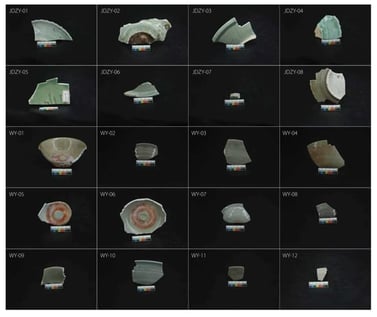
Samples of celadon from Jianyang Bowl Kiln and Jingdezhen Kiln.

The selective removal of radioactive cesium-137 and strontium-90 from high-salinity radioactive wastewater remains a critical challenge, as competing ions reduce adsorption efficiency and selectivity. In this study, high-performance granulated adsorbents were developed based on alkali-activated geopolymer matrices to enhance sorption performance. The adsorbents were synthesized by inorganic polymerization, and mechanically robust granules with controlled porosity and surface chemistry were obtained. Batch sorption experiments conducted in simulated seawater demonstrated greater than 99% removal efficiencies for cesium and strontium. Isotherm modeling confirmed high maximum sorption capacities (up to 0.41 meq/g for Cs+ and 5.07 meq/g for Sr2+). Continuous fixed-bed column tests demonstrated sustained removal efficiencies for the optimized adsorbents. Structural analyses, including scanning electron microscopy, energy-dispersive X-ray spectroscopy mapping, and X-ray diffraction, confirmed uniform elemental distribution and crystalline phases consistent with selective sorption mechanisms. Assessment of mechanical strength revealed sufficient compressive strengths to ensure operational durability under hydraulic stress. These findings demonstrate that the synthesized geopolymer-based granules are a potentially effective and versatile solution for the comprehensive treatment of radioactive wastewater.

9 February 2026

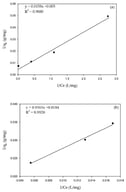
Langmuir isotherm adsorption curve of (a) ACSr, a granular form of ZA, for strontium ions and (b) NCGO, a granular form of NCFC, for cesium ions at 25 °C.

Dielectric capacitors, characterized by ultra-fast charge/discharge speeds and high power densities, are widely used in modern electronic power systems. However, their low energy density and poor thermal stability limit applications. In this study, SrBi3.25La0.75Ti4O15 (SBLT) ferroelectric thin films were prepared by the sol–gel method. We systematically investigated the effect of annealing temperature on microstructural evolution, electrical properties, and energy storage performance. The SBLT film annealed at 700 °C exhibited optimal performance, achieving a balanced enhancement in polarization and breakdown strength, with an energy storage density of 48.66 J cm−3 and an efficiency of 78%. The material also demonstrated excellent thermal stability (30–175 °C) and frequency stability (0.1–100 kHz). These findings not only validate the potential of SBLT as a next-generation energy storage dielectric but also provide a practical solution for applications in semiconductor technology.

9 February 2026

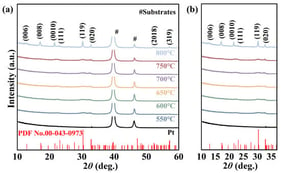
(a) XRD patterns of SBLT thin films annealed at different temperatures (550–800 °C) and the bare Pt/Ti/SiO2/Si substrate; (b) enlarged view of the XRD patterns in the low-angle region (10–37°). The symbol “#” denotes diffraction peaks originating from the substrate (Pt/Ti/SiO2/Si).

Valorizing construction and demolition waste (CDW) via alkaline activation enables low-carbon binders. This study assesses binary geopolymers formulated with recycled brick powder (PLR) and recycled concrete powder (PCR) in seven precursor ratios (0–100% PCR), activated with a ternary NaOH/Na2SiO3/KOH solution (silicate modulus Ms ≈ 3.2) at L/B = 0.15, and cured for 7, 14, and 28 days. Compressive strength (fc), X-ray diffraction (XRD), Fourier transform infrared spectroscopy (FTIR), and scanning electron microscopy with energy-dispersive X-ray spectroscopy (SEM-EDS) were used to link microstructure–phases–properties. A local maximum in fc at ~30% PCR (16.2 MPa at 28 d) was observed versus 0% PCR (14.2 MPa) and ≥50% PCR (13.8 → 10.1 MPa at 28 d). XRD indicated a reduction in inherited crystalline phases and an increased amorphous fraction at ~30% PCR; FTIR (normalized peak position and FWHM of the T–O–Si band, not absolute intensity) suggested higher network extension; SEM-EDS (local/semiquantitative) showed a moderate rise in Ca that supports C-A-S-H domains bridging the N-A-S-H network. At a high PCR, excess Ca simplified mineralogy (quartz/portlandite dominance), promoted competitive routes (C-S-H/carbonation), reintroduced microdefects, and reduced fc. A theoretical oxide balance per mix identified a compositional window where Ca/(Si + Al) ≈ 0.35–0.45 coincides with the mechanical optimum and with XRD/FTIR tracers. Overall, a ~30% PCR window maximizes co-reticulation of N-A-S-H/C-A-S-H and densification without compromising aluminosilicate continuity, providing transferrable design and process-control criteria for CDW-based geopolymer binders.

5 February 2026

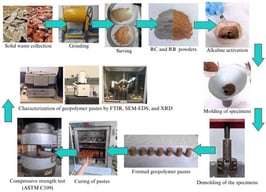
Experimental procedure workflow: conditioning of PCRs/PLRs → activator preparation → mixing → molding/compaction → pre-curing at 40 °C for 72 h → curing to 7/14/28 days → characterization (fc, XRD, FTIR, SEM–EDS).

News & Conferences

Issues

Open for Submission

Editor's Choice

Reprints of Collections

Transparent Ceramics
Reprint

Transparent Ceramics

a Theme Issue in Honor of Dr. Adrian Goldstein
Editors: Yiquan Wu
Innovative Manufacturing Processes of Silicate Materials
Reprint

Innovative Manufacturing Processes of Silicate Materials

Editors: Maurice Gonon, Sandra Abdelouhab, Gisèle Laure Lecomte-Nana

Get Alerted

Add your email address to receive forthcoming issues of this journal.

XFacebookLinkedIn
Ceramics - ISSN 2571-6131