Skip Content
You are currently on the new version of our website. Access the old version .

Catalysts

Catalysts is an international, peer-reviewed, open access journal of catalysts and catalyzed reactions, published monthly online by MDPI.
The Romanian Catalysis Society (RCS) is affiliated with Catalysts and its members receive discounts on the article processing charges.
Quartile Ranking JCR - Q2 (Chemistry, Physical)

All Articles (11,162)

Strong metal–support interactions (SMSI) are widely recognized as a powerful strategy for tuning catalytic selectivity and stability. However, a clear understanding of how controllable parameters govern SMSI strength and its impact on reaction pathways remains limited. In this work, the effect of hydrogen pretreatment temperature and Ni particle size on the SMSI behavior of Ni/TiO2-A catalysts and their catalytic performance in guaiacol hydrodeoxygenation (HDO) was systematically investigated. The results reveal a size-dependent SMSI behavior governed by the degree of metal encapsulation: small Ni particles (1–2 nm) are fully encapsulated by TiOx species, leading to suppression of aromatic ring hydrogenation, whereas larger Ni particles (~15 nm) are partially covered and retain aromatic hydrogenation activity. At 600 °C reduction, nearly complete Ni coverage suppresses aromatic hydrogenation sites, leading to selective formation of phenolic compounds. This study highlights that Ni particle size and reduction conditions jointly control SMSI strength, which in turn governs the catalyst activity and selectivity, providing guidance for rational design of SMSI catalysts.

8 February 2026
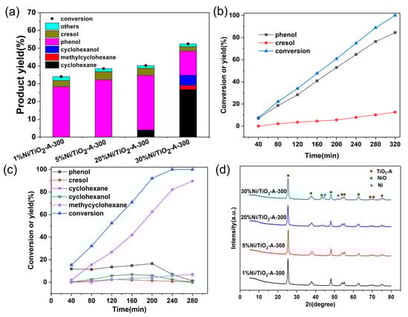
(a) Product yields in guaiacol HDO over Ni/TiO2-A catalysts with different Ni loadings after reduction at 300 °C for 1 h. “Others” in the products represent coke calculated based on mass balance. Reaction conditions: guaiacol 1.2 g, decane 25 mL, P(H2) = 4 MPa, 300 °C, 2 h. (b) Effect of reaction time on HDO of guaiacol over the 5%Ni/TiO2-A-300 catalyst. (c) Effect of reaction time on HDO of guaiacol over the 30%Ni/TiO2-A-300 catalyst. Reaction conditions: guaiacol 1.2 g, decane 25 mL, P(H2) = 4 MPa, 300 °C. (d) X-ray diffractograms of Ni/TiO2-A catalysts with different Ni loadings after reduction at 300 °C for 1 h.

Investigation of Lignin-Based Catalysts’ Effectiveness and Constraints in Selective Hydrogenation

  • Mahendra Kothottil Mohan,
  • Nadiia Shevchenko and
  • Yevgen Karpichev
  • + 4 authors

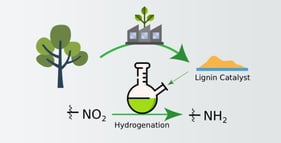
Lignin’s complex structure makes it a valuable resource for producing aromatic chemicals, but selectively converting it into specific products remains challenging. This study explores the use of technical hydrolysis lignin as a renewable support for palladium (Pd) and copper (Cu) catalysts in hydrogenation reactions. The materials were characterized using NMR, FTIR, XRF, AAS, XPS, and TEM. The reduction of nitrobenzene to aniline was tested with various Pd/Cu catalysts with different metal contents. The hydrogenation results showed that the Pd-only catalyst (catalyst-1) performed best on most substrates. In contrast, catalysts with only Cu or with Pd-Cu bimetallic showed no catalytic activity. The study discusses the effects of Pd incorporation and the Pd-Cu synergistic effect on catalyst stability, highlighting potential limitations in active-site stability and suggesting ways to enhance catalyst longevity. Overall, this research reveals that lignin is a promising, renewable support for catalysts, offering alternatives to traditional supports. These findings provide valuable insights into improving lignin modification and developing eco-friendly catalytic processes aligned with green chemistry principles.

6 February 2026

1H NMR spectra of hydrolysis lignin (HL), chloromethylated lignin (CML), and imidazoilium functionalized lignin (ImL); DMSO-d6.

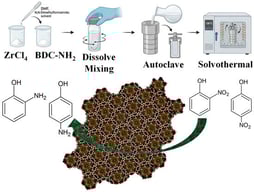
This study investigates the synthesis, dual functional applications, and electrochemical performance of the amine-functionalized metal-organic framework (MOF), namely UiO-66-NH2. The material was synthesized via the solvothermal method and characterized by X-ray diffraction (XRD), Fourier transform infrared spectroscopy (FT-IR), and scanning and transmission electron microscopy (SEM/TEM). UiO-66-NH2 was assessed as a catalyst for the reduction of nitroarenes, specifically 2-nitrophenol (2-NP) and 4-nitrophenol (4-NP), under both dark and photo-assisted (i.e., photocatalysis) conditions. Complete photoreduction of nitroarenes was achieved under photocatalysis, highlighting its photo-assisted catalytic efficacy. UiO-66-NH2 before and after nitroarenes adsorption capacities were investigated, and subsequent electrochemical assessments confirmed its suitability as a supercapacitor electrode. Cyclic voltammetry (CV) and galvanostatic charge–discharge (GCD) analyses demonstrated that nitroarene adsorption and light irradiation markedly improved specific capacitance. 2-NP@UiO-66-NH2 showed specific capacitance of 221 F/g at 1 A/g under UV radiation. UiO-66-NH2 demonstrated remarkable cycling stability (100%) across 7000 cycles. Structural and property modifications of UiO-66-NH2, adsorption of redox-active species, and photo-assisted mechanisms can significantly enhance the energy storage efficacy. The results illustrate the dual role of UiO-66-NH2 as an effective photo-assisted catalyst and electroactive supercapacitor material, facilitating integrated environmental remediation and energy storage applications.

5 February 2026

Synthesis procedure for UiO-66-NH2 and its application for nitroarenes reduction.

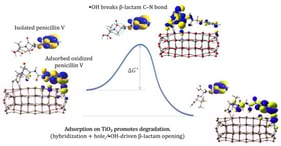
A promising route for removing antibiotics such as penicillin from wastewater is photocatalytic degradation under UV irradiation using TiO2 nanoparticles. However, the microscopic mechanisms governing the initial degradation steps remain poorly understood. In particular, it is still unclear whether degradation preferentially occurs in solution or upon adsorption on the oxide surface, and which molecular sites are most vulnerable to attack in solution compared to those activated on the catalyst. In this work, we introduce a unified density functional theory approach that treats penicillin V (phenoxymethylpenicillin) consistently, both isolated in solution and adsorbed on an anatase TiO2 nanocluster, enabling a direct comparison between solution-phase and surface-mediated degradation pathways. Within this framework, we analyze the adsorption configurations, energy-level alignment, charge-transfer pathways, UV-Vis absorption properties, local reactivity descriptors, and the initial steps leading to bond breaking. The results show that the direct photoexcitation of PenV followed by electron transfer to the oxide is less likely, due to the high energy of the pollutant’s excited states. In contrast, degradation initiated by the transfer of photogenerated holes from the catalyst to the adsorbed antibiotic appears more probable, driven by the smaller energetic offset and by the hybridization between molecular and oxide states. Overall, adsorption on the oxide surface appears to be more conducive to degradation, with the carbon atom in the β-lactam ring consistently identified as a susceptible site for attack across different environments.

5 February 2026

Optimized structure of (a) neutral and (b) deprotonated (carboxylate) PenV. Atom labeling is illustrated in (c). Atom colors: C—dark gray, O—red, S—yellow, N—blue, and H—light gray.

News & Conferences

Issues

Open for Submission

Editor's Choice

Reprints of Collections

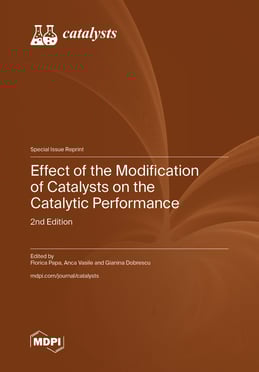
Effect of the Modification of Catalysts on the Catalytic Performance
Reprint

Effect of the Modification of Catalysts on the Catalytic Performance

2nd Edition
Editors: Florica Papa, Anca Vasile, Gianina Dobrescu

Get Alerted

Add your email address to receive forthcoming issues of this journal.

XFacebookLinkedIn
Catalysts - ISSN 2073-4344