

- Article

Rectifying and Photoconductive Responses in Graphene–Double-Insulator–Graphene (GI2G) Structures
- Takashi Uchino,
- Yanjun Heng and
- Taiichi Otsuji
- + 3 authors
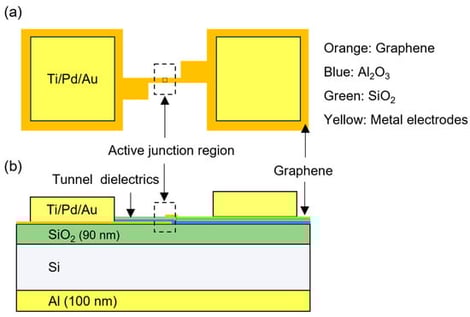
Advanced solar energy-harvesting devices, such as optical rectennas, typically use metal–insulator–metal diodes because of the ultrafast response of these diodes at high frequencies. However, the diode performance is limited by weak current–voltage (I–V) asymmetry and optical losses in metallic electrodes. Graphene offers a promising alternative electrode material owing to its high carrier mobility, broadband optical transparency, and compatibility with nanoscale device architectures. Nevertheless, graphene-based optical rectennas face challenges associated with insufficient diode nonlinearity. In this study, we developed a vertically stacked graphene–double-insulator–graphene (GI2G) tunnel diode. Devices with various junction sizes were fabricated to investigate size-dependent rectifying behavior. A reduced graphene overlap area was defined by electron-beam lithography to introduce asymmetry and increase nonlinear conduction. An Al2O3/SiO2 tunnel barrier composed of dielectrics with different band gaps and electron affinities improved the asymmetric I–V characteristics. Photoresponse measurements under AM1.5G illumination revealed a clear photocurrent, indicating rectification-related photoresponse. The photoresponse increased with decreasing junction area, which is consistent with enhanced rectification performance in smaller junctions. These results demonstrate that the GI2G tunnel diode provides a promising platform for next-generation energy harvesting and optical sensing applications.
20 February 2026