Skip Content
You are currently on the new version of our website. Access the old version .

All Articles (34,927)

Background/Objectives: Immune checkpoint inhibitors (ICIs) have revolutionized the treatment landscape of advanced non-small cell lung cancer (NSCLC), yet 70% of patients experience disease progression, underscoring the critical need for predictive biomarkers. Programmed death-ligand 1 (PD-L1) expression remains the most adopted biomarker for ICIs. With the emergence of machine learning, the development of radiomics algorithms based on CT scan images has demonstrated potential as a novel addition to the biomarker landscape in oncology. In this study, we aimed to develop a non-invasive surrogate of PD-L1 expression (rad-PDL1) derived from computed tomography (CT) scan imaging and compare its predictive value to pathological assessments. Furthermore, we evaluated its generalizability across advanced and limited-stage NSCLC. Methods: Radiomics features extracted from pretreatment CT were analyzed using a self-training pipeline that incorporated the feature tokenizer Transformer model to classify tumors as high vs. low PD-L1 expression. We included 482 advanced NSCLC patients treated with ICIs across three medical centers who were divided into training and hold-out validation sets. The algorithm was then further validated in an independent cohort of 51 patients with limited NSCLC treated with neoadjuvant ICI and chemotherapy. Results: Our pipeline demonstrated strong predictive performance in primary and independent validation (AUC = 0.75 and 0.68, accuracy = 0.73 and 0.69, respectively), highlighting its generalizability and adaptability to various disease stages. Kaplan–Meier curves revealed a longer progression-free survival for patients in the high rad-PDL1. Conclusions: These results demonstrate the feasibility of a CT-based radiomic surrogate of PD-L1 expression, showing partial generalization to an independent neoadjuvant cohort, while highlighting the need for larger prospective multi-site validation before clinical implementation.

8 February 2026
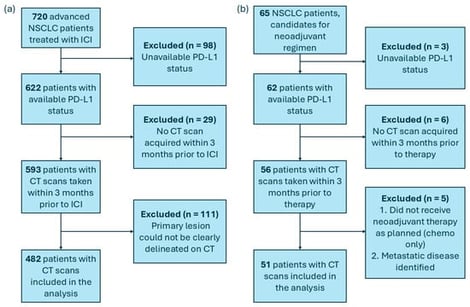
CONSORT-style diagram of patient selection in (a) the primary cohort and (b) the independent neoadjuvant cohort.
  • Perspective
  • Open Access

Lung cancer in never-smokers is increasingly recognized as a distinct clinical and biological entity, often enriched for actionable oncogenic alterations and characterized by molecular profiles that differ from tobacco-associated disease. However, therapeutic evidence for this growing patient population has frequently been extrapolated from trials in which smokers predominate, potentially limiting treatment optimization and biomarker-driven decision-making. In this review, we map and critically appraise clinical trials registered in ClinicalTrials.gov that explicitly target never-smokers with lung cancer, focusing on therapeutic strategies, molecular stratification approaches, trial design features, and temporal trends. We discuss how eligibility definitions, histological and genomic enrichment, and endpoints have been handled across studies, and we highlight persistent gaps in dedicated trial activity, particularly in prospective biomarker-guided designs and contemporary platform strategies. Finally, we propose priorities for future trials to better reflect never-smoker lung cancer biology, improve external validity, and accelerate evidence generation for personalized therapeutic approaches in this population.

8 February 2026

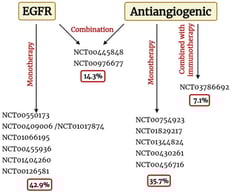
Distribution of clinical trials according to therapeutic target and treatment strategy in lung cancer. The figure summarizes the clinical trials previously identified, classified according to the main therapeutic target (EGFR or angiogenesis) and the treatment strategy employed (monotherapy or combination with other agents, including immunotherapy). The percentages indicate the proportion of clinical trials targeting a specific pathway relative to the total number of clinical trials analyzed, as well as their distribution across the different therapeutic approaches. Trials in which the combination involved only conventional chemotherapeutic agents and no other targeted therapies were included in the monotherapy group. Created in https://BioRender.com (27 January 2026).

The Paradox of Senescence in Glioblastoma: SASP as an Emerging Cancer Hallmark

  • Wataru Tarumi,
  • Kiyohito Murai and
  • Kenta Masui
  • + 1 author

Cellular senescence has been traditionally viewed as a tumor-suppressive program that halts its proliferation in response to oncogenic stress or DNA damage. However, recent studies have highlighted a paradoxical role for senescence in glioblastoma (GBM), IDH-wildtype, the most aggressive primary brain tumor in adults. Accumulating evidence indicates that senescence represents a “frequent and durable” cell fate in GBM, particularly following standard therapies such as temozolomide and radiotherapy. Senescent cells frequently persist after temozolomide or radiotherapy and acquire a senescence-associated secretory phenotype (SASP) composed of inflammatory cytokines, growth factors and matrix-remodeling enzymes. These factors not only promote tumor cell survival with stemness-induction but also reshape the pro-tumorigenic microenvironment with metabolic rewiring and immune evasion. Notably, senescence also arises in non-malignant cells—including astrocytes, endothelial cells, microglia, and infiltrating immune cells—creating a multicellular senescent niche that fuels recurrence. Here, we describe a recent advance in our understanding of senescence and SASP in the pathobiology of GBM. We further focus on a state-of-the-art, challenging exploration of the idea that single-cell and spatial profiling, capable of identifying senescence- and SASP-associated morphologic and heterogeneous states, will further refine patient selection and therapeutic timing. By reframing senescence as a modifiable determinant of GBM evolution, this review underscores its emerging significance as both a cancer hallmark and a therapeutic vulnerability.

8 February 2026

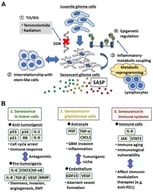
Induction, maintenance and consequences of senescence/SASP in GBM. (A) Induction and maintenance of senescence/SASP in GBM. Actively proliferating glioma cells could be induced and maintained in the senescent state with SASP by ① the effect of chemotherapeutics and radiation (TIS), ② the interaction of glioma stem-like cells, ③ inflammatory–metabolic coupling and ④ epigenetic regulation. (B) Consequences of senescence/SASP in GBM. Senescence in GBM cells shows anti-tumorigenic effects including cell cycle arrest and immune reaction, whereas it exerts pro-tumorigenic effects such as stemness, invasion, angiogenesis, and epithelial–mesenchymal transition (EMT). Senescence in glial/stromal cells creates a tumorigenic niche where senescent astrocytes promote tumor cell invasion and inflammation, and senescent endothelial cells contribute to abnormal vessel formation. Further, senescence in immune systems relates to immunological vulnerabilities and affects the effect of immune checkpoint inhibitors.

Background: Diffuse leptomeningeal glioneuronal tumors (DLGNT) are rare pediatric central nervous system tumors, first recognized in the 2016 WHO classification. Their clinical course is highly heterogeneous, and no international consensus treatment guidelines are currently available. This study aims to describe clinical characteristics, disease evolution, and management strategies for pediatric DLGNT patients, with a focus on aggressive forms. Methods: This retrospective, multicenter, international study (Belgium and France) included pediatric patients diagnosed with DLGNT between 1 February 2016 and 31 December 2024. Clinical, radiological, histopathological, molecular, and therapeutic data were collected. Findings were analyzed and contextualized through an extensive literature review. Results: Eleven patients were enrolled (median age: 8.2 years; median follow-up: 52 months). The median delay between the first MRI and definitive diagnosis was 6.5 months. Symptoms of intracranially elevated pressure were present in 55% of patients. Two-thirds of the patients presented with leptomeningeal dissemination at diagnosis. The primary tumor site could not be identified in two patients. A KIAA1549::BRAF transcript fusion was detected in 82% of cases, and chromosome 1q gain in 38%. All patients underwent surgery at diagnosis. The median number of therapeutic lines was four: 82% received chemotherapy (weekly vinblastine in 55%, vincristine/carboplatin regimen in 45%), 64% received MAPK pathway-targeted therapy, and 18% underwent radiotherapy. Five-year overall survival (OS) was 68.5%, and median progression-free survival (PFS) was 5.3 months after first-line therapy and 16.5 months after the second line. At the end of follow-up, only one patient achieved complete remission, and 78% of survivors presented with persistent neurological deficits. Conclusions: This study underscores the significant diagnostic delay, clinical heterogeneity, and absence of standardized therapeutic approaches in pediatric DLGNT patients. Conventional low-grade glioma chemotherapy constitutes the current treatment backbone, while MAPK pathway-targeted therapies show promising potential. Further studies and the establishment of an international registry are crucial to better characterize aggressive subtypes and optimize management strategies.

8 February 2026

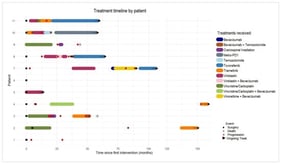
Treatment timeline by patient (swimmer plot).

News & Conferences

Issues

Open for Submission

Editor's Choice

Reprints of Collections

Management of Pancreatic Cancer
Reprint

Management of Pancreatic Cancer

Editors: Traian Dumitrascu
Advances in Pediatric and Adolescent Psycho-Oncology
Reprint

Advances in Pediatric and Adolescent Psycho-Oncology

Editors: Lori Wiener, Amanda L. Thompson

Get Alerted

Add your email address to receive forthcoming issues of this journal.

XFacebookLinkedIn
Cancers - ISSN 2072-6694