Skip to Content
You are currently on the new version of our website. Access the old version .

Buildings

Buildings is an international, peer-reviewed, open access journal on building science, building engineering and architecture published semimonthly online by MDPI.
The International Council for Research and Innovation in Building and Construction (CIB) is affiliated with Buildings and its members receive discounts on the article processing charges.
Quartile Ranking JCR - Q2 (Construction and Building Technology | Engineering, Civil)

All Articles (16,606)

Addressing the issues of the complex mechanical responses and significant spatial effects of asymmetric large-span cable-stayed steel box girder bridges with shared public-rail traffic under operational loads (live load, static wind, and structural temperature differences), this paper uses the Lijiatuo Yangtze River Double-Line Bridge on Chongqing Metro Line 18 as the engineering background to construct multi-scale finite element models for the entire bridge and the closure segment, and validates them against GNSS displacement and strain monitoring data from the actual bridge. The study shows that the spatiotemporal asymmetry of operational live loads induces significant lateral bias effects in the main bridge, resulting in reverse displacements in the mid-span section, and with stress distributions characterized by “oscillation in the side spans and concentration in the mid-span.” The study also shows that, under static wind loads, the bridge’s lateral displacement approximately increases linearly with wind speed, and the mid-span response is higher than that of the side spans, showing significant spatial sensitivity to wind loads. Finally, the study shows that, although the system temperature difference causes small overall displacements, it still induces symmetrical lateral deformations and local stress concentrations near the closure segment. Local refined analyses further reveal the displacement distribution mechanism of the closure segment under operational loads. The health monitoring data agree well with the simulation results, validating the reliability of the numerical model. The research systematically reveals the spatial mechanical behavior of such bridges under operational loads, providing theoretical basis and engineering references for the design optimization and safety monitoring of similar asymmetric cable-stayed bridges.

17 February 2026
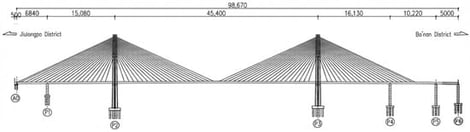
Layout of the main bridge structure (unit: cm).

To address the small ATC-63 record set for collapse-oriented motion selection and the limited interpretability of data-driven approaches, this study proposes a framework for identifying structural-collapse-critical ground motions. Using 5074 records from the PEER NGA-West2 database, we applied STA/LTA event detection and extracted multi-source features. A Gaussian mixture model (GMM) was then used to perform unsupervised clustering and identify four physically interpretable groups. LightGBM, XGBoost, and Random Forest were employed to test the separability of the cluster labels, with all three models achieving F1 scores above 0.89 and LightGBM reaching an accuracy of about 93%. SHAP-based feature-importance analysis was used at the model level to clarify feature contributions and improve interpretability. Cluster 2 exhibits markedly higher relative seismic energy, stronger time-domain variability, and more dominant frequencies, forming a typical strong-motion hazard signature. For external engineering verification, 22 ATC-63 far-field records were mapped onto the full dataset to examine cluster-level enrichment and coverage. Cluster 2 shows significant enrichment in engineering markers and high coverage and is therefore identified as the collapse-sensitive phenotype cluster (COP). Overall, the framework provides a technical basis for ground-motion selection in collapse assessment, fragility analysis, and design evaluation.

17 February 2026

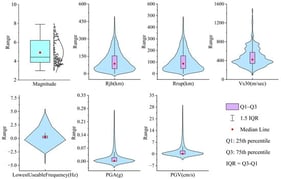
Statistical characteristics of the 21,336 ground motion records.

Urban waterfront walkways are everyday public built environments where people commonly engage in slow walking, yet evidence remains limited that links what pedestrians see to immediate psychophysiological responses under controlled first-person dynamic exposure. To address this gap, we developed a fixed-speed, fixed-duration VR walk-through model using real-world 360° panoramic video and quantified scene visual composition via computer vision-based image analysis. Based on the visible shares of key components (greenery, water, sky, hardscape, and built structures), clips were grouped into four interpretable waterfront typologies: Vegetation-Enclosed, Built-Dominant, Hardscape-Plaza, and Blue-Open. Fifty healthy adults completed within-subject VR exposures to the four typologies (50 s per clip), while multimodal physiological signals and brief affect and landscape ratings were collected before and after exposure. The results showed that scenes with more water and vegetation coverage, along with expansive views, were associated with promoted autonomic nervous system calming responses, whereas scenes with fewer natural elements and higher built structure density were more likely to induce tension responses. Negative emotions decreased significantly across all four scene experiences, though artificial scenes concurrently exhibited emotional improvement alongside physiological tension. Overall, brief first-person dynamic VR exposure can yield immediate emotional benefits, and waterfront designs combining water proximity, abundant greenery, and expansive vistas may maximize short-term restorative potential, offering quantitative targets for health-supportive planning and retrofitting.

17 February 2026

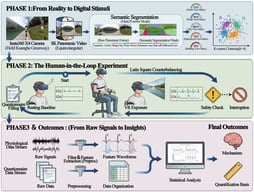
The overall research framework. The workflow consists of three phases: (1) Phase 1: From Reality to Digital Stimuli, involving panoramic data acquisition using an Insta360 X4 camera, semantic segmentation via the Mask2Former model to calculate visual indices (GVI, WVI, SKVI, HVI, and BVI), and K-means clustering to categorize scene types. (2) Phase 2: The Human-in-the-Loop Experiment, illustrating the specific experimental procedure arranged by Latin square counterbalancing. This phase comprises the cyclic process of questionnaire filling, resting baseline recording, dynamic VR exposure, and safety checks, with synchronous physiological monitoring (ECG, EDA). (3) Phase 3 and Outcomes (From Raw Signals to Insights), describing the data processing pipeline from raw signals to feature extraction and statistical analysis to derive statistical evidence and quantification basis.

The construction sector in developing countries continues to face persistent challenges related to cost overruns, projects delays, and compromised quality performance. In Oman, these concerns have hindered the ability of construction industry to achieve sustainable project success. This study aimed to empirically assess the effect of value management (VM) implementation on overall project success (OPS) in building projects in Oman using the partial least squares structural equation modelling (PLS-SEM). The questionnaire content was validated by 30 construction management experts using the content validity index (CVI). Data from 272 professionals across the construction sector in Oman were collected using a structured questionnaire to assess VM activities and OPS. The results indicated that VM implementation has a significant positive effect on OPS, with all phases except the creativity phase showing statistically significant relationships. The analysis showed a high coefficient of determination (R2 = 0.803) and a large effect size (f2 = 0.793), indicating that VM implementation explains over 80% of the variance in project success. Cost (β = 0.945) was the most significant success measure, followed by time (β = 0.883) and quality (β = 0.843). These results highlighted that the application of VM improves the performance of construction projects through the optimization of cost efficiency, improving scheduling reliability, and ensuring quality compliance. This study provided empirical evidence on the role of VM implementation in improving the overall project success by quantitatively linking VM phases to cost, time, and quality performance in developing countries. The findings offered practical guidance for policymakers and practitioners to integrate VM early in construction projects.

17 February 2026

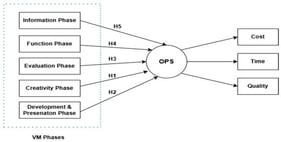
The proposed hypotheses of the study addressing the effects of VM phases on OPS.

News & Conferences

Issues

Open for Submission

Editor's Choice

Reprints of Collections

Advances in Road Pavements
Reprint

Advances in Road Pavements

Editors: Emanuele Toraldo, Misagh Ketabdari
Seismic Analysis and Design of Building Structures
Reprint

Seismic Analysis and Design of Building Structures

Editors: Bo Fu, Bo Wang, Xinxin Wei, Qing Lv

Get Alerted

Add your email address to receive forthcoming issues of this journal.

XFacebookLinkedIn
Buildings - ISSN 2075-5309