Skip Content
You are currently on the new version of our website. Access the old version .

Buildings

Buildings is an international, peer-reviewed, open access journal on building science, building engineering and architecture published semimonthly online by MDPI.
The International Council for Research and Innovation in Building and Construction (CIB) is affiliated with Buildings and its members receive discounts on the article processing charges.
Quartile Ranking JCR - Q2 (Construction and Building Technology | Engineering, Civil)

All Articles (16,486)

Accurate prediction and optimized control of shield tunneling attitude are critical for ensuring tunneling quality and construction safety. In karst and other highly heterogeneous strata, complex geological conditions and construction parameters exhibit significant nonlinear coupling, greatly increasing the difficulty of attitude regulation. To address this challenge, this study proposes a machine learning-based approach for the automatic control of shield tunneling attitude. First, a Tree-structured Parzen Estimator-optimized Light Gradient Boosting Machine predictive model is employed to construct a nonlinear mapping model between construction parameters and shield tunneling attitude. Subsequently, the SHapley Additive exPlanations (SHAP) interpretability model is introduced to identify the core tunneling factors influencing attitude stability. On this basis, the developed predictive model is integrated into the multi-objective evolutionary algorithm based on decomposition (MOEA/D) framework as a fitness function to achieve multi-objective optimization of key construction parameters. Using field data from shield tunneling construction in the karst strata of Shenzhen Metro Line 16, the proposed model achieved prediction accuracies of R2 = 0.959 for pitch and R2 = 0.936 for roll, outperforming XGBoost, Random Forest, Long Short-Term Memory, and Transformer baselines. SHAP analysis identified the partitioned propulsion thrust, partitioned chamber pressure, cutterhead rotational speed, and advance rate as key parameters influencing attitude. Further, MOEA/D optimization generated a Pareto set of construction parameters, from which the optimal solution was selected using the ideal point method, resulting in reductions of 26.45% and 39.47% in pitch and roll deviations, respectively. These findings demonstrate the feasibility and effectiveness of the proposed method in achieving high-precision prediction and intelligent optimization control of shield tunneling attitude under complex geological conditions, providing a reliable technical pathway for metro and tunnel construction projects.

8 February 2026
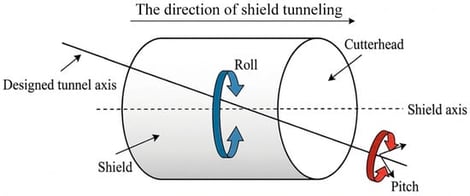
Schematic diagram of shield tunneling attitude parameters: roll and pitch.

Tornadoes represent a significant natural hazard to critical infrastructure worldwide, as they can cause sudden and severe damage with far-reaching societal consequences. In this study, the authors investigate the vulnerability and resilience of public and critical infrastructure buildings in the Czech Republic to tornado impacts, with a particular focus on the 2021 South Moravian tornado. The research identifies key structural weaknesses, damage patterns, and protective factors through a detailed field survey of 46 tornado-affected buildings. The results highlight that building size, construction quality, material durability, and maintenance significantly influence tornado resistance. Buildings of reinforced concrete and steel frames showed higher resistance, while older, inadequately maintained masonry and timber buildings were highly susceptible to collapse. The conclusions recommend regular maintenance of building, structural reinforcement, installation of protection elements and robust roof system of public buildings. These insights provide a practical foundation for strengthening disaster preparedness policies at regional or national levels.

8 February 2026

Kernel-smoothed tornado reports from the ESWD [13].

The lighting environment has transcended purely functional illumination and has evolved into a critical medium for orchestrating narrative rhythm and modulating audience emotional responses. However, existing studies often examine photometric properties and human emotional responses in isolation, failing to establish a quantitative coupling mechanism to elucidate the relationship between light distribution, visual attention, and emotional states. This study aims to quantify the coupling mechanisms between luminous environmental parameters (illuminance and CCT), visual attention distribution, and emotional states (PAD) in immersive narrative exhibition spaces for the optimization of visitor experience. Four screen-based simulated narrative scenes were constructed with different illumination levels (low/high) and four levels of correlated color temperature (2700 K, 3000 K, 4000 K, and 5000 K). Using the SIFT algorithm, the illuminance pseudo-color map and the eye-tracking heat map were spatially registered to quantify the spatial correlation between the physical light field and the visual attention field. The results demonstrate a significant nonlinear coupling effect: high-illuminance cold light (4000 K, 544 lx) establishes a strong guidance mechanism, with a high spatial correlation between visual attention and brightness (r = 0.82), which significantly enhances physiological arousal and perceived dominance. Conversely, low-illuminance warm light (2700 K, 150 lx) leads to a weak coupling state (r = 0.62), which promotes free visual exploration, thereby improving pleasure and perceived immersion. These results suggest that lighting design should not be treated as a fixed set of parameters, but rather as an adjustable strategy that responds to changes in visual attention and emotional experience. By modifying the strength of visual and optical interaction, lighting conditions can influence how visitors move from initial perception to emotional engagement. This provides practical support for applying evidence-based lighting strategies in the design of cultural heritage spaces.

8 February 2026

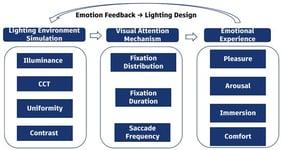
Conceptual framework of the “Light-Vision-Emotion” coupling model.

After a shear-type strongly braced steel frame suffers from non-sway buckling, the effective length factor for columns in a non-sway frame should be selected for stability calculations, and the P-δ effect should be considered for second-order analysis. However, an unreasonable design may result if the shear-type bracing cannot be accurately and practically designed to meet the strong bracing requirements. In this paper, an analytical method for the critical bracing design of shear-type strongly braced steel frames is proposed. First, the relationship between the shear-type bracing stiffness and buckling load of structures is analyzed, and then the calculation formula for the story critical bracing stiffness is derived based on the critical bracing stiffness of the separation column. Furthermore, the relationship between the cross-sectional properties of the shear-type brace members and the critical bracing lateral stiffness is established. Based on this, a direct calculation formula for the critical brace area of shear-type strongly braced steel frames is derived. This formula can determine whether a shear-type braced steel frame will experience sidesway or non-sway buckling, thereby providing a basis for selecting the appropriate approach for calculating the column effective length factor and second-order effects.

7 February 2026

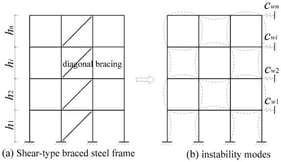
Equivalent diagram of a shear-type strongly braced steel frame.

News & Conferences

Issues

Open for Submission

Editor's Choice

Reprints of Collections

Seismic Analysis and Design of Building Structures
Reprint

Seismic Analysis and Design of Building Structures

Editors: Bo Fu, Bo Wang, Xinxin Wei, Qing Lv
Recent Studies in Static and Dynamic Behaviour of Engineering Structures
Reprint

Recent Studies in Static and Dynamic Behaviour of Engineering Structures

Editors: Xinzhi Dang, Zhihao Wang, Junfeng Jia, Xinxin Wei, Murat Dicleli

Get Alerted

Add your email address to receive forthcoming issues of this journal.

XFacebookLinkedIn
Buildings - ISSN 2075-5309