Skip Content
You are currently on the new version of our website. Access the old version .

Brain Sciences

Brain Sciences is an international, peer-reviewed, open access journal on neuroscience, published monthly online by MDPI.
The British Neuro-Oncology Society (BNOS) and Panhellenic Federation of Alzheimer's Disease and Related Disorders (PFADRD) are affiliated with Brain Sciences and their members receive a discount on article processing charges.

All Articles (10,025)

  • Systematic Review
  • Open Access

Association Between Homocysteine, Vitamin B12, Folate and Migraine: An Updated Systematic Review and Meta-Analysis

  • Islamia Ibrahim Ahmed Omer,
  • Eman A. Kubbara and
  • Hamdan Z. Hamdan
  • + 2 authors

Background: Migraine is a neurovascular disease; its pathogenesis has been linked to higher levels of homocysteine (Hcy) and/or deficiencies in vitamins (vitamin B12 and folate). However, previously published studies remained inconclusive. Therefore, the aim of this study is to review the literature to update the current evidence and clarify the association between Hcy, vitamin B12, folate and migraine in adult and pediatric patients. Methods: We searched the databases PubMed, ScienceDirect, Google Scholar, and the Cochrane Library for articles that investigated levels of Hcy, B12, and folate in association with migraine headaches, since inception through December 2025. The package “meta” in R software was used to calculate the standardized mean difference (SMD) of Hcy, B12 and folate in cases of migraine and compared with non-migraine controls. Results: A total of 17 studies (15 case–control and 2 cross-sectional) investigated the levels of Hcy, encompassing 1549 cases of migraine and 1824 non-migraine controls. The random effect model showed a significantly higher SMD for Hcy in migraine cases compared with non-migraine controls [SMD = 0.48, 95% CI (0.12; 0.83); p < 0.01; I2 = 91.0%]. Stratification analysis showed the same trends in a group of studies that was conducted in European countries [SMD = 0.29; 95% CI (0.04; 0.54); p = 0.02; I2 = 87.0%] and group of studies that used analytical methods other than immunoassays [SMD = 0.28; 95% CI (0.08; 0.49); p < 0.001; I2 = 84.0%]. Meta-regression results showed that only the year of publication had a significant positive effect [estimation coefficient = 0.087; p = 0.017]. Serum levels of vitamin B12 control [16 studies included 1330 cases vs. 1533 controls, SMD = −0.36, 95% CI (−0.62; −0.10); p < 0.01; I2 = 92.1%] and folate [10 studies included with 793 cases vs. 1011 controls, SMD = −0.25 [−0.47; −0.04], p = 0.02; I2 = 77.3%] were found to be significantly lower in migraine cases compared with non-migraine cases, respectively. Conclusions: Adult and pediatric patients with migraine had elevated Hcy levels and lower vitamin B12 and folate levels. Clinicians may check and correct for Hcy, vitamin B12, and folate levels as prophylactic and therapeutic interventions for migraine. Further studies with a longitudinal design are needed to establish a causal relationship.

11 February 2026
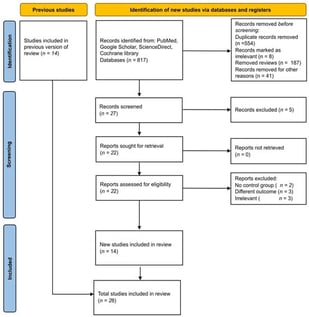
Study flowchart demonstrating study selection.
  • Systematic Review
  • Open Access

Background: Rapid Eye Movement (REM) sleep behavior disorder (RBD) is a parasomnia resulting from degeneration of pontine and medullary circuits responsible for muscle atonia during REM sleep, leading to dream-enactment behaviors and vocalizations. It is strongly linked to α-synucleinopathies, particularly Parkinson’s disease. Current biomarkers such as neurophysiological measures and imaging support diagnosis and monitoring, but remain invasive or costly. Aim: This study aims to evaluate vocal and speech alterations as exploratory, non-validated candidate biomarkers of REM sleep behavior disorder. Methods: A systematic review was conducted according to PRISMA 2020 guidelines. PubMed, IEEE Digital Library Web of Science, Embase and the Cochrane Library were systematically searched for studies published from database inception to November 2025, as preregistered on the Open Science Framework. Studies were selected through a multi-step screening process and underwent qualitative quality assessment. Results: Twelve studies met inclusion criteria. Individuals with RBD exhibited abnormal nocturnal vocalizations and early lexical, syntactic, and narrative disruptions despite preserved perceptual speech. Quantitative analyses identified consistent deficits in prosody, phonation stability, timing, and articulation, with significant group differences and diagnostic accuracy up to 96% sensitivity. Multilingual cohorts demonstrated progression over time, while digital phenotyping detected emerging Parkinsonian signs with AUC > 0.70. Conclusions: Speech and vocal abnormalities in iRBD reflect early neurodegenerative changes and show promising but still exploratory diagnostic and prognostic potential. Integrating vocal markers with established biomarkers may enhance early detection; however, further research is required to validate a reliable and reproducible vocal signature of prodromal synucleinopathies.

11 February 2026

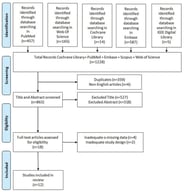
Process of study selection.

Background: Engagement of the NF-κB signaling pathway is crucial for controlling immune and inflammatory gene expression within the central nervous system (CNS). Naringenin, a flavonoid derived from citrus fruits, is known for its anti-inflammatory and antioxidant effects; however, its impact on LPS-induced neuroinflammation in HMC3 (human microglial) and SH-SY5Y (neuronal) cell lines has not been thoroughly studied. Objectives: We sought to ascertain the neuroprotective role of Naringenin in LPS-induced neuroinflammation in microglia and neuronal cell lines with a focus on modulation of the NF-κB signaling pathway. Methods: LPS treatment was given to HMC3 cells to induce an inflammatory response, besides the secretome of HMC3 cells was transfered to SH-SY5Y cells with the administration of Naringenin. A cell viability assay, ROS level measurements, Western blotting, and immunocytochemistry were employed to quantify and localize NF-κB and pro-inflammatory cytokines (TNF-α, IL-6, IL-1β). Nuclear fractions of NF-κB were analyzed to screen its activation and translocation. Results: Naringenin treatment led to a dose-dependent decrease in LPS-induced reactive oxygen species (ROS) production. It significantly reduced the expression of pro-inflammatory cytokines and inhibited NF-κB activation in HMC3 cells. The nuclear translocation of NF-κB was notably diminished after treatment, as demonstrated by both Western blot and immunocytochemistry. These results suggest that Naringenin exerts an anti-inflammatory effect by suppressing the NF-κB signaling pathway. Conclusions: The findings suggest the potential therapeutic role of Naringenin using in vitro models in mitigating neuroinflammation through modulation of the NF-κB signaling pathway.

11 February 2026

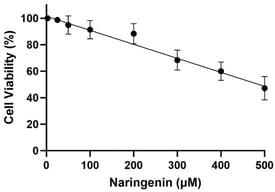
The impact of different concentrations of Naringenin on the survival of normal HMC3 cells. In the experiment, cell lines were treated with Naringenin at concentrations of 25–500 µg/mL for 24 h. Subsequently, an MTT assay was employed to measure cell viability. The reported values are presented as mean ± SEM and expressed as a percentage relative to untreated control samples.

Cognitive impairment (CI) is a common and disabling manifestation of multiple sclerosis (MS), yet it remains underdiagnosed in clinical settings. This study aims to identify the volumetric MRI markers of CI in MS patients. A total of 79 MS patients were enrolled; after exclusions, 63 with relapsing-remitting MS (RRMS) and 7 with primary progressive MS were analyzed. All participants underwent neuropsychological testing (CVLT, BVRT, CTT, VFT, VST, and SDMT). Brain volumes were analyzed using FreeSurfer. In RRMS, 59% had CI (35% single-domain, 24% multidomain). Multidomain CI was linked to reduced left cerebellar white matter and bilateral pallidum volumes, slight choroid plexus enlargement, and higher lesion volume versus cognitively preserved patients. Significant correlations were found between brain volumes and cognitive test scores: cerebellar and cerebral white matter, corpus callosum, subcortical gray matter, and thalamus volumes correlated positively with measures of processing speed, memory, and verbal fluency, while higher lesion load and larger choroid plexus volumes were associated with poorer cognitive performance. CI in MS is linked to both global and regional brain atrophy, as well as lesion load. Volumetric MRI, including choroid plexus analysis, may represent candidate imaging correlates of CI; however, longitudinal and externally validated studies are needed to confirm their predictive value and clinical utility.

11 February 2026

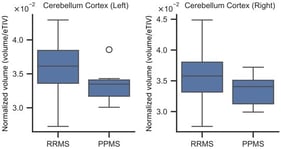
Cerebellum cortex volume normalized by estimated Total Intracranial Volume (eTIV) in patients with relapsing-remitting (RRMS) and primary progressive multiple sclerosis (PPMS).

News & Conferences

Issues

Open for Submission

Editor's Choice

Reprints of Collections

Future Challenges for the Diagnosis and Management of Affective Disorders
Reprint

Future Challenges for the Diagnosis and Management of Affective Disorders

From Preclinical Evidence to Clinical Trials
Editors: Antonio Ventriglio, Mario Luciano, Andrea Fiorillo
Recent Advances in Assessment and Rehabilitation of Individuals with Communication and Language Disorders
Reprint

Recent Advances in Assessment and Rehabilitation of Individuals with Communication and Language Disorders

Editors: Dionysios Tafiadis, Nafsika Ziavra, Louiza Voniati, Angelos Papadopoulos

Get Alerted

Add your email address to receive forthcoming issues of this journal.

XFacebookLinkedIn
Brain Sci. - ISSN 2076-3425