Skip Content
You are currently on the new version of our website. Access the old version .
  • 31 days
    Time to First Decision

Blockchains

Blockchains is an international, peer-reviewed, open access journal on blockchain and its applications published quarterly online by MDPI.

All Articles (45)

Traditional Human Resource Management (HRM) systems are criticized for lacking transparency, being inefficient, and offering ample opportunities for fraud because of their centralized design and reliance on manual processes. This work proposes a blockchain-enabled framework for HRM that enhances the transparency, trust, and global mobility of talents by integrating distributed ledgers, consensus protocols, and smart contract networks into Human Resources (HR) functions. A four-layer theoretical model—data, consensus, smart contract, and application layers—is developed and comparatively examined against traditional HR systems to show how blockchain principles can be systematically mapped into HR processes. This study shows how blockchain-driven HRM can ensure tamper-evident employee records, automate contractual and payroll operations, and enhance auditability and compliance. By informing the framework with established technology adoption perspectives, this paper extends both the theoretical and managerial understanding of blockchain in HR. In comparison with previous studies that were limited to either recruitment or credential verification, this article presents an overarching, cross-layer synthesis that connects blockchain architectures with end-to-end HR functions, thus providing a clear conceptual foundation for its future enterprise adoption in the digital economy.

8 January 2026
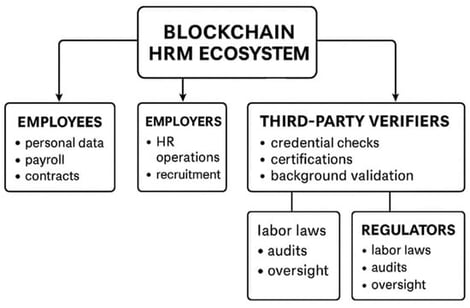
Stakeholder mapping in blockchain-enabled HRM ecosystem.

Blockchain-Enhanced Network Scanning and Monitoring (BENSAM) Framework

  • Syed Wasif Abbas Hamdani,
  • Kamran Ali and
  • Zia Muhammad

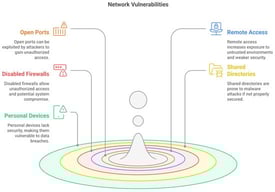
In recent years, the convergence of advanced technologies has enabled real-time data access and sharing across diverse devices and networks, significantly amplifying cybersecurity risks. For organizations with digital infrastructures, network security is crucial for mitigating potential cyber-attacks. They establish security policies to protect systems and data, but employees may intentionally or unintentionally bypass these policies, rendering the network vulnerable to internal and external threats. Detecting these policy violations is challenging, requiring frequent manual system checks for compliance. This paper addresses key challenges in safeguarding digital assets against evolving threats, including rogue access points, man-in-the-middle attacks, denial-of-service (DoS) incidents, unpatched vulnerabilities, and AI-driven automated exploits. We propose a Blockchain-Enhanced Network Scanning and Monitoring (BENSAM) Framework, a multi-layered system that integrates advanced network scanning with a structured database for asset management, policy-driven vulnerability detection, and remediation planning. Key enhancements include device profiling, user activity monitoring, network forensics, intrusion detection capabilities, and multi-format report generation. By incorporating blockchain technology, and leveraging immutable ledgers and smart contracts, the framework ensures tamper-proof audit trails, decentralized verification of policy compliance, and automated real-time responses to violations such as alerts; actual device isolation is performed by external controllers like SDN or NAC systems. The research provides a detailed literature review on blockchain applications in domains like IoT, healthcare, and vehicular networks. A working prototype of the proposed BENSAM framework was developed that demonstrates end-to-end network scanning, device profiling, traffic monitoring, policy enforcement, and blockchain-based immutable logging. This implementation is publicly released and is available on GitHub. It analyzes common network vulnerabilities (e.g., open ports, remote access, and disabled firewalls), attacks (including spoofing, flooding, and DDoS), and outlines policy enforcement methods. Moreover, the framework anticipates emerging challenges from AI-driven attacks such as adversarial evasion, data poisoning, and transformer-based threats, positioning the system for the future integration of adaptive mechanisms to counter these advanced intrusions. This blockchain-enhanced approach streamlines security analysis, extends the framework for AI threat detection with improved accuracy, and reduces administrative overhead by integrating multiple security tools into a cohesive, trustworthy, reliable solution.

26 December 2025

Illustration of common network vulnerabilities including open ports, remote access, disabled firewalls, and shared directories in enterprise networks.

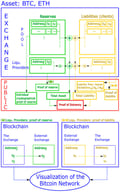
Trust in financial institutions hinges on the ability to prove solvency, yet recent crises have exposed the limits of audits and opaque governance. We introduce a practical protocol that enables crypto-exchanges and other financial actors to demonstrate real-time solvency without continuous third-party oversight, while preserving transparency and regulatory alignment. Complemented by a Particles model that fragments transactions to protect privacy and enhance liquidity, this framework integrates solvency, privacy, and governance into a unified standard. We argue that it represents a potential revolution in the financial industry.

18 November 2025

Protocol implementation for proof of solvency, regarding bitcoin or ether assets (the b’s are the balances, x designates the private key, and B the total Liquidity Providers liability).

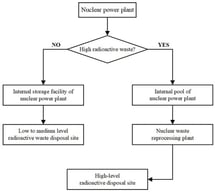
This study addresses critical challenges in managing the transportation of spent nuclear fuel, including inadequate data transparency, stringent confidentiality requirements, and a lack of trust among collaborating parties—issues prevalent in traditional centralized management systems. Given the high risks involved, balancing data confidentiality with regulatory transparency is imperative. To overcome these limitations, a technical framework integrating blockchain technology and the Internet of Things (IoT) is proposed, featuring a multi-tiered consortium chain architecture. This system utilizes IoT sensors for real-time data collection, which is immutably recorded on the blockchain, while a hierarchical data structure (operational, supervisory, and public layers) manages access for diverse stakeholders. This approach significantly enhances data immutability, enables real-time multi-sensor data integration, improves decentralized transparency, and increases resilience compared to traditional systems. It should be noted that the proposed framework is a theoretical study and has not yet been implemented or empirically validated, with practical deployment reserved for future work. Ultimately, this blockchain-IoT framework improves the safety, transparency, and efficiency of spent fuel transportation, effectively resolving the conflict between confidentiality and transparency in nuclear data management and offering significant practical implications.

15 October 2025

The process of spent nuclear fuel treatment.

News & Conferences

Issues

Open for Submission

Editor's Choice

Get Alerted

Add your email address to receive forthcoming issues of this journal.

XFacebookLinkedIn
Blockchains - ISSN 2813-5288