Skip to Content

Birds

Birds is an international, peer-reviewed, open access journal on ornithology published quarterly online by MDPI.

Quartile Ranking JCR - Q1 (Ornithology)

All Articles (234)

The combined effects of plateau pikas and yak grazing on the distribution or occupancy of endemic passeridae birds on the Qinghai-Tibetan plateau, China remain largely unknown. To assess habitat selection patterns within the frameworks of niche construction theory and the rivet hypothesis, we measured the occupancy rates of passeridae species along five sample strips of transects established in a treeless ecosystem. Each transect was surveyed three times within each seasonal sampling window (spring, summer, and autumn 2024), and repeated visits were treated as detection occasions for occupancy modeling. We used plateau pika density and yak grazing patterns as key variables to investigate their influence on the occupancy of alpine passeridae birds. We found that the occupancy of both the White-rumped and Rufous-necked Snowfinch was positively associated with proximity to yak bedding sites and high densities of plateau pika burrows. However, the occupancy of both species declined with increasing distance from yak bedding areas. In contrast, the Ground Tit showed no detectable association with these variables. This strong interspecific variation underscores the importance of disentangling mechanistic linkages among large herbivores, ecosystem engineers, and avian niche specialization in this fragile biome. Further research should explore how cross-taxa interactions mediate habitat availability and species resilience under ongoing environmental change.

24 February 2026
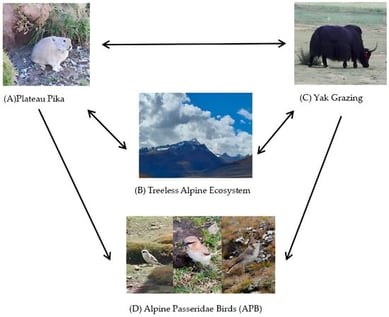
A schematic layout of the interactions studied: (A) plateau pikas as burrow engineers; (B) treeless alpine ecosystem as living habitat for species studied; (C) yak grazing as resource—modifying agents; (D) alpine passeridae bird species (White-rumped Snowfinch; Rufous-necked Snowfinch; Ground Tit) as mainly studied species. The arrow denotes the pathway that is impacted.

Ground-nesting shorebirds face growing pressure from recreational activities in coastal urban areas. We monitored the breeding success of Kentish Plover (Charadrius alexandrinus) and Little Ringed Plover (Charadrius dubius) over six consecutive years (2020–2025) at the Promenade of Sablettes, a heavily visited waterfront in Algiers, Algeria. We combined field surveys with multi-sensor remote sensing analysis using Sentinel-1, Sentinel-2, and Dynamic World data to quantify habitat change. A total of 105 nests were recorded across both species. Breeding success reached 70% during the COVID-19 lockdown period (2020–2021), when human visitation dropped sharply. In contrast, complete reproductive failure occurred in 2022 and 2023, coinciding with resumed tourism and unplanned construction activities. Remote sensing revealed that 80–85% of the study area experienced severe habitat degradation between 2020 and 2025, while suitable refuge zones shrank to less than 10% of the total surface. Fledged chicks consistently moved toward a less disturbed vegetated zone, highlighting its functional importance for brood survival. Our results show that human disturbance is the primary factor limiting breeding success at this site, operating through two pathways: direct disturbance of nesting birds and progressive habitat degradation driven by recreational use and unplanned construction. When disturbance was reduced during the pandemic, the habitat proved fully functional for both species. These findings suggest that simple management measures such as seasonal access restrictions and symbolic fencing during the April–July breeding period could restore breeding conditions without major habitat engineering. This study provides one of the first integrations of long-term field breeding data with landscape-scale remote sensing to document the effects of the anthropause and subsequent recovery on urban shorebird populations.

18 February 2026

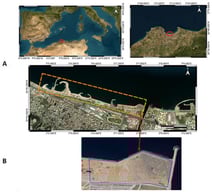
Location of the study site at the Sablettes Promenade, Algiers, northern Algeria. (A) Regional context showing the position of Algiers Bay along the Mediterranean coast (red circle indicates the study location). (B) Detailed view of the promenade: the orange line indicates the park boundaries; the blue line delineates the area actively monitored for plover nests during 2020–2025.

Regulation of the Dependence Period in Booted Eagles: Effects of Nutritional Condition

  • Virginia Morandini,
  • Jorge García-Macía and
  • Miguel Ferrer

The post-fledging dependence period is a crucial stage in the development of altricial birds that may influence their future performance and fitness. This period is regulated by parental investment, in terms of food provisioning and protection, and the young’s demands associated with their development and physical condition. We examined post-fledging dependence regulation in 21 Booted Eagle (Hieraaetus pennatus) nestlings in southern Spain. We compared the dependence timing among juvenile birds from different territories. Here, we analyzed the blood plasma chemistry of nestlings in southern Spain and compared blood biochemistry parameters, including urea levels and a body condition index with the hatching date. Urea levels showed a stronger negative relationship with the length of dependence period than with the hatching date or body condition index. Our results support that better nourished nestlings attain independence later than those in an inferior condition, highlighting the potential of urea levels as a reliable indicator of nestling status. In this study, we describe the concentrations of selected chemical parameters in the plasma of free-living Booted Eagle nestlings, including chemical parameters that have been shown to be related to nutritional condition. Young with a better nutritional condition started dispersal later. Blood parameters can be used as a very useful complementary technique when approaching ecological issues. Early dispersal onset seems to be controlled by endogenous factors that are evolutionarily selected since it should provide inherent benefits in terms of future fitness.

11 February 2026

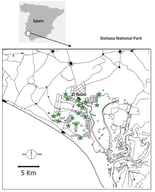
Location of the study area (Doñana National Park, SW, Spain). Green stars indicate the location of the 14 nests with radio-tagged nestlings in this study. Black dots indicate the bulk of the breeding Booted Eagle population.

Multivariate Assessment of Geographic and Ecological Drivers of Heavy Metal Accumulation in Bird Feathers from Jalisco, Mexico

  • Hector Leal-Aguayo,
  • Blanca Catalina Ramírez-Hernández and
  • Aura Libertad Calleja-Rivera
  • + 6 authors

This study evaluated heavy metal accumulation in bird feathers across four contrasting environments in Jalisco, Mexico (urban, semi-urban, agricultural, and semi-natural). We analyzed 370 feather samples from 58 species spanning seven trophic guilds using XRF spectrometry. Fifteen metals were quantified, with zinc (Zn) showing the highest concentrations overall. Multivariate analyses identified trophic guild as the strongest predictor of metal variation, while spatial differences were present but less pronounced. CUAltos was the only site consistently distinct from the others, mainly due to lower concentrations of several metals. Despite quantitative differences among guilds, their proportional metal profiles were similar—dominated by Zn, Y, Mo, and Hf—suggesting broad regional exposure rather than guild-specific accumulation. Redundancy Analysis indicated that atmospheric pollutants (COV and PM10) were the main environmental drivers of spatial variation, especially in Guadalajara’s urban sites. Agricultural variables, including agave cover, showed minor and non-significant effects. Neither sex nor migratory status influenced metal loads, consistent with feathers reflecting exposure during feather growth at the molt site, while potentially also incorporating locally deposited external contaminants. Overall, this study demonstrates the effectiveness of feathers as a non-invasive biomonitoring tool and highlights air quality as a key determinant of regional heavy metal contamination.

10 February 2026

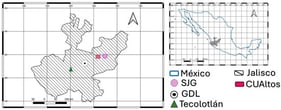
Location of the four sampling sites in Jalisco, Mexico, including urban (Guadalajara), semi-natural (Tecolotlán), semi-urban (CUAltos), and agricultural (San José de Gracia) environments. The inset shows Jalisco within Mexico. In the inset, Jalisco is shown in grey, whereas in the detailed map Jalisco is indicated by hatched shading.

News & Conferences

Issues

Open for Submission

Editor's Choice

Get Alerted

Add your email address to receive forthcoming issues of this journal.

XFacebookLinkedIn
Birds - ISSN 2673-6004