Skip Content
You are currently on the new version of our website. Access the old version .

Birds

Birds is an international, peer-reviewed, open access journal on ornithology published quarterly online by MDPI.

Quartile Ranking JCR - Q1 (Ornithology)

All Articles (230)

Many cemeteries include large amounts of greenspace and so have substantial potential to support urban plant and wildlife communities. However, the physical structure and design of these human-focused greenspaces may ultimately determine which species successfully inhabit these areas. Here, I studied the relationship between grave markers, a unique and ubiquitous feature of cemeteries that vary widely in shape and structure within and between burial areas, and the behavior of cemetery avian communities. I hypothesized that areas with greater structural heterogeneity of markers would be used by a larger diversity of species and that species would alter their behavior and interactions with markers based on marker structure. I assessed avian abundance and species richness in areas with varied upright and homogenously flat grave markers and observed behaviors exhibited by four common species in relation to grave markers and other structural features. While I found no relationship between grave marker heterogeneity and avian species richness or abundance, there is evidence for species-specific behavior and interactions with grave markers, suggesting that marker design is an important and relevant landscape feature for birds. These results have practical applications for cemetery design at a time when there is both increased public interest in environmentally friendly burials and growing competition for land in increasingly heavily developed urban areas.

6 February 2026
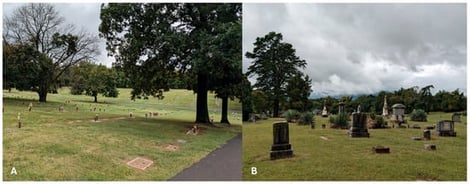
Grave marker area structure types: (A) Homogenous flat: markers are laid even with the surrounding substrate and uniformly arranged, sometimes with graveside décor such as an attached vase for flowers or a flag. Nearly all markers are rectangles of similar size; the only vertical elements on any of these markers are the attached vases or other décor. (B) Heterogeneous upright: Most markers have some amount of vertical height and encompass a wide range of styles and shapes. These areas may include some flat markers as well, but vertical markers appear throughout the area.

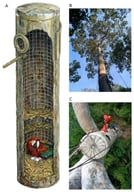
Cavity limitations and interspecific competition render large macaws valuable models for elucidating the integration of parental care, pair-bond maintenance, and nest defense across reproductive stages. Through continuous video monitoring of a single artificial polyvinyl chloride nest box in the Tambopata National Reserve, Peru, we quantified the complete breeding cycle of a resident green-winged macaw (Ara chloropterus) pair and the visitation behavior of a sympatric scarlet macaw (Ara macao) pair within the same cavity. We constructed daily time budgets for 17 behaviors, categorized into seven functional groups, from motion-triggered video clips; employed multivariate tests; and generalized additive models with beta error distribution to describe the temporal changes across the five reproductive stages. The resident A. chloropterus exhibited a significant reorganization of parental investment, with early courtship behaviors transitioning to peak nest attendance and sentinel vigilance during incubation and early brooding. In later stages, locomotion increased significantly, associated with chick provisioning, whereas the frequency of allopreening remained relatively constant throughout the cycle. The visiting A. macao displayed a brief, behaviorally rich prospecting phase, characterized by nest inspection and locomotion, followed by a sharp decline in minimal activity. These divergent strategies align with owner–intruder asymmetries and floater dynamics, indicating that artificial cavities can support A. chloropterus breeding, while suggesting that additional cavities may redistribute breeding opportunities among competing macaws, a hypothesis necessitating multi-nest and multi-year evaluation.

5 February 2026

Artificial nest box design and canopy deployment. (A) Cross-section of the double-walled PVC structure showing the clay insulation and sand–clay substrate. (B) Installation site on an emergent canopy tree. (C) Breeding macaws at the nest entrance. Note: Panel (A) is a digital illustration generated using Gemini Advanced 1.5 Pro.

Sexual Size Dimorphism and Sex Discrimination in the Wood Sandpiper (Tringa glareola)

  • Włodzimierz Meissner,
  • Marta Witkowska and
  • Natalia Karlionova
  • + 1 author

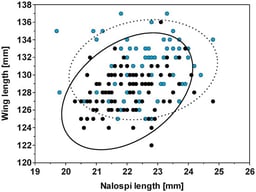
The possibility of sex identification in birds is of substantial importance for studies on various aspects of their ecology and behaviour. Discriminant functions have become increasingly popular in studies of bird species that are monomorphic in plumage characteristics because these methods are inexpensive and non-invasive. In this paper, we provide the first discriminant function that could potentially aid in determining sex in a common wader species, the Wood Sandpiper, based on external body measurements. Females were larger than males in all linear body measurements; however, no single measurement can be used to determine sex due to the high degree of overlap between the sexes. Discriminant equation with the most commonly used linear measurements, wing length and bill length, was provided. Identifying birds with discriminant function values D3 < –0.409 as males and those with D3 > 0.217 as females would lead to sex misclassification of only 5% of individuals of each sex, but it would leave as many as 83% of the individuals unsexed. Allowing for a misclassification of 10% would shift the cut-off values to −0.509 for males and 0.633 for females and reduce the number of unsexed birds to 66%. The method presented here allows us to account for sex-specific patterns in future ecological studies of the Wood Sandpiper and can be applied to past data.

2 February 2026

Relationship between nalospi length and wing length in male (black dots) and female (blue dots) Wood Sandpipers sexed molecularly. The ellipses show the 95% prediction intervals, representing the range in which a single new observation is expected to fall, based on the bivariate distribution estimated from the male (solid line) and female (dotted line) data.

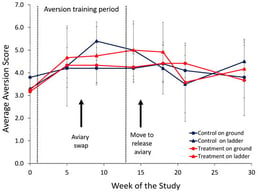
Illegal wildlife trade exerts severe pressure on wild parrot populations, and confiscated parrots often end up in rescue centers where they are rehabilitated for release. However, parrots kept in captivity often develop potentially maladaptive behaviors, including attraction to humans. This behavior can increase the risk of recapture. We modified and tested a previously published human aversion training (HAT) protocol designed to reduce human attraction in confiscated Amazona parrots. The HAT consisted of observers either on the ground or on a ladder, offering food to a single individual and then feigning capture of birds that approached or failed to move away from the observer. Twelve Yellow-naped Amazons (Amazona auropalliata) underwent 36 sessions of HAT over a 14-week period. Ten additional birds were held without training as a control. All birds were evaluated through food offer tests (FOTs) before, during, and after the experiment (FOT scores ranged from 1 when the bird approached the observer to 6 when the bird flew away). Over the training period, both groups showed increased aversion to people. However, contrary to our predictions, aversion scores were not higher for the group given aversion training. Aversion training also did not have a strong impact on fate post-release: within a month of release, 40% of the 22 birds were recaptured in a nearby village, including 4 treatment and 5 control birds. Overall, these results suggest that holding these birds in monospecific groups increased aversion to humans. However, the intense training aversion protocol did not further increase the fear of humans in these Amazona parrots, many of which may have been pets for years before entering the program. This study suggests that rehabilitation and release projects should regularly evaluate the impacts of their training programs and improve or eliminate costly protocols that do not achieve stated objectives.

2 February 2026

Average human aversion (HA) scores by group (control vs. treatment) during ground and ladder-based food offer tests (FOTs). During the study, 12 Yellow-naped Amazons received 36 sessions of aversion training over a 14-week period (treatment). The first FOT was performed before the start of training, two tests were conducted during the training period, and an additional four were conducted post-training. A control group (blue lines) consisting of 10 parrots did not receive any training. Food was either offered by the observer standing on the ground (triangle points) or on a step ladder (dot points). In total, 308 tests were conducted on the 22 birds. Analysis revealed that HA scores by birds who received aversion training were not significantly different from the scores of the birds that were not trained. “Aviary swap” denotes when all birds in both groups were captured and switched from one aviary to the other. The two vertical dotted lines denote the start and end of the “Aversion training period.” “Move to Release Aviary” denotes when both groups were placed together in the pre-release aviary. Bars above and below the points show one standard deviation. The study was conducted in Costa Rica, with all parrots originating from the illegal pet trade.

News & Conferences

Issues

Open for Submission

Editor's Choice

Get Alerted

Add your email address to receive forthcoming issues of this journal.

XFacebookLinkedIn
Birds - ISSN 2673-6004