
Skip to Content
  • 1.4
    Impact Factor
  • 1.9
    CiteScore
  • 21 days
    Submission to First Decision
  • 9 days
    Acceptance to Publication

Biomechanics

Biomechanics is an international, peer-reviewed, open access journal on biomechanics research published quarterly online by MDPI.
  • Open Access— free for readers, with article processing charges (APC) paid by authors or their institutions.
  • High Visibility: indexed within ESCI (Web of Science), Scopus, EBSCO, and other databases.
  • Rapid Publication: manuscripts are peer-reviewed and a first decision is provided to authors approximately 20.7 days after submission; acceptance to publication is undertaken in 8.2 days (median values for papers published in this journal in the first half of 2026).
  • Recognition of Reviewers: Reviewers whose reports are timely and of high quality receive an APC discount voucher for a future publication in an MDPI journal. Become a reviewer.

Get Alerted

Add your email address to receive forthcoming issues of this journal.

All Articles (393)

  • Article
  • Open Access

Background: Adjusting walking speed on demand is fundamental to daily mobility and is achieved by modulating the anterior–posterior ground reaction force. However, kinetic control at the onset of a velocity change has not been isolated from control during an ongoing change or from the confounding influence of instantaneous speed. This study characterized step-by-step modulation of peak braking force (BF) and peak propulsive force (PF) during externally imposed velocity transitions and continuous velocity change. Methods: Nineteen healthy young adults walked on an instrumented dual-belt treadmill while belt speed was modulated sinusoidally. Transitions from constant speed to acceleration (CtoA) or deceleration (CtoD) were compared with continuous acceleration and deceleration. Each outcome was analyzed with a linear mixed-effects model with stepwise belt speed as a covariate. Results: The condition × step interaction was significant for both BF and PF in each condition pair (all PFDR < 0.001; η2p = 0.042–0.223). PF changed at the transition step in both CtoA and CtoD, whereas BF changed at the transition step in CtoA but one step later in CtoD. These changes differed from the continuous conditions and were not explained by instantaneous belt speed. Vertical ground reaction force and spatiotemporal parameters did not parallel these changes. Conclusions: Treadmill-imposed velocity transitions elicited the step-by-step modulation of braking and propulsive forces corresponding to transition onset. However, these findings cannot be directly generalized to self-initiated speed changes during overground walking.

Biomechanics

5 November 2026
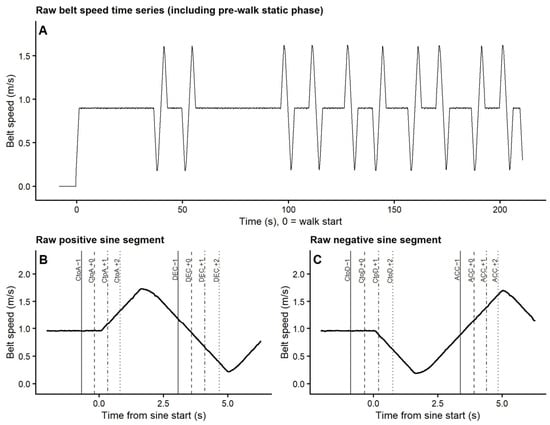
Protocol schematic of belt-speed modulation and phase definitions. Panel (A) shows the raw belt-speed time series for a representative participant across the full program. Panels (B,C) illustrate a positive and a negative sinusoidal cycle, respectively, used to define the ACC, CtoA, DEC, and CtoD conditions and the step-labeling scheme. In Panels (B,C), vertical lines indicate the initial contacts corresponding to each step: solid lines indicate step −1, dashed lines indicate step 0, dash-dotted lines indicate step +1, and dotted lines indicate step +2. Step 0 denotes the transition step in CtoA and CtoD or the reference step in ACC and DEC. ACC, acceleration condition; DEC, deceleration condition; CtoA, constant speed to acceleration; CtoD, constant speed to deceleration.
  • Article
  • Open Access

Background/Objectives: Quadriceps tendon (QT) rupture in non-native knees (such as post-total knee arthroplasty) is catastrophic. Primary repair of the poor-quality tendon with significant gapping has led to a high failure rate and poor functional outcomes. Synthetic polypropylene mesh graft (PMG) reconstruction of QT tears has been introduced to address this issue. This cadaveric study compared the biomechanical performance of a novel synthetic mesh reconstruction technique for QT rupture with the commonly used patellar transosseous tunnel fixation (TTF) technique. Methods: Cadaveric patellar bone-quadriceps tendons were harvested with the QT cut at the superior pole of the patella to simulate tendon rupture. The tears were repaired using either patellar TTF or PMG reconstruction. After repair, each specimen was subjected to 250 cycles of biomechanical cyclic loading. Early and late local displacement (gap between the PMG and superior pole of the patella), overall construct elongation, ultimate tensile load, and failure mode were recorded. Results: Displacements measured at the 20th and 250th cycles demonstrated significantly smaller displacement at the patellar bone–mesh fixation site for the PMG reconstruction group (though it should be noted that this measurement did not account for movement at the tendon–mesh interface). Overall construct elongation was significantly lower in the new technique compared to TTF. The new technique also demonstrated a significantly higher ultimate tensile load. Conclusions: The novel technique of the composite PMG construct—utilising synthetic mesh, bone cement, and K-wire augmentation to reconstruct the QT—has demonstrated enhanced biomechanical performance. The construct shows biomechanical potential and warrants further evaluation in non-native knees and clinical settings.

Biomechanics

2 November 2026

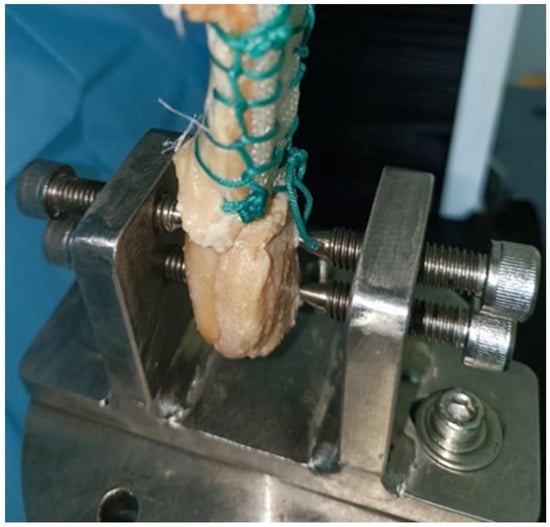
The patellar bone was secured to the testing surface using a custom-made metal fixture, with a spike clamp utilised to hold the patella securely during testing.
  • Article
  • Open Access

Background/Objectives: Shaft stiffness (“flex”) is the only routinely individualised ice hockey stick specification, yet evidence on its effect on shooting is inconsistent; this is because previous studies have used fixed stiffness levels for players of different sizes and strengths. We determined the effect of deviating, in either direction, from the player’s habitual flex, congruent with the body mass reference flex, on on-ice shooting velocity and snap-shot accuracy in junior players. Methods: Thirty male junior players (18–19 years) whose habitual effective flex was within ±10 units of the body mass reference flex completed a complete counterbalanced (Williams-type) crossover with three sticks differing only in nominal shaft flex—the habitual flex (FLEX0), a shaft 15 units more compliant (FLEX−15), and one 15 units stiffer (FLEX+15)—each preceded by three familiarisation sessions. Wrist- and snap-shot velocity (radar) and snap-shot accuracy in an externally paced target task were analysed with linear mixed models. Results: Flex affected wrist-shot velocity (ηp2 = 0.35), snap-shot velocity (ηp2 = 0.68) and snap-shot accuracy (ηp2 = 0.34), with all three outcomes highest at FLEX0. The wrist shot lost 2.9% with both deviations, whereas the snap shot lost 5.6% with the compliant shaft, but only 1.6% with the stiff shaft (Flex × Technique ηp2 = 0.29). Snap-shot accuracy fell by 9.1 and 14.4 percentage points. Conclusions: In players fitted within ±10 units of the body mass reference flex, deviations of ±15 flex units from the habitual flex were associated with lower shooting velocity and snap-shot accuracy; for the snap shot, an over-compliant shaft was the costlier deviation.

Biomechanics

30 October 2026

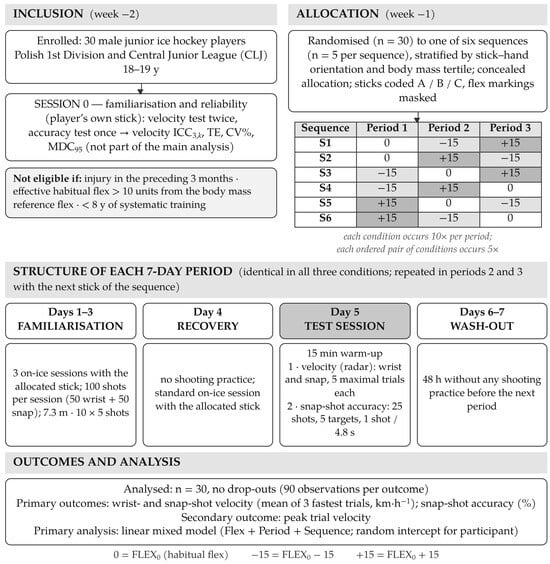
Flow diagram of the experimental protocol. Thirty junior players were enrolled, stratified by stick–hand orientation and body mass tertile, and randomly allocated to one of six treatment sequences (n = 5 per sequence) of a complete counterbalanced (Williams-type) crossover design. Each period comprised three familiarisation sessions with the allocated stick: one recovery day, one test session (shooting velocity and snap-shot accuracy), and a 48 h wash-out. 0 = habitual flex (FLEX0); −15 = FLEX0 − 15; +15 = FLEX0 + 15.
  • Article
  • Open Access

Background: There is still a controversial debate regarding the pressure in the patellofemoral joint (PFJ) following deepening trochleoplasty (DTP). Objective: The purpose of this pilot study was to compare the PFJ contact area before and after DTP in patients treated for trochlear dysplasia and to discuss the biomechanical aspects regarding patellofemoral pressure. Methods: DTP was performed on four female patients to treat lateral patellar instability due to trochlear dysplasia. The preoperative and postoperative articular patellofemoral contact area was evaluated using three-dimensional (3D) MRI. Bone and cartilage were traced slice by slice in the acquired dimension, while the AMIRA segmentation software reconstructed the 3D model. This model was then transferred to the Rhinoceros software for measurement. Contour lines along the 3D model containing trochlear and patellar cartilage were placed, and the boundary and the curvature of the contact area were defined. The contact surfaces before and after DTP were compared. Results: The size of the articular contact area of the PFJ increased after DTP in three out of four cases compared to the preoperative condition. The preoperative average size of the contact area was 153 mm2 (range, 68–185); postoperatively, it was 289 mm2 (range, 200–370). The increase in contact area was, on average, 53% (−6% to 444%). Conclusions: The size of the articular contact area of the PFJ increased after DTP compared to the preoperative condition. The results provide biomechanical evidence that pressure in the PFJ decreases following DTP. The use of 3D MRI scans has demonstrated several advantages.

Biomechanics

30 October 2026

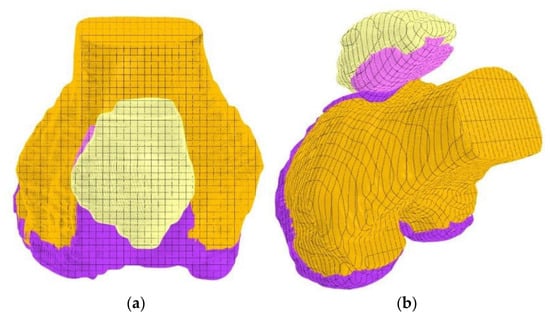
Three-dimensional (3D) models. (a) Anteroposterior view. (b) Oblique medial view from proximal.

Highly Accessed Articles

News & Conferences

Latest Issues

Open for Submission

Journal Sections

XFacebookLinkedIn
Biomechanics - ISSN 2673-7078