Skip to Content

Batteries

Batteries is an international, peer-reviewed, open access journal on battery technology and materials published monthly online by MDPI.
The International Society for Porous Media (InterPore) is affiliated with Batteries and its members receive discounts on the article processing charges.
Quartile Ranking JCR - Q2 (Electrochemistry | Materials Science, Multidisciplinary | Energy and Fuels)

All Articles (2,273)

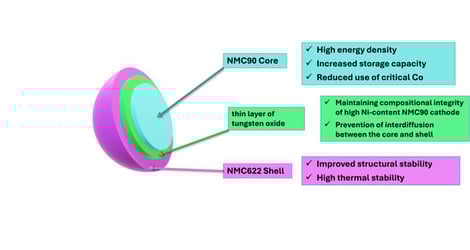
The growing demand for higher-energy lithium-ion batteries, encompassing consumer electronics, stationary grid storage, and electric mobility to specialized sectors like aerospace, medical devices, and industrial robotics, requires cathode materials that offer higher capacity while remaining cost-effective. This trend has intensified the development of nickel-rich LiNi1−x−yMnxCoyO2 (NMC) systems. However, high-Ni NMCs such as LiNi0.9Mn0.05Co0.05O2 (NMC90) suffer from limited thermal and cycling stability. Core–shell architectures using LiNi0.6Mn0.2Co0.2O2 (NMC622) as a shell can partially alleviate these drawbacks, but structural degradation caused by interdiffusion between the core and shell persists as a major challenge. This study investigates whether a tungsten oxide interlayer can act as a protective barrier that suppresses interdiffusion, stabilizes the crystal structure, and improves long-term electrochemical performance. In this work, NMC cathode powders were synthesized via a one-pot oxalate co-precipitation route, followed by structural characterization using X-ray diffraction (XRD), scanning electron microscopy (SEM), X-ray photoelectron spectroscopy (XPS), and ion scattering spectroscopy (ISS). Electrochemical performance, including capacity retention, cycling stability, and internal resistance, was evaluated through galvanostatic charge–discharge (GCD) testing and electrochemical impedance spectroscopy (EIS). The core–shell configuration delivered higher specific discharge capacity compared to the individually synthesized core-only and shell-only reference materials, and the incorporation of a tungsten oxide interlayer resulted in a twofold increase in cycle life. These results demonstrate that tungsten oxide effectively enhances cycling stability by inhibiting core–shell interdiffusion, offering a promising pathway toward more durable high-Ni NMC cathodes.

27 February 2026
Synthesis process for NMC via the oxalate co-precipitation route. (a) Preparation of precursor solutions by separately dissolving TM salts, lithium salt, and oxalic acid. (b) Controlled mixing and homogenization of the reactants at 65 °C under continuous stirring. (c) Formation of the metal-oxalate precipitate following the dropwise addition of oxalic acid. (d) Intermediate product obtained as a fine greenish powder after drying at 80 °C overnight, and (e) final NMC powder after calcination at 850 °C for 8 h and subsequent mortar grinding for de-agglomeration.

Module- and pack-level mechanical design of lithium-ion batteries in electric vehicles is a primary driver of swelling-induced stack pressure and spatially varying ageing. Current practice remains largely empirical or data-driven and configuration-specific, limiting the ability to predict how design changes translate into local pressure heterogeneity and state-of-health (SOH) loss. This motivates a compact chemo-mechanical model that maps packaging boundary conditions to pressure, swelling, and SOH evolution with few interpretable parameters. This study introduces finite-element-ready constitutive laws that couple reversible and irreversible swelling to SOH and through-thickness pressure, covering three boundary cases reported in literature: constant pressure, thickness clamp after an initial preload, and flexible support. Parameters are identified from different published datasets, and the model is validated against independent constraint scenarios. Good quantitative agreement is shown with averaged RMSE of 1.16% for SOH and 0.16 [MPa] for pressure evolution. Variance-based sensitivity analysis shows SOH uncertainty dominated by the damage-law parameters of the proposed constitutive relationship, whereas pressure evolution is primarily controlled by irreversible swelling and the non-linear through-thickness stiffness, indicating calibration priorities for engineering design studies. The framework is intended for fast comparative analyses of individual cells under a controlled environment. Further extensions, including SOC-dependent mechanics, refined hysteresis, temperature, and C-rate variations require dedicated datasets and are left for future work.

26 February 2026

Reversible swelling strain amplitude versus damage ω = 1 − SOH. Experimental results [30,31,32] and linear curve fit according to Equation (3).

The increasing demand for sustainable battery technologies requires effective recycling strategies for end-of-life lithium-ion battery cathodes. In this study, virtual materials testing, a well-established framework for modeling conventionally manufactured NMC-based cathodes, is applied to partially recycled cathodes. To this end, virtual cathodes consisting of mixtures of pristine and recycled NMC particles are utilized to systematically analyze structure–property relationships depending on mixing ratios and different spatial arrangement strategies. For this purpose, a stochastic 3D model is developed that is capable of generating virtual cathodes with arbitrary volume fractions of active materials and mixing ratios of pristine and recycled NMC particles. Particularly, the stochastic 3D model can mimic the different size distributions of pristine and recycled particles that are observed in image data. Additionally, the model allows the structuring of pristine and recycled NMC either uniformly mixed or layer-wise arranged, mimicking single- and dual-layer cathodes. Subsequently, a systematic computational analysis is conducted to assess the influence of increasing active material ratios of recycled particles, ranging from 0 % to 100 %, while maintaining a constant overall active material volume fraction. The impact of particle mixing on cathode performance is evaluated by examining transport-relevant geometrical descriptors and effective properties, such as geodesic tortuosity, specific surface area, and tortuosity factor.

26 February 2026

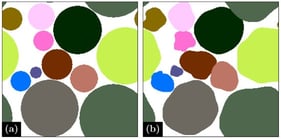
(a) Placeholder spheres packed with minimal overlap within the sampling window. (b) Subsequently, these spheres are replaced by volume-equivalent particles by aligning their barycenters with the centers of the respective sphere. Each individual sphere and its corresponding particle are shown in false colors for visualization purposes, i.e., the colors have no physical meaning.

Silicon (Si) has attracted extensive attention as a promising anode material for next-generation lithium-ion batteries (LIBs) due to its ultra-high theoretical capacity, low lithiation potential, and economic advantages. However, drastic volume expansion during cycling and slow reaction kinetics severely compromise its structural stability and practical application. Recently, two-dimensional (2D) MXenes have been explored as effective functional components in Si-based electrodes because of their excellent electrical conductivity, high specific surface area, adjustable surface terminations, and mechanical robustness. When integrated with Si, MXenes serve as conductive matrices that alleviate volumetric stress, enhance charge transport, and accelerate electron/ion diffusion. Consequently, Si/MXene nanocomposites (NCs) exhibit significantly improved lithium (Li) storage performance. This review outlines recent advances in Si/MXene NCs, covering fabrication strategies, structural engineering, and various configurations, including particulate materials, three-dimensional (3D) architectures, films, and fibrous systems, and establishes the relationship between structural design and electrochemical behavior. Remaining challenges and prospective research directions are also discussed to guide the development of high-energy-density LIB anodes.

24 February 2026

Illustration of degradation processes in Si electrodes. Adapted from [26]. Copyright 2022, Elsevier B.V.

News & Conferences

Issues

Open for Submission

Editor's Choice

Reprints of Collections

High-Performance Super-capacitors
Reprint

High-Performance Super-capacitors

Preparation and Application
Editors: Xin Chen

Get Alerted

Add your email address to receive forthcoming issues of this journal.

XFacebookLinkedIn
Batteries - ISSN 2313-0105