Skip to Content
You are currently on the new version of our website. Access the old version .

Automation

Automation is an international, peer-reviewed, open access journal on automation and control systems published bimonthly online by MDPI.

All Articles (239)

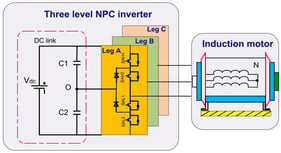
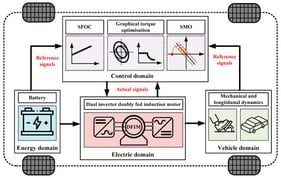
In response to the need for cost-effective and resilient drivetrain architectures in renewable energy emulation platforms, this paper proposes a wind turbine emulator (WTE) designed to enhance the operational efficiency of variable-speed wind turbines (WTs) connected to electric generators in power grid applications. The proposed emulator relies on a robust sensorless vector-controlled induction motor (IM) drive fed by a reduced-switch soft–voltage source inverter (Soft-VSI) topology. The proposed control chain combines a second-order super-twisting sliding-mode flux observer, based on stator measurements, with a modified MRAS speed estimator whose Popov hyperstability offers explicit PI tuning and ensures stable sensorless speed convergence. The complete WTE design, from the aerodynamic model to the Soft-VSI induction motor drive, is implemented and evaluated in MATLAB/Simulink environment. A Mexican hat wind speed profile is used to excite the emulator and assess its dynamic behavior under diverse transient conditions. The simulation results demonstrate fast convergence of the estimated flux and speed, stable closed-loop operation when using the estimated speed, and strong robustness against no-loaded and loaded operations and rotor-resistance variations. Moreover, a comparative analysis between the proposed control scheme and a conventional first-order sliding-mode flux observer is carried out to highlight the enhanced flux and speed estimation accuracy, reduced chattering, and improved dynamic robustness of the WTE. The proposed framework provides a flexible tool to support the energy transition through the development of advanced wind energy system control strategies.

11 February 2026

Proposed wind turbine emulator structure.

Adaptive Thermostat Setpoint Prediction Using IoT and Machine Learning in Smart Buildings

  • Fatemeh Mosleh,
  • Ali A. Hamidi and
  • Md Atiqur Rahman Ahad
  • + 1 author

Increased global energy consumption contributes to higher operational costs in the energy sector and results in environmental deterioration. This study evaluates the effectiveness of integrating Internet of Things (IoT) sensors and machine learning techniques to predict adaptive thermostat setpoints to support behavior-aware Heating, Ventilation, and Air Conditioning (HVAC) operation in residential buildings. The dataset was collected over two years from 2080 IoT devices installed in 370 zones in two buildings in Halifax, Canada. Specific categories of real-time information, including indoor and outdoor temperature, humidity, thermostat setpoints, and window/door status, shaped the dataset of the study. Data preprocessing included retrieving data from the MySQL database and converting the data into an analytical format suitable for visualization and processing. In the machine learning phase, deep learning (DL) was employed to predict adaptive threshold settings (“from” and “to”) for the thermostats, and a gradient boosted trees (GBT) approach was used to predict heating and cooling thresholds. Standard metrics (RMSE, MAE, and R2) were used to evaluate effective prediction for adaptive thermostat setpoints. A comparative analysis between GBT ”from” and “to” models and the deep learning (DL) model was performed to assess the accuracy of prediction. Deep learning achieved the highest performance, reducing the MAE value by about 9% in comparison to the strongest GBT model (1.12 vs. 1.23) and reaching an R2 value of up to 0.60, indicating improved predictive accuracy under real-world building conditions. The results indicate that IoT-driven setpoint prediction provides a practical foundation for behavior-aware thermostat modeling and future adaptive HVAC control strategies in smart buildings. This study focuses on setpoint prediction under real operational conditions and does not evaluate automated HVAC control or assess actual energy savings.

5 February 2026

Overview of the research workflow: data acquisition, preprocessing, model training, and evaluation.
  • Systematic Review
  • Open Access

Human–robot collaboration (HRC) offers a significant potential to improve productivity, safety, and performance in construction, yet its adoption remains constrained by interrelated barriers. The existing studies largely identify these barriers in isolation, with limited insight into their systemic interactions. This study addresses this gap by synthesising prior research using PRISMA and applying interpretive structural modelling (ISM) to examine the hierarchical and causal relationships among barriers to HRC in construction. Eight barrier categories are identified: financial, safety, communication, robot technology-related, organisational, legal/regulatory, education/training, and social and human factors. The ISM–MICMAC results reveal regulatory and communication barriers as key upstream drivers shaping downstream safety, training, organisational, and technological outcomes. By moving beyond descriptive listings, the study provides a systems-level framework that supports the strategic prioritisation of interventions and informed decision-making. The findings advance the theoretical understanding of HRC as a socio-technical system and offer an evidence-informed foundation for context-sensitive implementation strategies in construction.

5 February 2026

Applications of robotics in the built environment today.

Reliable environmental monitoring in remote or sparsely instrumented regions is hindered by the cost, maintenance demands, and inaccessibility of dense physical sensor deployments. To address these challenges, this study introduces VSG-SGL, a unified virtual sensor generation framework that integrates Sparse Gaussian Process Regression (SGPR) and Bayesian Ridge Regression (BRR) with deep generative learning via Variational Autoencoders (VAE) and Conditional Tabular GANs (CTGAN). Real meteorological datasets from multiple South Korean cities were preprocessed using thresholding and Isolation Forest anomaly detection and evaluated using distributional alignment (KDE) and sequence-learning validation with BiLSTM and BiGRU models. Experimental findings demonstrate that VAE-augmented virtual sensors provide the most stable and reliable performance. For temperature, VAE maintains predictive errors close to those of BRR and SGPR, reflecting the already well-modeled dynamics of this variable. In contrast, humidity and wind-related variables exhibit measurable gains with VAE; for example, SGPR-based wind speed MAE improves from 0.1848 to 0.1604, while BRR-based wind direction RMSE decreases from 0.1842 to 0.1726. CTGAN augmentation, however, frequently increases error, particularly for humidity and wind speed. Overall, the results establish VAE-enhanced VSG-SGL virtual sensors as a cost-effective and accurate alternative in scenarios where physical sensing is limited or impractical.

3 February 2026

Illustration of a virtual sensor (Place 5) inferred using nearby physical sensors capturing wind speed, humidity, temperature, and solar radiation.

News & Conferences

Issues

Open for Submission

Editor's Choice

Reprints of Collections

Advances in Construction and Project Management
Reprint

Advances in Construction and Project Management

Volume III: Industrialisation, Sustainability, Resilience and Health & Safety
Editors: Srinath Perera, Albert P. C. Chan, Dilanthi Amaratunga, Makarand Hastak, Patrizia Lombardi, Sepani Senaratne, Xiaohua Jin, Anil Sawhney
Advances in Construction and Project Management
Reprint

Advances in Construction and Project Management

Volume II: Construction and Digitalisation
Editors: Srinath Perera, Albert P. C. Chan, Dilanthi Amaratunga, Makarand Hastak, Patrizia Lombardi, Sepani Senaratne, Xiaohua Jin, Anil Sawhney

Get Alerted

Add your email address to receive forthcoming issues of this journal.

XFacebookLinkedIn
Automation - ISSN 2673-4052