Skip Content
You are currently on the new version of our website. Access the old version .

Atmosphere

Atmosphere is an international, peer-reviewed, open access journal of scientific studies related to the atmosphere, published monthly online by MDPI.
The Italian Aerosol Society (IAS) and Working Group of Air Quality in European Citizen Science Association (ECSA) are affiliated with Atmosphere and their members receive a discount on the article processing charges.

All Articles (12,192)

PM2.5 and Lung Cancer: An Ecological Study (2014–2023) Using Data from Brazilian Capitals

  • Albery Batista de Almeida Neto,
  • Fernando Rafael de Moura and
  • Flavio Manoel Rodrigues da Silva Júnior
  • + 6 authors

Air pollution remains a major global public health concern, with fine particulate matter (PM2.5) recognized as an important environmental risk factor for lung cancer. This ecological study assessed lung cancer mortality attributable to long-term PM2.5 exposure in the 26 Brazilian state capitals and the Federal District (Brasília) from 2014 to 2023. Annual mean PM2.5 concentrations were estimated using reanalysis-based PM2.5 concentration estimates and atmospheric reanalysis data, ensuring consistent spatial and temporal coverage. Mortality data were obtained from the Brazilian Mortality Information System (SIM/DATASUS). Health impacts attributable to PM2.5 exposure were estimated using the World Health Organization’s AirQ+ model, based on exposure–response functions from the Global Burden of Disease framework. During the study period, 97.41% of annual PM2.5 means exceeded the WHO Air Quality Guideline of 5 µg/m3, and 28.52% surpassed the current Brazilian regulatory limit. Higher concentrations were observed mainly in capitals from the North and Southeast regions, reflecting the influence of biomass burning, urbanization, and regional atmospheric processes. Approximately 13.56% of lung cancer deaths in Brazilian capitals were attributable to PM2.5 exposure, with the highest absolute numbers concentrated in the Southeast region. These findings demonstrate a substantial and spatially heterogeneous lung cancer burden associated with urban air pollution in Brazil and highlight the need for strengthened air quality management and targeted urban public health policies.

8 February 2026
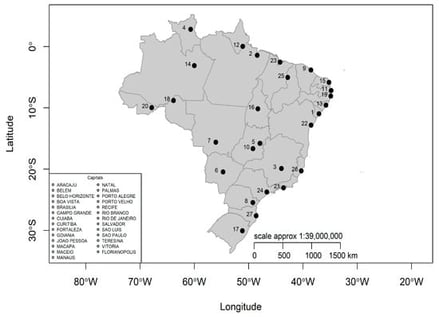
Geographic location of the 26 Brazilian state capitals and the Federal District (Brasília) included in the study.

Wildfires in the Southern Amazon: Insights into Pyro-Convective Cloud Development from Two Case Studies in August 2021

  • Katyelle Ferreira da Silva Bezerra,
  • Flavio Tiago Couto and
  • Fabrício Daniel dos Santos Silva
  • + 14 authors

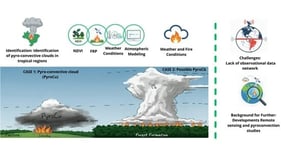
This study examines two wildfire events in the southern Amazon in August 2021, addressing the challenges in investigating the development of pyro-convective clouds in tropical regions. The analysis combines the Normalized Difference Vegetation Index, Fire Radiative Power derived from the Suomi-NPP and NOAA-20 satellites, and meteorological conditions from thermodynamic profiles and atmospheric modeling. The Meso-NH model was applied exploratorily with two simulations that allow convection, at a 2.5 km resolution. In the first case, a pyro-convective cloud (PyroCu) formed directly from active fires. In the second, a deep convective cloud developed over dispersed fire hotspots, exhibiting characteristics compatible with pyro-convective activity, although uncertainties remain regarding its classification as a true PyroCb. The results indicate that background thermodynamic instability primarily controls vertical plume development, modulating the influence of fire intensity. Incorporating high-resolution thermodynamic profiles into coupled atmospheric and chemical dispersion models can improve estimates of smoke injection height, complementing information on fire power. The results provide a basis for future developments related to understanding tropical pyro-convective clouds, showing how smoke dispersion may occur in the tropical region depending on the vertical structure of the atmosphere and fire intensity.

6 February 2026

Digital Elevation Model (DEM) of the AMACRO region, located within the Amazon biome, derived from the Shuttle Radar Topography Mission (SRTM) database. Panel (a) shows the regional DEM with the AMACRO boundary and the locations of the two case-study areas. Panels (b,c) present zoomed-in DEM views of Case 1 and Case 2, respectively, with red markers indicating the exact locations. Elevation is given in meters above sea level.

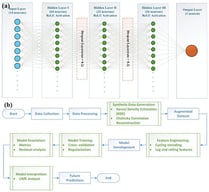
This study develops a practical framework for forecasting long-term drought conditions in Karaman Province, a semi-arid region of Turkey, where accurate climate information is vital for water planning and agriculture. Since the area has limited rainfall records and strong year-to-year fluctuations, traditional modeling approaches often fall short. To better capture local conditions, drought intensity was defined using a simple monthly wetness anomaly measure based directly on precipitation; here, positive values indicate wetter months and negative values indicate drier ones. This makes the method suitable for regions where detailed hydrological data are scarce. Rainfall observations from 1965 to 2011 were expanded using a combination of kernel density estimation and Cholesky-based correlation reconstruction. These steps preserved the main statistical and temporal patterns of the original data while increasing sample diversity. The enriched dataset was then used to train artificial neural networks to predict both precipitation and drought intensity. The models reached R2 values of 0.76 and 0.72, with mean absolute errors of 12.8 mm and 28.4%, which represents an improvement of roughly 10–15% over traditional statistical methods. They were also able to capture the seasonal and year-to-year variability that strongly affects drought conditions in the region. To understand what drives the predictions, the model was examined with LIME, which consistently highlighted lagged rainfall and seasonal indicators as the most influential inputs. A walk-forward validation approach was also used to mimic real forecasting conditions and demonstrated that the model remains stable when projecting into the future. Overall, the proposed framework offers a reliable and practical basis for early-warning efforts and drought-management strategies in semi-arid regions like Karaman.

6 February 2026

Proposed ANN structure and the flowchart of the study. (a) Architecture of Artificial Neural Network, (b) flowchart for research.

HF Lightning Observations in the Upper Volga Region of Russia

  • Anatoly N. Karashtin and
  • Yury V. Shlyugaev

Much of the information for studying the processes of lightning discharge initiation and development is provided by studying thundercloud radio emissions in various frequency bands. The High-Frequency (HF) band better corresponds to the characteristic scales of lightning development but has been undeservedly forgotten and is used quite rarely. Based on observations carried out in the Upper Volga region it is shown that the intensity of HF radio emissions from lightning is high enough to be reliably recorded in nearby thunderstorms. It is found that at all stages of lightning development the intensity of its radio emission in the HF band up to 10 MHz exceeds the average background intensity significantly. The amplitudes of lightning pulses exceed the background level more significantly, up to 60 dB and more. The feasibility of using the HF band for lightning observations including tracing the direction of arrival of a radio emission is clearly demonstrated.

6 February 2026

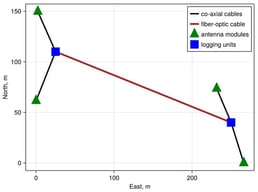
The antenna module arrangement at the receiving point.

News & Conferences

Issues

Open for Submission

Editor's Choice

Get Alerted

Add your email address to receive forthcoming issues of this journal.

XFacebookLinkedIn
Atmosphere - ISSN 2073-4433