Skip Content
You are currently on the new version of our website. Access the old version .

Astronomy

Astronomy is an international, peer-reviewed, open access journal on observational astronomy, theoretical astronomy and other specific subfields published quarterly online by MDPI.

All Articles (85)

A large number of transits have been observed by TESS from the rapidly orbiting exoplanet 55 Cancri e. This amount of transit data, combined with the relatively high frequency of TESS observations, allows for a direct measurement of not only the planetary radius and orbital parameters but also the limb darkening coefficients of the host star. We obtain a planetary radius of 1.64±0.10 earth radii, an orbital radius of 0.019±0.009 AU, and an orbital inclination of 85±17 degrees. For the quadratic limb darkening coefficients u1 and u2 we report measurements of and , and discuss strategies to reduce the uncertainty in the measurement. We also measured the curvature of the transit depth as a function of time using an effective parametrization , and found in units of relative intensity per day squared. This parametrization resulted in a higher goodness-of-fit value than the quadratic model, with a reduced χ2 of 1.153 rather than 1.201 for the quadratic model, and a ΔBIC of 31.75 in favor of the effective parametrization.

6 February 2026

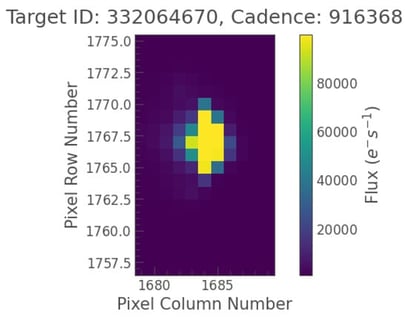
Target pixel file from the 10/2021 TESS observation period.
  • Brief Report
  • Open Access

Forty-two Jupiter Mass Binary Objects (JuMBOs) have been discovered in the Trapezium Cluster: either brown dwarf stars or planets mutually orbiting in pairs. Here it is shown that, just as in galaxies and wide binaries, the mutual orbits of the objects in each of these twin systems deviate from the Newtonian and level off around a mutual acceleration of m/s2 supporting the minimum acceleration predicted by Quantised Inertia (QI), a theory that attributes inertial mass to an interaction between information horizons and quantum fields and predicts galaxy rotation without the need for dark matter. QI further predicts that the JuMBOs with separations of 400 AU should show orbital anomalies of 70 m/s. This could be tested using spectral Doppler data.

26 December 2025

Chandra Observations of the X-Ray Binary Population in the Field of the Dwarf Galaxy IC 10

  • Sayantan Bhattacharya,
  • Silas G. T. Laycock and
  • Dimitris M. Christodoulou
  • + 1 author

IC 10 is a dwarf galaxy in Cassiopeia, located at a distance of 660 kpc, and hosts a young stellar population, a large number of Wolf–Rayet stars, and a large number of massive stars in general. Utilizing a series of 11 Chandra observations (spanning 2003–2021, with a total exposure of 235.1 ks), 375 point sources of X-ray emission were detected. Similar studies have been conducted earlier in the central region of IC 10. Here, we consider all regions covered by Chandra-ACIS. By comparing our catalog of X-ray sources with a published optical catalog, we found that 146 sources have optical counterparts. We also created a list of 60 blue supergiant (SG) candidates with X-ray binary (XRB) companions by using an optical color–magnitude selection criterion to isolate the blue SGs. Blue SG-XRBs form a major class of progenitors of double-degenerate binaries. Hence, their numbers are an important factor in modeling the rate of gravitational-wave sources. Identifying the nature of individual sources is necessary as it paves the way toward a comprehensive census of XRBs in IC 10, thus enabling meaningful comparisons with other Local Group galaxies exhibiting starbursts, such as the Magellanic Clouds.

13 December 2025

Cosmological scenarios wherein the cumulative number of spontaneously formed, cognitively impaired, disembodied transient observers is vastly larger than the corresponding number of atypical ‘ordinary observers’ (OOs) formed in the conventional way—essentially via cosmic evolution and gravitational instability—are disqualified in modern cosmology on the grounds of Cognitive Instability—the untrustworsiness of one own’s reasoning—let alone the atypicality of OOs like us. According to the concordance ΛCDM cosmological model—when described in the (expanding) ‘cosmic frame’—the cosmological expansion is future-eternal. In this frame we are atypical OOs, which are vastly outnumbered by typical Boltzmann Brains (BBs) that spontaneously form via sheer thermal fluctuations in the future-eternal asymptotic de Sitter spacetime. In the case that dark energy (DE) ultimately decays, the cumulative number of transient ‘Freak Observers’ (FOs) formed and destroyed spontaneously by virtue of the quantum uncertainty principle ultimately overwhelms that of OOs. Either possibility is unacceptable. We argue that these unsettling conclusions are artifacts of employing the (default) cosmic frame description in which space expands. When analyzed in the comoving frame, OOs overwhelmingly outnumber both BBs and FOs. This suggests that the dual comoving description is the cognitively stable preferred framework for describing our evolving Universe. In this frame, space is globally static, masses monotonically increase, and the space describing gravitationally bounded objects monotonically contracts.

8 December 2025

News & Conferences

Issues

Open for Submission

Editor's Choice

Get Alerted

Add your email address to receive forthcoming issues of this journal.

XFacebookLinkedIn
Astronomy - ISSN 2674-0346