Skip Content
You are currently on the new version of our website. Access the old version .
  • 42 days
    Time to First Decision

Arthropoda

Arthropoda - formerly Entomology - is an international, peer-reviewed, open access journal on the study of arthropods published quarterly online by MDPI.

All Articles (60)

Unlocking Industry Views for Effective Redlegged Earth Mite Resistance Management

  • Elizabeth C. Lowe,
  • Luis Mata and
  • Paul A. Umina
  • + 3 authors

Insecticide resistance is a growing threat to global food security, with several major pests in Australian broad-acre systems already showing high resistance levels. Integrated Pest Management (IPM) can reduce insecticide reliance and slow resistance evolution, yet adoption remains low. Using the redlegged earth mite (Halotydeus destructor, RLEM) as a case study, we examined how knowledge gaps and risk attitudes influence insecticide use and broader pest management. An online survey of grain growers and advisors in RLEM-affected regions revealed that, despite widespread resistance to synthetic pyrethroids and organophosphates, and most respondents identifying with an IPM mindset, these insecticides remain frequently used. Advisors demonstrated greater overall knowledge than growers, but substantial gaps persisted across both groups, including awareness of field resistance and familiarity with national resistance management guidelines. Risk aversion showed a stronger and more consistent influence on management decisions than knowledge, shaping both growers’ and advisors’ recommendations. These findings highlight demographic and attitudinal factors that can undermine resistance management. While centred on RLEM, the behavioural drivers identified here likely influence pest control decisions across a range of pest species and farming systems.

26 January 2026
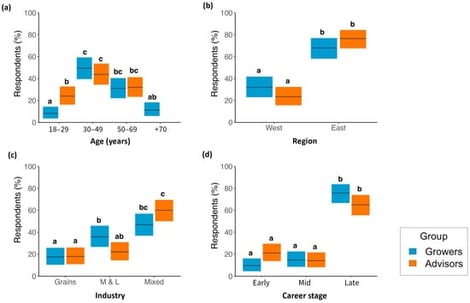
Summary of the survey respondent demographics by (a) age, (b) region, (c) industry, and (d) career stage. Lowercase letters indicate significant differences within each plot. For industry categories, Grains = grain crops only; M&L = meat and livestock only; Mixed = grain crops and meat and livestock. For career stage, Early = 0–5 years of experience; Mid = 6–10 years of experience; Late = >10 years of experience. Shaded areas represent 95% confidence intervals.

The Global Fossil Record of Chilopoda

  • Suzzet Cadenas-Amaya,
  • Francisco Riquelme and
  • Fabio Cupul-Magaña
  • + 1 author

We present a revised catalog of the Chilopoda fossil record based on descriptions and reports published from 1854 to the present. Our compilation reveals 74 fossil occurrences encompassing five orders, 13 families, 26 genera, and 35 species. The fossil record is distributed across three geological eras: the Paleozoic (11 records), the Mesozoic (17 records), and the Cenozoic (46 records). This study provides insights into the diversity and distribution of centipedes across geological time.

26 December 2025

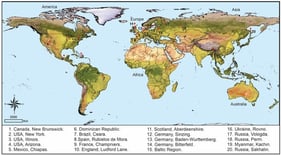
The fossil record of the class Chilopoda worldwide.

Pincushion millipedes or bristly millipedes (Polyxenida) are common and widespread around the world, yet we still lack a proper understanding of the life of these elusive animals. This limit is even more expressed when looking at their extinct counterparts. Luckily, such fossils are usually preserved in amber, which has the potential to preserve unusual details. We investigated 44 new and 6 previously published fossils of Polyxenida, starting from the Cretaceous period (~100 mya) through the Eocene (~35 mya) and Oligocene/Miocene (~23 mya) to the present. As suggested by previous research, fossil bristly millipedes in the Cretaceous period shared the same lifestyle as their extant counterparts, including aggregation behaviour of both immatures and adults. In addition, we report newly observed behaviours for the fossils such as defecation, cohabitation between representatives of Polyxenidae and Synxenidae, and the possible role of frass and exuviae as defence. Altogether these findings improve our knowledge on the intricate life of bristly millipedes, revealing not only glimpses into their past but also clues and cues on their modern-day counterparts. Bristly millipedes are not just “simple” bark-dwellers; their communities and behaviours visibly testify to a rather complex lifestyle, which remained largely unchanged for 100 million years.

12 December 2025

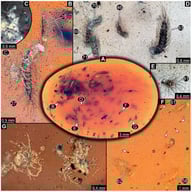
A 100-million-year-old community of 87 specimens of Synxenidae in Kachin amber (NIGP208860). (A) Overview of the amber. (B) Two individuals of Synxenidae with a mite (NIGP208860-92) attached to NIGP208860-27. (C) Mouthparts of NIGP208860-92. (D) Five individuals of Synxenidae (NIGP208860-46, 69–71, 83) of different developmental stages with frass close by. (E) NIGP208860-81; immature of stage 1. (F) NIGP208860-58, NIGP208860-61, and NIGP208860-62 with frass close by (arrows). (G) NIGP208860-90–91, in ventral view. Abbreviations: numbers refer to specimen number in this amber piece (see Supplementary Figure S1); arrows refer to frass.

Viruses and Ticks: An Integrative Review of Virological Findings in Ticks

  • Lucas Henrique da Silva e Silva,
  • Fábio Silva da Silva and
  • Joaquim Pinto Nunes Neto
  • + 5 authors

Vector-borne diseases account for over 17% of reported infectious diseases worldwide and are associated with approximately 700,000 deaths annually. The main vectors include mosquitoes, moths, sand flies, black flies, and ticks. Ticks deserve special attention because they transmit a wide range of pathogens, including viruses of major medical importance, such as tick-borne encephalitis virus (Orthoflavivirus encephalitidis) and Crimean-Congo hemorrhagic fever virus (Orthonairovirus haemorrhagiae), as well as animal-borne pathogens, such as African swine fever virus (Asfivirus haemorrhagiae). Recent advances in next-generation sequencing have expanded the ability to detect and characterize tick-borne viruses, revealing increasing viral diversity. However, for many of these viruses, aspects such as pathogenic potential, main vectors, and natural hosts remain unclear. To address this gap, we conducted an integrative literature review using the PubMed, SciELO, BVSalud, and Patuá-IEC databases. We analyzed 336 articles addressing various species of tick-borne viruses. The Flaviviridae, Phenuiviridae, and Nairoviridae families were the most frequently identified among the viral agents detected. Furthermore, we identified that as-yet-unclassified viruses have been frequently detected in different tick species, which sparks significant interest in investigating their potential interactions and public health implications. Investigating viral agents in tick populations is crucial for understanding viral diversity and assessing potential public health risks, especially in the current context of climate change.

29 November 2025

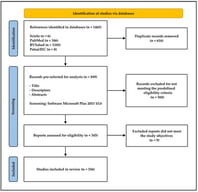
Flowchart of the methodology for bibliographic data collection.

News & Conferences

Issues

Open for Submission

Editor's Choice

Get Alerted

Add your email address to receive forthcoming issues of this journal.

XFacebookLinkedIn
Arthropoda - ISSN 2813-3323