Skip to Content
You are currently on the new version of our website. Access the old version .

Architecture

Architecture is an international, peer-reviewed, open access journal on studies related to architectural research published quarterly online by MDPI.

All Articles (317)

Many World Heritage Sites hold universal and exceptional values of a hybrid nature, combining cultural and environmental richness. Yet these complex dimensions are rarely recognised within their designation criteria, making it urgent to update their cultural valuation through the lens of social and environmental sustainability. In this context, water—as both a natural and a cultural asset—emerges as a fundamental element for understanding their natural–cultural capital. This study examines two World Heritage Sites in southern Spain—the Royal Alcázar of Seville and the Alhambra of Granada—which are particularly representative at the European scale due to their severe climatic conditions. The methodology is based on the analysis and mapping of their landscape conditions using historical cartography and Geographic Information Systems, together with a review of water-related attributes and values across their protection and management frameworks. As a result, their water systems are critically assessed within existing protection and management documents, a narrative approach to water as natural-cultural capital is proposed, and this approach is linked to the sites’ principal climate-related vulnerabilities and benefits. Overall, the study contributes to the international debate on biocultural heritage, supporting the need to update the water system approach applied to World Heritage Sites under conditions of climate stress.

13 February 2026
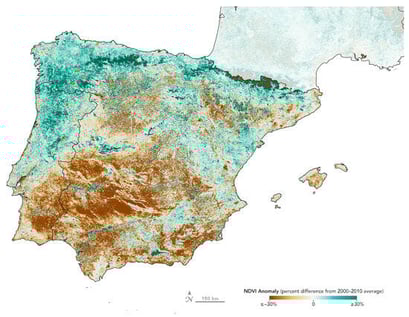
NDVI of the Iberian Peninsula. This map indicates areas where vegetation was less healthy than average (brown) during spring 2023, reflecting anomalies in the Normalized Difference Vegetation Index (NDVI)—a satellite-derived indicator used to assess vegetation conditions. Source: NASA Earth Observatory images by Allison Nussbaum, using MODIS data from NASA EOSDIS. Available at https://earthobservatory.nasa.gov/images/151366/spain-browned-by-drought (accessed on 28 January 2026).

This study analyzes the impact of 360° panoramic imaging on the documentation of heritage sites, using a SWOT analysis. A multi-method approach was adopted, combining a review of scholarly literature and institutional reports, expert interviews, user surveys, and hands-on testing of three widely used platforms: Kuula, 3DVista, and Pano2VR. The findings demonstrate that 360° imaging significantly improves visual engagement and spatial understanding, particularly in educational and public outreach contexts. However, challenges remain in terms of data integration, navigation, and long-term digital preservation. Platforms such as 3DVista and Pano2VR offer extensive features and advanced media integration, but their complexity and cost make them less accessible to smaller institutions. Conversely, Kuula was found to be more accessible and user-friendly, though it offers fewer customization options. This study adds to the growing body of literature by applying a SWOT lens to evaluate not just the technical capabilities but also the strategic usability of 360° tools in heritage documentation. It highlights key gaps in data management and cross-platform functionality, calling attention to the need for standardization and training. Future research should explore hybrid models that integrate panoramic imaging with high-precision technologies such as LiDAR and immersive media (VR/AR), aiming to enhance both accuracy and public engagement in digital heritage preservation.

12 February 2026

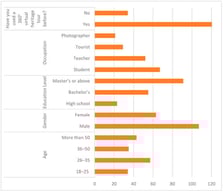
The demographics of the survey questionnaire.

Contemporary housing design practices in Erbil’s hot–dry climate remain understudied with respect to indoor thermal comfort performance. This study evaluates indoor thermal comfort in traditional and contemporary dwellings in Erbil, Iraq, a hot–dry climate characterized by extreme summer conditions. An integrated methodology combining field measurements, locally calibrated climatic data, and validated computational simulation was applied to representative case studies. Indoor thermal comfort parameters were monitored, and a custom EnergyPlus Weather (EPW) file was developed to capture local climatic conditions. Year-round computational simulations were conducted using the Ladybug Tools workflow. Indoor thermal comfort was evaluated using the adaptive comfort model for the naturally ventilated traditional courtyard house and the PMV–PPD model for contemporary air-conditioned dwellings, in accordance with ASHRAE 55 Standard. Validation of the computational simulations against field measurements confirmed close agreement between the measured and simulated results. The findings indicate that the traditional house consistently achieved acceptable thermal comfort within adaptive comfort limits, while contemporary houses experienced persistent overheating and elevated discomfort indices. These results demonstrate that thermal underperformance in contemporary housing is primarily driven by architectural and envelope design rather than modeling uncertainty. The study highlights the effectiveness of vernacular, climate-responsive strategies and suggests their integration into sustainable house design in hot–dry regions.

11 February 2026

Average monthly minimum and maximum temperatures in Erbil, Iraq [1].

Urban kampungs in Surabaya, Indonesia, face layered vulnerabilities due to overlapping environmental hazards, socioeconomic precarity, and limited infrastructural support. Despite being central to the city’s cultural and spatial fabric, these communities are often excluded from formal risk governance frameworks and mischaracterized as homogenous informal settlements. This paper explores how multi-hazard risks, such as tidal flooding, electrical hazards, and social insecurity, manifest in three kampungs: Kampung Nelayan Kenjeran, Kampung Kue Rungkut, and Kampung Kota Ketandan-Kebangsren. Using qualitative methods including interviews, field observation, and participatory risk mapping, the study examines local adaptation strategies, collective resilience, and everyday practices that mitigate risk. The findings emphasize the value of a community-based risk analysis approach that centers on resident knowledge and social networks. Such bottom-up strategies not only complement existing urban policies but also offer contextually relevant insights for inclusive and adaptive resilience planning in rapidly urbanizing environments.

11 February 2026

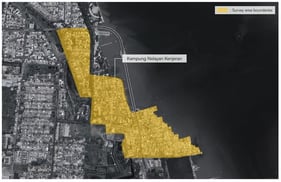
Site 1—Kampung Nelayan Kenjeran.

News & Conferences

Issues

Open for Submission

Editor's Choice

Reprints of Collections

Biophilic School Design for Health and Wellbeing
Reprint

Biophilic School Design for Health and Wellbeing

Editors: Rokhshid Ghaziani, Kenn Fisher
The Future of Built Heritage Conservation
Reprint

The Future of Built Heritage Conservation

Editors: Johnathan Djabarouti

Get Alerted

Add your email address to receive forthcoming issues of this journal.

XFacebookLinkedIn
Architecture - ISSN 2673-8945