

- Article

Numerical and Experimental Study on the Hydraulic Performance of a Fish Passage Structure Featuring Lateral Sluice Gates for Small Dams
- Cornel Ilinca,
- Dmytro Rozputniak and
- Valentin Minghiraș
- + 1 author
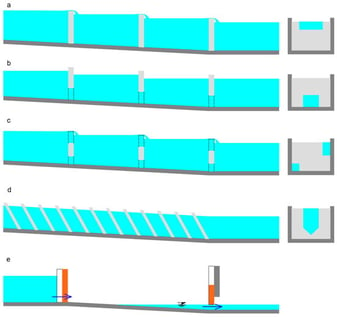
Restoring longitudinal connectivity at small dams remains a significant challenge due to fluctuating reservoir levels that render traditional fish passes ineffective, this research focuses on the implementation of ecological flow, knowing that to this date, no passages in Romania have been designed to meet the bio-hydraulic conditions for longitudinal connectivity for a wide range of flows transiting through the passage. The proposed technical fish pass incorporates side valves that are individually operable to regulate water inflow across varying reservoir levels, thereby overcoming a significant drawback of conventional designs. A three-dimensional numerical model was developed using Computational Fluid Dynamics (CFD) to analyze the velocity fields and flow patterns within the basins under variable ecological flow regimes. To validate the numerical findings, an experimental investigation was conducted on a 1:10 scale physical model. The design’s primary objective is to ensure the passage remains functional despite fluctuating reservoir levels, offering a comprehensive and efficient solution for modern ecological flow management. Results indicate stable velocity profiles on the vertical slots, with values of approximately 1.1 m/s for the high-water regime and 0.85 m/s for the medium one, ensuring hydraulic conditions compatible with the swimming capacity of the targeted species. The results demonstrate that the proposed design effectively prevents high-pressure currents, ensuring a free surface flow suitable for ichthyofauna migration.
8 February 2026