Skip Content
You are currently on the new version of our website. Access the old version .
  • Tracked for
    Impact Factor
  • 2.9
    CiteScore
  • 21 days
    Time to First Decision

AppliedChem

AppliedChem is an international, peer-reviewed, open access journal on all aspects of applied chemistry published quarterly online by MDPI.

All Articles (139)

Hydrothermal Synthesis of FAU-Type Zeolite NaX Using Ladle Slag and Waste Aluminum Cans

  • Borislav Barbov,
  • Hristina Lazarova and
  • Aleksandar Nikolov
  • + 1 author

This study explores a sustainable synthesis route for FAU-type zeolite X using acid-treated ladle slag as a silicon source and waste aluminum cans as an alternative aluminum precursor. Conventional zeolite synthesis relies on high-purity reagents, which are costly and environmentally intensive to produce. Previous research has rarely addressed the valorization of ladle slag and metallic aluminum waste for zeolite formation, leaving their potential largely unexplored. The study focuses on the effective utilization of industrial and post-consumer wastes—acid-treated ladle slag and aluminum cans—as precursors for FAU-type NaX zeolite, demonstrating their feasibility as alternative silicon and aluminum sources. Here, zeolite X was synthesized hydrothermally from treated slag combined with either dissolved aluminum cans and commercial sodium aluminate at 90 °C for 6 h. FAU-type zeolite X was successfully synthesized using both aluminum sources, with a SiO2/Al2O3 ratio of approximately 1.4. The results demonstrate that waste-derived precursors can effectively replace conventional chemicals, yielding predominantly NaX zeolite with high crystallinity and minor NaA impurity (as observed by XRD), with experimental yields of 1.47 g for aluminum cans and 1.266 g for sodium aluminate. The obtained zeolite X samples were structurally and texturally characterized by XRD, FTIR, XRF, BET surface area analysis, and thermogravimetric analysis (TG).

3 February 2026
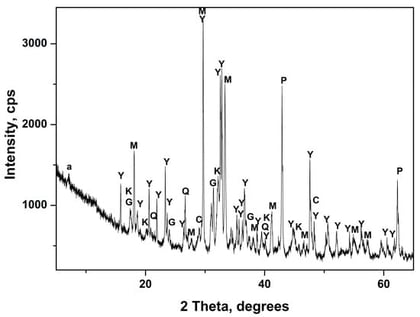
Powder XRD of the ladle slag (LS). Legend: a—strätlingite, C—calcite, G—gehlenite, K—katoite, P—periclase, Q—quartz, M—mayenite, γ—γ-belite (Ca2SiO4).

Lavender Paper: A Sustainable Alternative for Pulp Production

  • Kateřina Hájková,
  • Josef Bárta and
  • Jiří Synek
  • + 2 authors

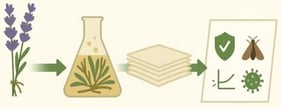
This research investigates the potential of secondary lavender biomass (Lavandula officinalis) as a raw material for paper production within the context of the circular economy and its practical applications. Lavender stems, a by-product of essential oil extraction, were processed using the nitrate–alkali pulping method. The chemical composition of the raw material was analysed according to TAPPI standards, and the resulting pulp was characterised in terms of its mechanical and physical properties, including tensile strength and air permeability. Lavender stems contained 29.43% cellulose and 24.10% lignin, indicating moderate delignification efficiency under the applied conditions. The pulp yield was 24.2% with a Kappa number of 15.9. Of the prepared sheets, the paper with a weight of 80 g·m−2 showed the best mechanical properties, with a breaking length of 1.71 km and a tensile strength index of 16.76 N·m·g−1. In addition, lavender-based paper demonstrated measurable repellent activity against Tineola bisselliella, reducing insect presence by 70% compared to control samples, as determined by controlled laboratory exposure tests. This bioactivity is attributed to residual volatile compounds such as linalool and linalyl acetate, originating from lavender biomass. Overall, lavender secondary biomass represents a promising non-wood fibre for the production of biodegradable, functional paper materials that combine structural integrity with natural repellent properties.

3 February 2026

SEM image of a lavender sheet of paper, magnification 200×.

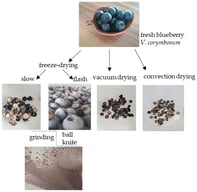
This study investigated the influence of drying techniques such as convection hot-air drying, vacuum drying, and freeze drying with slow and flash pre-freezing on the total phenolic content and the profile of dominant phenolic compounds in cultivated blueberry (Vaccinium corymbosum L.). Although fresh blueberries exhibited higher total phenolic content (1350.85 mg GAE/100 g), total flavonol glycosides (66.20 mg/100 g), and total anthocyanins (218.23 mg/100 g) compared with dried samples, freeze-dried samples, particularly those subjected to flash pre-freezing, retained higher contents of these components in the dried material compared to other drying techniques. This could be attributed to the microstructural preservation of plant tissue during freeze drying. Furthermore, the study demonstrated that subsequent milling of freeze-dried samples, whether using a knife mill or a ball mill, also affects the availability of bioactive compounds in freeze-dried blueberry powders. The combination of flash pre-freezing followed by ball milling yielded the highest availability of bioactive components in the processed blueberry powder.

2 February 2026

Scheme of dried blueberry preparation.

Acid violet 19 (AV19) dye is used in many fields, including photographic film, inks, leather, and textiles. Potassium ferrate (VI) (Fe(VI)) represents a novel oxidant, notable for its strong oxidative capabilities, stability, and environmental sustainability. This research investigates the decolorization and mineralization of AV19 through the application of Fe(VI), with a particular emphasis on essential parameters, including pH, molar ratios, and temperature variations. The study ascertained that the optimal conditions for AV19 oxidation are a pH of 7.0, a molar ratio of AV19: Fe(VI) of 1:5, and a temperature of 45 °C with a reaction time of 12 min. The decolorization efficiency achieved was approximately 98%, and the mineralization was 31%. The degradation process yielded intermediates, such as sulfonic acid derivatives, benzoic acid, benzene, and cyclohexane compounds, which were further oxidized into acetic acid, carbon dioxide, and water. Comprehensive computational toxicity evaluations confirmed that both the intermediates and the final products are non-toxic.

2 February 2026

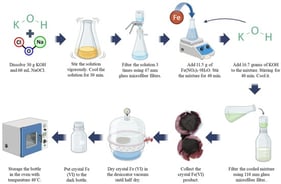
Procedure synthesis of Fe(VI).

News & Conferences

Issues

Open for Submission

Editor's Choice

Get Alerted

Add your email address to receive forthcoming issues of this journal.

XFacebookLinkedIn
AppliedChem - ISSN 2673-9623